
Food Service Equipment Market Outlook: Commercial Kitchen Expansion and Growth Opportunities
The Food Service Equipment Market is experiencing strong growth driven by the expansion of restaurants, hotels, and quick-service outlets worldwide.

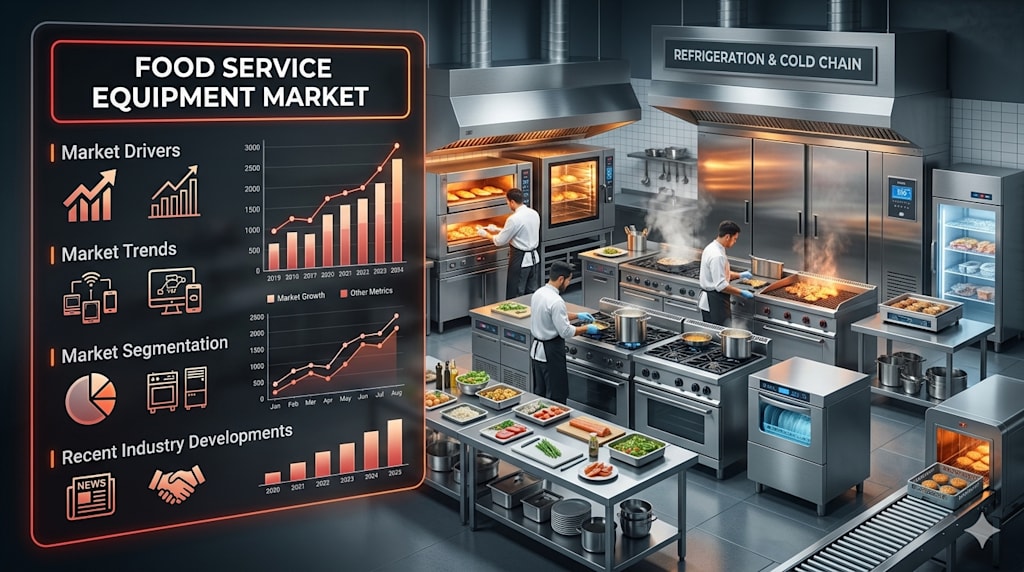
According to IMARC Group's latest research publication, The global food service equipment market size reached USD 41.9 Billion in 2025. Looking forward, IMARC Group expects the market to reach USD 61.1 Billion by 2034, exhibiting a growth rate (CAGR) of 4.14% during 2026-2034.
How AI is Reshaping the Future of Food Service Equipment Market
- Predictive Maintenance and Equipment Monitoring: AI-powered sensors track equipment performance metrics in real time, detecting early warning signs before breakdowns occur. Restaurant operators using these systems reduce downtime by identifying potential failures through predictive analytics, minimizing repair costs and extending asset life across commercial kitchens.
- Smart Kitchen Integration and IoT Connectivity: Connected kitchen platforms combine equipment monitoring, facility performance tracking, and food safety compliance into unified systems. Open Kitchen solutions enable operators to remotely control HVAC, refrigeration, and cooking equipment across multiple locations, optimizing workflow efficiency and reducing energy consumption by up to 15 percent.
- Automated Temperature and Food Safety Controls: Machine learning algorithms continuously monitor refrigeration units and cooking appliances, automatically adjusting settings to maintain optimal food storage conditions. IoT-enabled temperature sensors send instant alerts when coolers malfunction, preventing spoilage and saving thousands in inventory losses while ensuring health code compliance.
Food Service Equipment Industry Overview:
National Health Expenditure reached USD 5.3 Trillion in 2024, growing 7.2 percent and representing 18.0 percent of GDP IMARC, driving investment in commercial kitchen infrastructure across hospitals, eldercare facilities, and healthcare institutions. Equipment downtime costs the foodservice industry an estimated USD 46 Billion annually, while repair and maintenance expenses climbed 31 percent since 2019, accelerating adoption of IoT-enabled predictive maintenance systems. Energy now consumes nearly 6 percent of average restaurant operating costs, making energy-efficient appliances critical for operators managing tight profit margins in competitive markets.
Food Service Equipment Market Trends & Drivers
The explosive growth of quick-service restaurants and fast-casual dining formats is transforming equipment demand across global markets. QSR chains prioritize compact, high-speed cooking appliances like fryers, grills, and combi ovens that maximize throughput in limited kitchen spaces. McDonald's, Chipotle, and Panera have adopted self-ordering kiosks and automated kitchen display systems, creating demand for integrated equipment solutions that connect front-of-house ordering with back-of-house production. Ghost kitchens and delivery-only models are expanding rapidly, requiring specialized equipment optimized for off-premise dining rather than traditional dine-in service.
Sustainability mandates and energy efficiency regulations are driving equipment replacement cycles and innovation investments. Electrolux Professional released dishwashers that use less water and detergent, meeting sustainability requirements Future Market Insights, while Hoshizaki Corporation transitioned all standard commercial refrigerators in Japan to natural refrigerants by end of 2024. Government energy standards in North America and Europe require new equipment to meet stringent efficiency benchmarks, pushing manufacturers to develop heat pump dryers consuming 45 percent less electricity than conventional models.
Technological integration and automation are reshaping commercial kitchen operations as operators address persistent labor shortages and rising wage pressures. In February 2024, RATIONAL introduced the iHexagon, a new product category coordinating steam, hot air, and microwave technology in one professional kitchen system Future Market Insights. Middleby Corporation launched ventless cooking technology enabling kitchen installations in locations with restricted space and limited ventilation infrastructure.
Leading Companies Operating in the Global Food Service Equipment Industry:
- AB Electrolux
- Ali group s.r.l. a socio unico
- Alto-Shaam Inc.
- Cambro Manufacturing
- Comstock-Castle Stove Co. Inc
- Dover Corporation
- Duke Manufacturing
- Illinois Tool Works Inc.
- The Middleby Corporation
- Welbilt
Food Service Equipment Market Report Segmentation:
By Product Type:
- Cooking Equipment
- Storage and Handling Equipment
- Warewashing Equipment
- Food and Beverage Preparation Equipment
- Serving Equipment
Cooking equipment represents the largest segment, as ovens, ranges, fryers, grills, and cooktops are essential for food preparation across all commercial kitchen formats.
By Distribution Channel:
- Online
- Offline
Offline channels exhibit clear dominance in the market due to established dealer relationships, hands-on product evaluation, and comprehensive installation services.
By End Use:
- Full-service Restaurants and Hotels
- Quick-service Restaurants and Pubs
- Catering
Full-service restaurants and hotels account for the largest market share owing to comprehensive equipment requirements spanning cooking, refrigeration, warewashing, and specialized serving solutions.
Regional Insights:
- North America (United States, Canada)
- Asia Pacific (China, Japan, India, South Korea, Australia, Indonesia, Others)
- Europe (Germany, France, United Kingdom, Italy, Spain, Russia, Others)
- Latin America (Brazil, Mexico, Others)
- Middle East and Africa
North America exhibits a clear dominance in the food service equipment market due to mature restaurant infrastructure, early adoption of automation technologies, and stringent energy efficiency standards.
Recent News and Developments in Food Service Equipment Market
- September 2024: Parts Town launched Part Predictor, an AI-powered digital tool designed to streamline commercial kitchen repairs. This innovation helps technicians quickly identify correct replacement parts, reducing equipment downtime and improving service efficiency across foodservice operations. The platform addresses the industry's USD 46 Billion annual downtime challenge through predictive component identification.
- August 2024: The Foodservice Equipment Association published a specialized e-newsletter focused on the light equipment and tableware sector. The initiative concentrates on enhancing relationships between dealers and manufacturer affiliates, strengthening distribution networks and supporting sustainable product development throughout the supply chain.
- April 2025: Qu redefined restaurant operations with its industry-first Smart Kitchen platform integrating energy and equipment intelligence. Built on IoT sensors and edge computing, the system features real-time equipment monitoring, energy optimization reducing utility costs up to 15 percent, predictive maintenance using AI to detect early warning signs, and remote equipment control capabilities.
- April 2024: Electrolux Professional Group acquired Adventys, a specialist in induction cooking technology. The strategic addition expanded Electrolux's portfolio with advanced induction solutions, positioning the company to serve growing demand for energy-efficient cooking equipment across commercial foodservice segments.
- February 2024: RATIONAL AG introduced the iHexagon, describing it as a revolutionary product category coordinating steam, hot air, and microwave technology in one integrated professional kitchen system. The innovation enables precision cooking control while reducing equipment footprint requirements in space-constrained commercial kitchens.
Note: If you require specific details, data, or insights that are not currently included in the scope of this report, we are happy to accommodate your request. As part of our customization service, we will gather and provide the additional information you need, tailored to your specific requirements. Please let us know your exact needs, and we will ensure the report is updated accordingly to meet your expectations.
About the Creator
Olivia Smith
Olivia Smits is a Research and Marketing Analyst who specializes in market research, trend analysis, and consumer insights. I help businesses make smarter marketing and strategy decisions by turning data into clear, actionable insights.
Enjoyed the story? Support the Creator.
Subscribe for free to receive all their stories in your feed.
Comments
There are no comments for this story
Be the first to respond and start the conversation.