
Food Logistics Market: Demand Drivers, E-Commerce Growth & Future Growth Prospects
The food logistics market is expanding with advancements in cold chain infrastructure and temperature-controlled transportation.

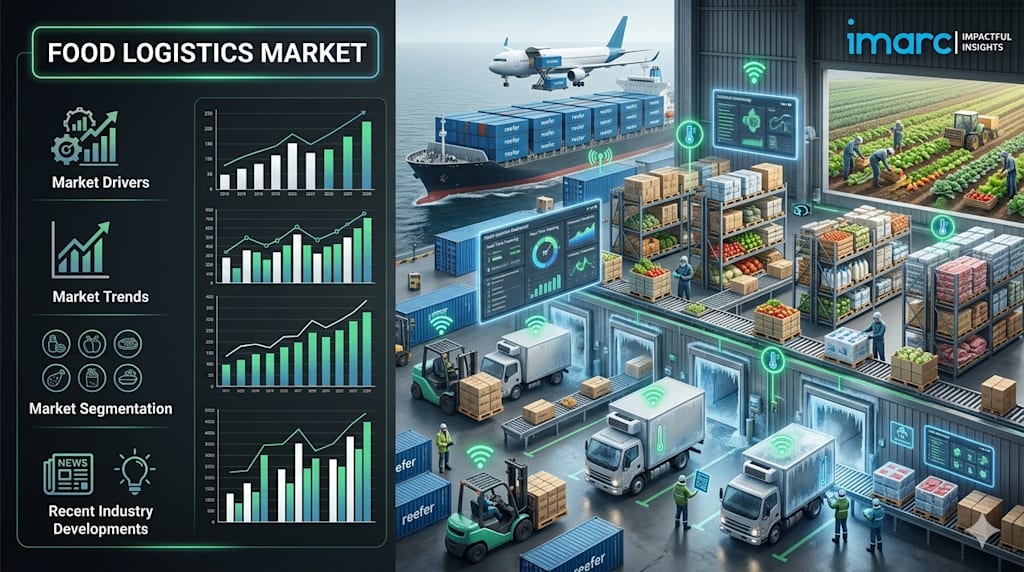
According to IMARC Group's latest research publication, the global food logistics market reached a value of USD 130.0 Billion in 2025. Looking forward, IMARC Group expects the market to reach USD 227.0 Billion by 2034, exhibiting a CAGR of 6.39% during 2026–2034.
How AI is Reshaping the Future of Food Logistics Market
- AI-Powered Route Optimization and Last-Mile Delivery:Artificial intelligence is transforming food logistics through advanced route optimization systems that analyze real-time traffic, weather conditions, delivery schedules, and fuel efficiency. These systems dynamically reroute vehicles to ensure timely delivery of perishable goods, reducing spoilage and improving operational efficiency. AI-driven last-mile solutions are especially critical for e-commerce grocery and food delivery services.
- Predictive Demand Forecasting and Inventory Management:AI enables logistics providers to forecast demand by analyzing historical consumption patterns, seasonal trends, and market fluctuations. These insights help optimize inventory levels, reduce food waste, and ensure the availability of fresh products. Machine learning models also assist in balancing supply and demand across distribution networks.
- Cold Chain Monitoring and Quality Assurance:AI-powered IoT systems continuously monitor temperature, humidity, and storage conditions across the supply chain. These intelligent systems detect anomalies in real time and trigger alerts to prevent spoilage of sensitive food items such as dairy, meat, and seafood. This ensures compliance with stringent food safety regulations and enhances product quality.
Food Logistics Industry Overview
Food logistics involves the transportation, storage, and distribution of food products from producers to consumers while maintaining safety, quality, and freshness. The industry plays a crucial role in global food supply chains, especially for perishable goods requiring temperature-controlled environments. The rapid expansion of global food trade, urbanization, and changing consumer preferences have significantly increased the demand for efficient and reliable logistics solutions.
Food Logistics Market Trends & Drivers
The increasing demand for fresh and perishable food products is a major driver of the market. Consumers are increasingly preferring fresh produce, frozen foods, and ready-to-eat meals, which require advanced cold chain logistics to maintain quality and safety during transportation and storage.
The rapid growth of e-commerce and online grocery platforms has further accelerated the need for efficient food logistics systems. The rise of doorstep delivery services has increased demand for last-mile logistics solutions and real-time tracking technologies.
Technological advancements, including IoT-enabled tracking, automated warehousing, and temperature-controlled logistics, are enhancing supply chain visibility and operational efficiency. These innovations help reduce food wastage and improve delivery accuracy.
Leading Companies Operating in the Global Food Logistics Industry
- Americold Logistics LLC
- DSV A/S
- C.H. Robinson Worldwide, Inc.
- Schneider National, Inc.
- CaseStack
- A.N. Deringer, Inc.
- Echo Global Logistics, Inc.
- Evans Distribution Systems, Inc.
- Hellmann Worldwide Logistics SE & Co. KG
- Matson Logistics
- Odyssey Logistics & Technology Corporation
Food Logistics Market Report Segmentation
By Transportation Mode:
- Railways
- Roadways
- Seaways
- Airways
Roadways dominate the market due to their flexibility and efficiency in last-mile delivery operations.
By Product Type:
- Fish, Shellfish, and Meat
- Vegetables, Fruits, and Nuts
- Cereals
- Bakery and Dairy Products
- Coffee, Tea, and Vegetable Oil
- Others
Fish, meat, and seafood segments hold significant share due to high cold chain dependency.
By Service Type:
- Cold Chain
- Non-Cold Chain
Cold chain logistics dominate due to the growing demand for temperature-sensitive food products.
By Segment:
- Transportation
- Packaging
- Instrumentation
Transportation accounts for the largest share as it forms the backbone of food logistics operations.
Regional Insights
- North America
- Europe
- Asia Pacific
- Latin America
- Middle East & Africa
North America dominates the market due to advanced cold chain infrastructure, strong transportation networks, and strict food safety regulations.
Recent News and Developments in Food Logistics Market
- March 2025: Major logistics companies announced significant investments in cold storage infrastructure, including new automated warehouses and acquisitions to expand capacity and improve supply chain efficiency.
- May 2025: Increasing adoption of AI-driven route optimization and real-time tracking solutions across logistics providers is enhancing last-mile delivery efficiency and reducing food wastage globally.
Note: If you require specific details, data, or insights that are not currently included in the scope of this report, we are happy to accommodate your request. As part of our customization service, we will gather and provide the additional information you need, tailored to your specific requirements. Please let us know your exact needs, and we will ensure the report is updated accordingly to meet your expectations.
About the Creator
sujeet. imarcgroup
With 2 years of hands-on experience at IMARC Group, I have conducted in-depth market research and analysis across diverse industries including technology, healthcare, agriculture, and consumer goods.
Enjoyed the story? Support the Creator.
Subscribe for free to receive all their stories in your feed.
Comments
There are no comments for this story
Be the first to respond and start the conversation.