
Food Logistics Market: Cold Chain Expansion, Supply Chain Efficiency & Growth Outlook
The food logistics market is growing due to rising demand for efficient transportation and storage of perishable food products worldwide.

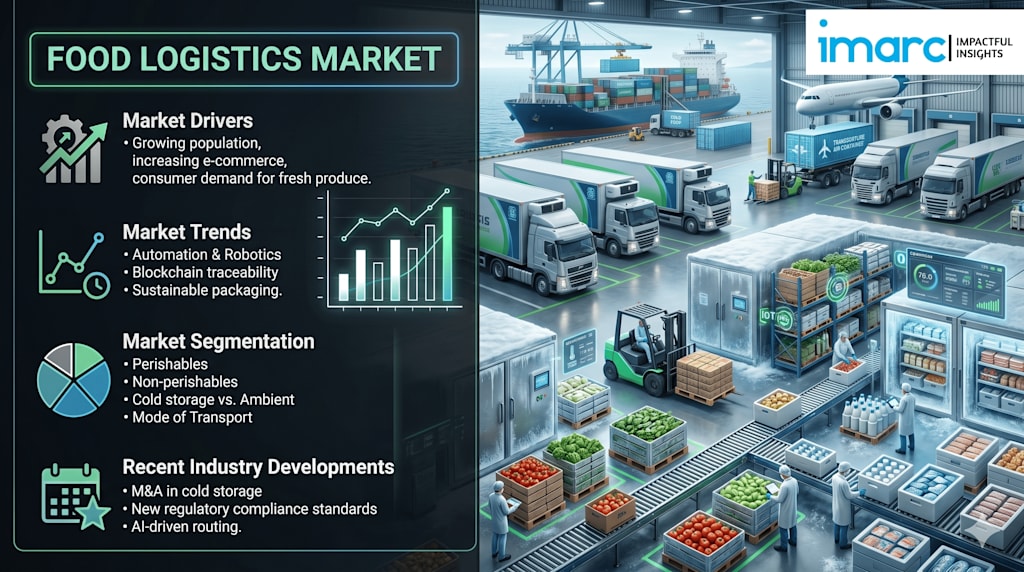
According to IMARC Group's latest research publication, the global food logistics market size was valued at USD 130.0 Billion in 2025. Looking forward, IMARC Group estimates the market to reach USD 227.0 Billion by 2034, exhibiting a growth rate (CAGR) of 6.39% during 2026-2034.
How AI is Reshaping the Future of the Food Logistics Market
- Route Optimization and Last-Mile Efficiency: AI-powered algorithms analyze traffic, weather, and delivery windows in real time to dynamically reroute vehicles, cutting last-mile delivery costs and ensuring perishable foods arrive fresh and on schedule.
- Cold Chain Temperature Monitoring: Machine learning models continuously monitor refrigerated containers and flag temperature deviations before spoilage occurs, helping logistics operators maintain food safety compliance across long-haul and cross-border shipments.
- Demand Forecasting and Inventory Planning: AI tools process sales trends, seasonal patterns, and consumer behavior data to predict food demand with greater accuracy, reducing overstock situations and minimizing food waste across distribution networks.
Food Logistics Industry Overview
The food logistics market sits at the intersection of two powerful forces: growing consumer demand for fresh, perishable food and the increasing complexity of getting that food delivered safely across vast geographies. North America leads with a 43.2% market share, backed by an advanced cold chain network and strict regulatory frameworks like the U.S. Food Safety Modernization Act.
Food Logistics Market Trends and Drivers
Consumer eating habits have shifted significantly, and fresh food is no longer a premium preference but a baseline expectation for a large share of shoppers. Two out of three consumers in the United States now actively seek fresh food options, which puts enormous pressure on logistics operators to maintain cold chain integrity across every leg of the journey.
The rapid expansion of online grocery shopping is fundamentally changing how food logistics networks are structured. U.S. retail e-commerce sales hit USD 308.9 billion in Q4 alone, with food and grocery among the fastest-growing categories.
Across every major region, logistics operators are making large-scale infrastructure bets to stay competitive. Lineage announced plans to deploy over USD 1 billion in capital, acquiring four Tyson Foods cold storage facilities for USD 247 million and committing over USD 740 million to two new fully automated greenfield warehouses adding 80 million cubic feet of capacity.
Leading Companies Operating in the Global Food Logistics Industry
- AmeriCold Logistics LLC
- DSV
- C.H. Robinson Worldwide, Inc.
- Schneider National
- CaseStack
- A.N. Deringer, Inc.
- Echo Global Logistics, Inc.
- Evans Distribution Systems, Inc.
- Hellmann Worldwide Logistics SE and Co. KG
- Matson Logistics
- Odyssey Logistics and Technology Corporation
Food Logistics Market Report Segmentation
By Transportation Mode:
- Railways
- Roadways
- Seaways
- Airways
Roadways dominate with a 52.8% share due to their flexibility, cost-effectiveness, and ability to serve last-mile delivery at scale.
By Product Type:
- Fish, Shellfish, and Meat
- Vegetables, Fruits, and Nuts
- Cereals, Bakery and Dairy Products
- Coffee, Tea, and Vegetable Oil
- Others
Fish, shellfish, and meat represent a significant share of demand.
- Cold Chain
- Non-Cold Chain
Cold chain logistics holds the largest market share at 61.2%, reflecting strong demand for temperature-controlled handling of dairy.
By Segment:
- Transportation
- Packaging
- Instrumentation
Transportation is the leading segment, underpinned by the growing need for refrigerated trucks.
Regional Insights:
- North America (United States, Canada)
- Asia Pacific (China, Japan, India, South Korea, Australia, Indonesia, Others)
- Europe (Germany, France, United Kingdom, Italy, Spain, Russia, Others)
- Latin America (Brazil, Mexico, Others)
- Middle East and Africa
North America leads with a 43.2% market share, supported by mature cold chain infrastructure, strict food safety regulations, and rapidly growing e-commerce grocery penetration.
Recent News and Developments in the Food Logistics Market
May 2025: C.H. Robinson joined the I-10 Coalition to pilot long-haul battery-electric Class 8 trucks along the Los Angeles to El Paso corridor, partnering with Terawatt Infrastructure to deploy six heavy-duty Megawatt Charging System hubs supporting electric and autonomous freight vehicles.
April 2025: DSV completed its acquisition of Schenker from Deutsche Bahn for approximately EUR 14.3 billion, doubling its workforce to nearly 160,000 employees across 90+ countries and targeting EUR 41.6 billion in combined revenue, with DKK 9 billion in annual synergies expected by 2028.
Note: If you require specific details, data, or insights that are not currently included in the scope of this report, we are happy to accommodate your request. As part of our customization service, we will gather and provide the additional information you need, tailored to your specific requirements. Please let us know your exact needs, and we will ensure the report is updated accordingly to meet your expectations.
About the Creator
sujeet. imarcgroup
With 2 years of hands-on experience at IMARC Group, I have conducted in-depth market research and analysis across diverse industries including technology, healthcare, agriculture, and consumer goods.
Enjoyed the story? Support the Creator.
Subscribe for free to receive all their stories in your feed.
Comments
There are no comments for this story
Be the first to respond and start the conversation.