
Food Enzymes Market Set for Steady Expansion as Clean-Label Demand and Biotechnology Reshape Food Processing
Rising demand for processed foods, innovation in enzyme engineering, and the global shift toward sustainability are pushing the food enzymes market into a new growth phase.

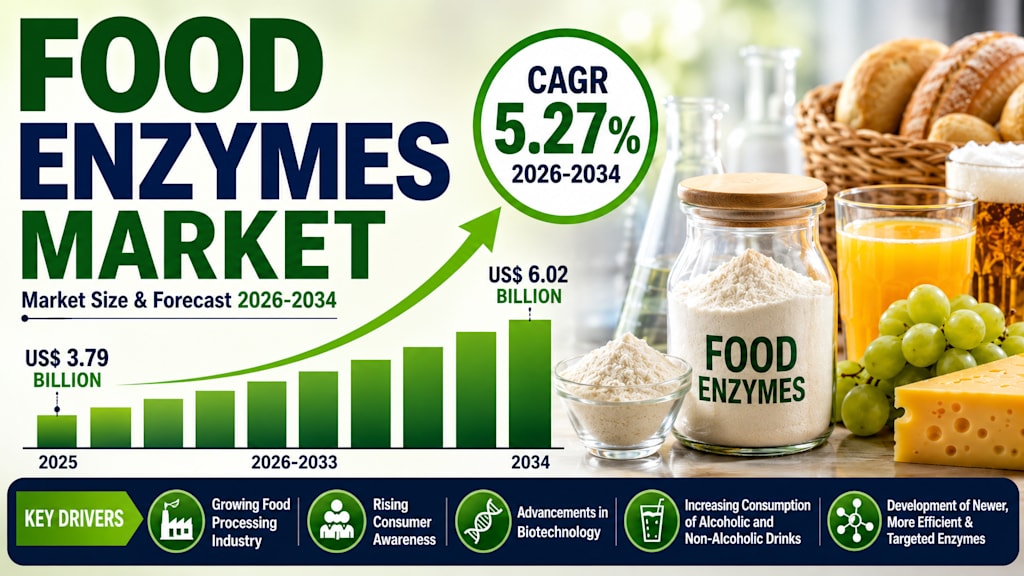
The global food industry is changing fast, and one of the quiet but powerful forces behind that change is the food enzymes market. According to Renub Research, the market is expected to grow from US$ 3.79 billion in 2025 to US$ 6.02 billion by 2034, registering a CAGR of 5.27% from 2026 to 2034. That growth reflects more than just rising food production. It signals a broader shift in how manufacturers think about efficiency, sustainability, ingredient quality, and consumer expectations. Enzymes are increasingly being used not only to improve processing performance, but also to support cleaner labels, reduce waste, and deliver more consistent product quality across categories such as bakery, dairy, beverages, meat processing, and processed foods.
A market built on efficiency, quality, and innovation
Food enzymes are biological catalysts derived mainly from microorganisms, plants, or animals. Their role in food production is simple to describe but highly valuable in practice: they speed up biochemical reactions that improve texture, flavor, yield, shelf life, and processing efficiency. Because they are used in very small amounts and are biodegradable, they fit well with modern food production priorities. That makes them especially attractive in industries where manufacturers must balance cost control, product consistency, and consumer demand for more natural ingredients.
The market is not growing for only one reason. It is expanding because several important trends are moving in the same direction. The rise of processed and convenience foods has created a need for ingredients that help manufacturers deliver uniform results on a large scale. At the same time, biotechnology has made enzymes more efficient, more stable, and more specialized. Consumers, meanwhile, are asking for foods that feel less artificial, less heavily processed, and more aligned with health and sustainability goals. Food enzymes fit neatly into that shift, which is why their role in modern food manufacturing has become more strategic than ever.
Processed and convenience foods are driving demand
One of the strongest forces supporting the food enzymes market is the global rise in processed and convenience food consumption. Busy lifestyles, urbanization, and higher disposable incomes have made ready-to-eat, packaged, and shelf-stable foods a staple in many households. That trend places pressure on manufacturers to maintain taste, texture, freshness, and appearance across long supply chains. Enzymes help solve that problem by improving dough handling in bakery products, boosting sweetness and clarity in beverages, and supporting fat breakdown in dairy processing.
In bakery applications, enzymes are widely valued for their ability to improve dough stability and bread volume. In dairy, they are essential in cheese production and lactose-free product development. In beverages, they assist in fermentation, clarification, and filtration. The same logic applies to meat processing and confectionery, where consistent quality and efficient production matter just as much as in bakery and dairy. As foodservice chains, retail brands, and industrial food processors continue to expand, enzyme usage is likely to deepen further because the market rewards ingredients that support scale without compromising product performance.
Biotechnology is making enzymes smarter
A major reason the market outlook remains strong is the pace of innovation in enzyme engineering and biotechnology. Modern techniques such as genetic modification, recombinant DNA technology, and protein engineering have significantly improved the performance of food enzymes. These advances allow manufacturers to design enzymes that remain effective under challenging conditions such as extreme temperatures, varying pH levels, or intense processing environments. That not only improves efficiency but also lowers production costs over time.
Biotechnology is also broadening the range of applications. Enzymes are no longer limited to traditional uses in baking and dairy. They are increasingly being tailored for niche and fast-growing segments such as lactose-free dairy, low-calorie sweeteners, gluten-free bakery products, and specialty beverages. In practical terms, this means manufacturers can create more targeted solutions for changing consumer preferences instead of relying on one-size-fits-all processing aids. Advances in fermentation and microbial cultivation are also increasing enzyme yield and reducing production costs, which makes enzyme-based solutions more accessible to food processors across different regions.
Clean-label and sustainability trends are changing the game
If there is one theme that keeps resurfacing across the food industry, it is the demand for cleaner, simpler, and more natural formulations. Food enzymes have become important in this shift because they can often replace synthetic additives while supporting the same functional outcome. For brands trying to meet clean-label expectations, that is a powerful advantage. Consumers are increasingly paying attention to ingredient lists, and they tend to favor products that appear less artificial and more transparent.
Enzymes also support sustainability goals. They can reduce energy use, limit waste, improve raw material efficiency, and extend shelf life. For example, amylases can improve baked goods by optimizing starch behavior, while cellulases and pectinases can enhance juice extraction and reduce water and energy needs. These kinds of efficiency gains matter to manufacturers facing pressure to lower costs while also reducing environmental impact. In that sense, food enzymes are not just a processing tool; they are part of a broader industrial transition toward more responsible production.
The market still faces real challenges
Despite the positive outlook, the food enzymes market is not free from obstacles. Regulatory compliance remains one of the most important challenges. Enzymes must meet strict food safety and labeling requirements, and approval pathways can vary significantly by region. Manufacturers often need toxicological studies, allergenicity assessments, and detailed documentation covering enzyme source, purity, and production methods. In markets such as the United States, Europe, and parts of Asia, these requirements can increase both time-to-market and compliance costs.
High production costs are another barrier. Enzyme manufacturing depends on sophisticated biotechnological processes, including microbial fermentation, purification, stabilization, and formulation. These steps require advanced infrastructure, skilled labor, and strong quality control. Smaller companies may struggle to compete because they lack the scale and technical depth needed to manage costs efficiently. At the same time, enzymes must perform reliably under a range of processing conditions, which often pushes companies to invest in additional engineering and product development. In a market where innovation is essential, that creates pressure on margins.
Regional markets show different growth patterns
The United States remains a mature and technologically advanced market for food enzymes. Demand there is supported by widespread consumption of processed and convenience foods, strong biotechnology capabilities, and broad usage across bakery, dairy, beverages, meat, and confectionery applications. Clean-label preferences are especially influential in the U.S., where consumers increasingly want natural alternatives to synthetic additives.
Germany also stands out as a mature market with a strong food processing base and a well-developed research ecosystem. Enzymes are widely used there to improve product quality, reduce waste, and support premium bakery and dairy applications. The country’s emphasis on natural ingredients and sustainability has made enzyme adoption especially attractive.
China is one of the fastest-growing markets, driven by urbanization, rising incomes, and changing diets. The expansion of food manufacturing, retail networks, and e-commerce has accelerated demand for processed foods and functional ingredients. As consumers move toward convenience and clean-label products, enzyme usage is likely to keep expanding across multiple categories.
The United Arab Emirates represents a smaller but increasingly important emerging market. Demand there is being supported by growing consumption of processed foods, modern retail infrastructure, and a strong foodservice sector. Since the country relies heavily on imports, enzyme-based ingredients benefit from efficient distribution channels and rising consumer demand for higher-quality products.
Recent developments show how competitive the market has become
Recent industry moves highlight how active and competitive the food enzymes space has become. In February 2025, Novonesis agreed to pay EUR 1.5 billion to acquire DSM-Firmenich’s share in the Feed Enzyme Alliance, a major transaction that reflects ongoing consolidation and strategic expansion. In November 2024, International Flavors & Fragrances introduced TEXSTAR, a combination of enzymes designed to improve textures in fresh fermented foods, especially in premium dairy and fermented food applications.
Other product launches reinforce the same pattern. In October 2024, Biocatalysts Ltd. introduced an enzymatic solution aimed at improving flavor characteristics in enzyme-modified dairy products, with an emphasis on natural, savory, umami-rich notes. In September 2024, IFF launched DIAZYME NOLO, an enzyme intended to improve flavor, efficiency, and production in low- and no-alcohol beverages without major capital investment. Taken together, these developments show that companies are focusing on practical innovation, premium applications, and better sensory performance.
A market with long-term room to grow
Looking ahead, the food enzymes market appears well positioned for steady expansion. The combination of processed food demand, clean-label preferences, sustainability goals, and technological progress creates a durable growth base. Enzymes are increasingly valued not just for what they do, but for what they help manufacturers avoid: unnecessary waste, excessive energy use, and artificial additives. That makes them relevant to a food industry that is trying to become both more efficient and more consumer-friendly.
The market segmentation also suggests broad opportunity. Carbohydrases, lipases, proteases, and other enzyme types each play different roles, while applications across beverages, bakery products, dairy products, and other food categories continue to diversify. The source base, including microorganisms, plants, and animals, offers additional pathways for innovation. Meanwhile, companies such as Novozymes, Kerry Group, DuPont Danisco, Chr. Hansen, Associated British Foods, and others remain central to the competitive landscape, bringing scale, research capabilities, and global reach to the sector.
Final Thoughts
The food enzymes market is no longer a niche corner of food processing. It is becoming a critical enabling layer for modern food manufacturing. As producers seek better yields, cleaner labels, stronger sustainability credentials, and more consistent product performance, enzymes are moving from supportive ingredients to strategic solutions. With Renub Research projecting the market to reach US$ 6.02 billion by 2034, the story is not just about growth in numbers. It is about a food industry learning to do more with less, and doing it in a way that better matches the expectations of today’s consumers.
About the Creator
Enjoyed the story? Support the Creator.
Subscribe for free to receive all their stories in your feed.
Comments
There are no comments for this story
Be the first to respond and start the conversation.