
Fluorochemicals Market: How Innovation and Sustainability Are Reshaping a Critical Global Industry
From advanced refrigeration to semiconductor manufacturing, fluorochemicals are becoming indispensable materials in the next generation of industrial technologies.

The materials that support modern life often work behind the scenes, yet their importance cannot be overstated. Fluorine-based compounds are among those unsung contributors, playing vital roles in everything from air conditioning systems and electric vehicles to medical devices and semiconductor manufacturing. Their exceptional resistance to heat, chemicals, and corrosion makes them difficult to replace in applications where performance and reliability are essential.
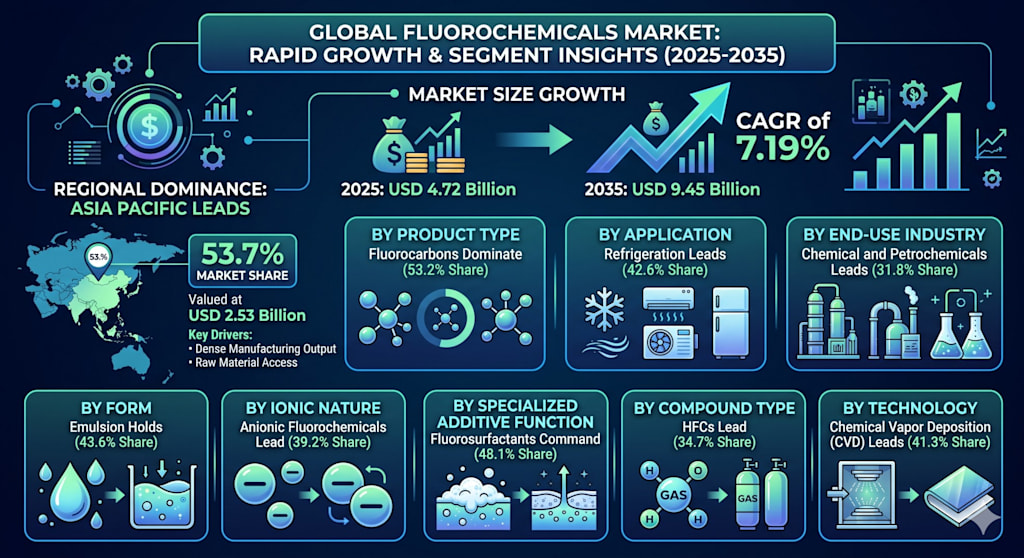
The Global Fluorochemicals Market will grow from USD 4.72 Billion in 2025 to USD 9.45 Billion by 2035, at a CAGR of 7.19%.
As industries pursue cleaner technologies and governments tighten environmental regulations, the demand for advanced fluorinated materials is entering a new phase. Manufacturers are investing heavily in research, production capacity, and sustainable alternatives to meet evolving customer expectations while complying with stricter environmental standards. At the same time, supply chain challenges and changing regulations are reshaping how these materials are produced, sourced, and used across the world.
Market Highlights
- Asia Pacific leads with a 53.7% market share, valued at USD 2.53 Billion, driven by dense manufacturing output and raw material access.
- Fluorocarbons dominate the By Product Type segment with a 53.2% share, while Refrigeration leads By Application at 42.6%.
- Emulsion holds a 43.6% share in the By Form segment; Anionic Fluorochemicals lead By Ionic Nature at 39.2%.
- Fluorosurfactants command 48.1% in By Specialized Additive Function; HFCs lead By Compound Type at 34.7%.
- Chemical Vapor Deposition leads By Technology at 41.3%; Chemical and Petrochemicals leads By End-Use Industry at 31.8%.
The Expanding Role of Fluorochemicals in Modern Industry
The Fluorochemicals Market has grown far beyond its traditional association with refrigerants. Today, fluorine-based compounds support a remarkably diverse range of industries, including electronics, renewable energy, pharmaceuticals, automotive manufacturing, aerospace, and chemical processing. Their unique physical and chemical properties allow products to withstand extreme temperatures, aggressive chemicals, and demanding operating conditions.
One reason for the industry's resilience is its diversified customer base. Demand does not rely on a single application or economic sector. While refrigeration continues to represent a significant share of consumption, rapidly growing industries such as semiconductor fabrication, battery manufacturing, and specialty coatings are creating entirely new opportunities.
Another important characteristic is the long product lifecycle of many fluorochemical applications. Components used in aircraft, industrial plants, or semiconductor equipment often remain in service for years, creating stable long-term demand. This stability encourages manufacturers to invest in production capacity and technological innovation despite short-term economic fluctuations.
Regulations Are Driving the Next Wave of Innovation
Environmental policy has become one of the strongest forces shaping the future of the industry. Governments worldwide are introducing stricter regulations aimed at reducing greenhouse gas emissions and limiting the environmental impact of certain fluorinated compounds.
One of the biggest catalysts is the global transition toward low-global-warming-potential (low-GWP) refrigerants. Older hydrofluorocarbons (HFCs), widely used in cooling systems for decades, are gradually being replaced with more environmentally friendly alternatives. This shift is encouraging manufacturers to develop new formulations that deliver similar performance with significantly lower environmental impact.
Beyond refrigerants, increasing attention is being given to per- and polyfluoroalkyl substances (PFAS). Some legacy chemistries are facing tighter restrictions due to environmental persistence, prompting companies to invest in shorter-chain alternatives and next-generation materials. Although these changes require considerable research and compliance costs, they also create opportunities for businesses capable of developing innovative and compliant products.
Rather than slowing industry growth, many of these regulations are accelerating technological advancement. Companies that adapt quickly are strengthening their competitive positions while helping customers transition to more sustainable solutions.
Emerging Technologies Are Creating New Sources of Demand
Rapid technological progress is opening entirely new markets for fluorinated materials. Electric vehicles, renewable energy systems, artificial intelligence infrastructure, and advanced electronics all require materials capable of performing under highly demanding conditions.
Battery manufacturing has become one of the fastest-growing opportunities. Fluorinated binders and electrolyte materials contribute to battery stability, efficiency, and durability. As governments and automakers continue investing in electric mobility, demand for these specialized materials is expected to increase steadily.
The semiconductor industry represents another major growth engine. Manufacturing modern computer chips involves highly sophisticated processes that rely on ultra-high-purity fluorinated gases for plasma etching and chemical vapor deposition. As artificial intelligence, cloud computing, and data centers drive semiconductor production, suppliers of specialty fluorochemicals are benefiting from expanding fabrication capacity worldwide.
Renewable energy technologies also depend on advanced fluoropolymers. Solar panels, hydrogen production equipment, and energy storage systems require durable materials that resist weathering, heat, and chemical exposure over long operating lifespans. These applications further diversify the industry's revenue streams while supporting the global transition toward cleaner energy.
Supply Chains and Regional Dynamics Continue to Evolve
The global supply chain for fluorinated materials presents both opportunities and challenges. Asia-Pacific currently dominates production due to its extensive manufacturing infrastructure, abundant raw materials, and well-established processing capabilities. China, in particular, maintains a significant advantage because of its leadership in fluorspar mining and downstream processing.
India is also strengthening its position through investments in domestic manufacturing capacity and infrastructure. Expanding production capabilities are helping reduce import dependence while supporting growing demand from regional industries such as refrigeration, chemicals, and electronics manufacturing.
Meanwhile, North America and Europe are placing greater emphasis on supply chain diversification. Governments and manufacturers increasingly recognize the importance of securing reliable access to strategic materials, particularly as semiconductor production and battery manufacturing expand.
However, raw material availability remains an important consideration. Fluorspar, the primary mineral used to produce many fluorochemicals, has geographically concentrated production. Any disruption to mining operations, trade policies, or logistics can influence pricing and availability across global markets. As a result, many manufacturers are pursuing vertical integration and long-term supply agreements to reduce exposure to supply risks.
Balancing Performance, Sustainability, and Future Growth
The industry's future will depend on balancing exceptional material performance with growing sustainability expectations. Customers increasingly expect products that not only deliver technical excellence but also meet evolving environmental standards throughout their lifecycle.
Manufacturers are responding by investing in cleaner production methods, renewable energy, improved recycling processes, and advanced research. Artificial intelligence is beginning to accelerate material discovery by helping scientists identify promising chemical structures before laboratory testing begins, reducing both development time and research costs.
Digital technologies are also improving manufacturing efficiency and quality control. Real-time monitoring, predictive maintenance, and automated production systems help producers achieve the consistency required for demanding applications such as semiconductor fabrication and medical devices.
Another notable trend is the movement toward higher-value specialty products. Rather than competing primarily on commodity materials, many companies are expanding into customized solutions designed for specific industries. These specialized products often command higher margins while strengthening long-term customer relationships.
Although regulatory compliance and environmental responsibilities continue to increase operating costs, they also encourage continuous innovation. Businesses capable of adapting quickly are likely to emerge as industry leaders during the coming decade.
Conclusion
The Fluorochemicals Market is entering a period of significant transformation driven by technological innovation, environmental responsibility, and changing industrial priorities. What was once viewed primarily as a supplier of refrigerants has evolved into a critical enabler of advanced manufacturing, clean energy, healthcare, electronics, and transportation technologies. Its ability to support multiple high-growth industries gives it a resilient foundation for long-term development.
Success will depend not only on expanding production but also on developing safer, more sustainable materials that meet increasingly demanding regulatory and customer expectations. Companies that invest in research, strengthen supply chains, and embrace cleaner technologies will be best positioned to capitalize on emerging opportunities. As industries continue to modernize and the global economy shifts toward lower-carbon solutions, fluorochemicals will remain an essential building block of innovation, helping shape the next generation of industrial progress while supporting a more sustainable future.
About the Creator
Yash Mule
SEO Specialist with 10+ years of experience at Evolvance Market Research. Expert in technical SEO, content strategy, and data-driven optimization, with a proven track record of significantly increasing organic traffic and search rankings.
Enjoyed the story? Support the Creator.
Subscribe for free to receive all their stories in your feed.
Comments
There are no comments for this story
Be the first to respond and start the conversation.