
Floodgates
For Already Here


Ask me if I use AI in my life.
Go on, ask me.
“Do you,” you can say, “use artificial intelligence yourself at all?”
“No!” I shall say. Say it out loud, with a tone of indignance and scorn. Say it again. “No!”
Well, we all have our delusions, don’t we. And we can work very hard to maintain them.
I resisted writing about AI. After all, it simply isn’t a part of my life. Sure, there are fascinating applications and developments. I could write with a degree of zeal about the role of machine learning in developing and repurposing medicines, I could pontificate about the perils of employing large language models in lieu of the brain when writing essays or stories, and I could speculate with all the bombast of the worst of science fiction writers about the future of war, or culture, or human dominance should AI be permitted to proliferate. But it’s not relevant to MY life, today, now, is it. Is it? No, I told myself, if I want to think about living in a science-fictionesque world, I shall write a piece about how food production impacts nutrition, or what increasing automation reveals about human nature, or the how the systematic categorisation of people via the DSM fragments the human experience.
And yet every time I approach my computer, I find myself uncomfortably close to the arse of the elephant in the room.
Because AI runs through my life like air pollution. I don’t seek it, I don’t want it, I don’t even sanction it. But I do steep in it. Daily.
Let me take you on a little experiment with me. It is 2.23pm on a Friday afternoon, and I am going to pick up my phone. I am going to google the word “bombast”, because I am suddenly uncertain that I have used it appropriately. I press my finger to the sensor on the rear of the machine, a simple gesture, part of picking it up, no more, and there before my eyes is my “google feed”, a seemingly endless list of articles that my phone thinks I may be interested in. I must have left this open last time I put my phone down, but yes, you know, it might be good to know how Yasmin Le Bon stays strong with short workouts and weight training, I could definitely look more like Yasmin Le Bon without being sorry, and do you know what else? I DO like that jacket from Monsoon, how serendipitous!
But no, let’s not get distracted, lets…. Oh. I have been distracted, thank you Facebook, because I AM in the market for some outdoor floor tiles as it happens… and this woman losing her rag for laughs, well, it’s a bit unkind, but those people – you can either laugh or scream, eh? And speaking of moral superiority, I agree, threatening RNLI volunteers for saving the “wrong” lives at sea is disgusting behaviour…
Focus, I tell myself. Bombast. Ah. Yes, AI overview concurs with my intended usage, we are all good. So how much was that jacket?
It is now 2.41pm on a Friday afternoon, and I have put down my phone. I have just taken an eighteen minute AI dunking. Now, with the exception of the AI overview of the word “bombast” it is unlikely that any of the adverts or articles I have just engaged with were generated by AI. But my engagement was.
Think of the person closest to you. Your best friend perhaps. Your child. You dog, even. Would you say you know them? Yes?
How?
I have a cat. I am going to use my cat for this example because I feel no ethical qualm about revealing her likes and dislikes for scrutiny. My cat does not like the chicken flavour cat meat, but she very much likes the beef. I make this supposition because she spends about five seconds on her first visit to the bowl for chicken, but up to a minute when it’s beef. She also likes some humans in the house more than others, I assume, because she touches some, and ignores others. She likes to go outside at around 9am, or at least she does, daily, and nip home for lunch before an afternoon which remains a mystery to me because she is out of my sight. And she is very interested in broken hair ties and birds, but not a fan of cat beds.
Based off these observations – time spent engaging with things, what she looks at and for how long, who she associates with, what her daily routine is – I feel I know my cat reasonably well. Well enough to offer a soft voice, not a hard one, lamb, but not turkey, fresh kibble for a lunch time nibble. I anticipate her needs, and I don’t waste my time on things she has zero interest in. I take the data I have, and I optimise my insertions into her life accordingly.
Now imagine my cat has money. And you are the cat. And I am AI.
By 8am this morning, I had generated hundreds of data points online. Just by scrolling through my feed. So had a billion or so other people. Vast quantities of data about what I like, what people I like like, where my tender spots are. And somewhere out there in this sea of data, machine learning is tracking what I linger on, neural networks are scanning what sensory stimuli suck me in, natural language processing is listening to what I say – AI, with it’s big ears and big eyes, is getting to know me. All the better to eat me. Or rather, to serve me up exactly what I might eat, when I might eat it.
Of course, none of this is news, is it. We all know this. The conceptual leap from deterministic, rules based computing to probabilistic, prediction based machine learning is significant, yes, but the acknowledgement that AI already permeates my life despite my reticence, as a consumer, to recognise it’s presence is a product of wilful naivety on my part. We all know we are being mined for information, and we are all aware that AI has given super-powers to standard algorithms used to feed us content at seemingly every moment we are online. That I am in contact with personally targeted advertisements, opinions and information for significant portions of my waking life may be the science-fiction device, but the interesting part is what I do with it.
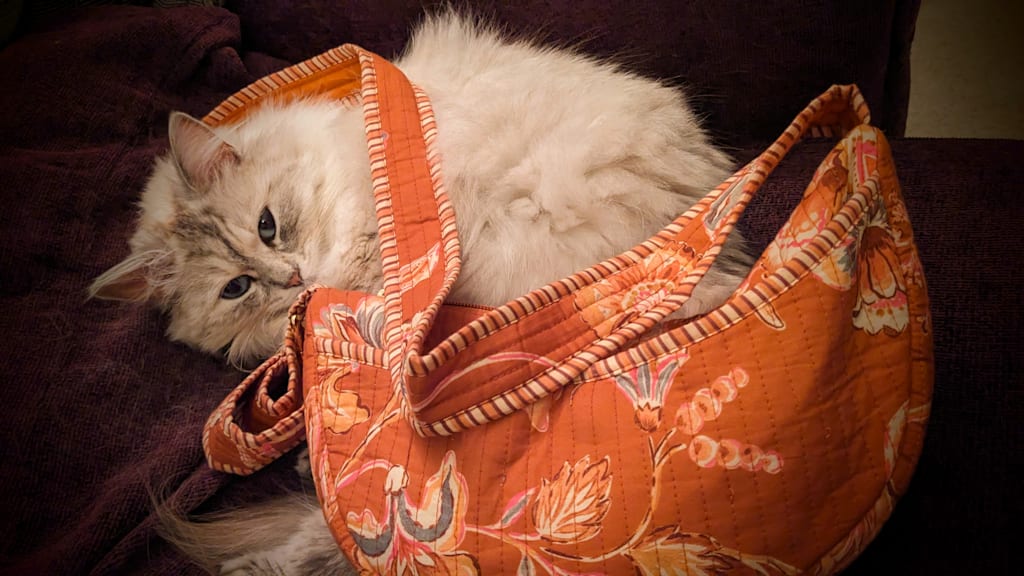
Now I, like everyone I imagine, like to think of myself as reasonably bright. Capable of the weighing up of information. Attuned to the soft-sell. Resistant to manipulation. So when I am shown a picture (true story this one) of a rust coloured floral print cross body bag, available to me at the upfront cost of three or four finger taps, I know that if I find myself wanting it, it is because I actually want it.
Well, I think so. I bought the bag. Two or three weeks on, I remain happy with the bag. But you see, I wasn’t in the market for a bag. I have a bag. It is black, nothing on it is broken, and it has a handy internal zip pocket, which this one does not have. I didn’t wake up one Wednesday morning and decide to buy a bag. But AI had other plans!
At first it dropped it in on an educated guess. “She has lingered on pictures with patterns like this” it thought to itself. Nefariously. “Her friend opened this link just two hours ago.”
It was an act of seduction I was wise to of course. But AI knew that my eye would pause on the warm, naturalistic fabric, and before I could notice myself doing it, I had slowed my downward scroll by just a beat and it knew it had a bite. “I respect that” it said, as I scrolled on by. “You know your own mind, nothing forced here, you do what you want to do, I only want you to be happy.”
“But did you want to see that again?”
“Again?”
“No hassle, I just was worried you might have forgotten.”
By Friday I had seen that advert more times that I had seen my own bed. The bag was beginning to feel like mine. The sale felt inevitable. Why fight?
This is nothing new. People have tried to exchange something for something else in order to profit themselves probably for the entirety of human history, and advertising goods, appealing to someone’s emotions, alerting them to their options, has been around a long long time. But now, well, it knows what I like. It anticipates what I might want better than ever before. It does it to the point where I am no longer entirely certain what I like and what I am told I like. Sometimes, it knows things about me I don’t know. On one occasion, it suggested I might like to join a Facebook group dedicated to the appreciation of gates. “Gates!” I scoffed. “Who on earth would want to join a…oh, that IS a nice gate actually. And I think I’ve been to that one….” This, I am afraid to say, is ALSO a true story.
Much of the time, this might be either innocuous or even beneficial. These same predictive models which tell me what to buy can also put me in touch with others who share my interests (do I WANT to befriend a cohort of gate lovers, I ask myself?), or simply offer a gentle exposure to my personal pleasures (because looking at gates on the internet is far more accessible of a Friday night that trekking through Wales in pursuit of a nice little wrought iron number). But I am also plunged, by this process, into an incessant state of wanting. And not that kind of wanting that motivates me to work hard and build my life towards my personal priorities. No, this is a thinly spread wanting, which is exhausting to maintain, often based on inaccurate comparison of my life against that of others, and might easily lead to financially questionable decisions.
So who do we blame? Who do we blame for the fact that the manipulation of our minds for commercial gain has been honed to such a fine point? Well, er, there are the billionaires of course, the mega-beneficiaries of capitalism. But also….gosh…there are an awful lot of mirrors in here aren’t there?
But the story doesn’t end with the financial exploitation of my information. These same processes drive an even more sinister phenomena. Again, nothing new, a well-documented human inclination since documenting was poor and Babbage’s difference engine was beyond imagining, but there is something about the speed and scale in this AI age that feels threatening. Because this same data driven drip feed of information also, bit by quite chunky bit, sinks me into an echo chamber ringing with vehement opinions.
For many of us, the majority of opinions we encounter on the internet will either align with our own, or be such extreme versions of opinions which affront our own sensibilities that we will feel entirely vindicated in what we believe. And once we show an interest, once we pause, or read, or watch, well, we get more of it. But it’s okay though, because I am sure most of us, including myself, are right, so it’s fine that we are accessing what is, after all, the correct version of the truth.
Except my version of the truth, and someone else’s version of the truth (I could name names – see, even now, when I am making exactly this point, I think I am right on this), two perspectives that maybe shared a front path once upon a time, gradually tilt further and further into opposition by the repetition of the selective presentation of information.
So here I am. In some ways, known more intimately than I have ever been known before, and in others, less sure that I know my own mind than I have ever been. This technology, this wonderful, world-altering technology, which I believe will one day save far more lives than it squanders, permeates my days. It is scoping me constantly, sizing me up, looking to make someone some money, somewhere along the way. But it does so with a complete disinterest whether it caters to my best or my worst qualities along the way. I could be greedy, envious and lustful so very easily. I can be prideful, I can be slothful, and yes, I can wallow in wrath. Perhaps the biggest issue though, is gluttony. Because whatever it feeds me, I keep coming back for more.
So. Do I use AI? I still say no. Am I used by AI? Daily. And does that influence what I do, or how I feel? I very much fear it does. It’s not all bad. Sometimes it helps me find my way to things I benefit from, whether there is financial exchange or not. Writing communities. Videos of donkeys that make me smile. Nicely crafted gates. But sometimes it nudges me towards my baser nature. Those seven deadly sins are in all of us, are they not? AI has no desire to see me swallowed by my own wickedness of course. It too is only being true to its nature. Gather, learn, predict, return the best result. Any burgeoning political intolerance on my part is far more likely to be a by-product of AI seeking to please me, to keep my engaged, than some plot to rule the world. But you know what? I don’t really want to stay engaged. I don’t think, on balance, it does me a lot of good.
So, what can I do? Well, I can be aware. I can question what I think. I can seek alternative information. But perhaps the biggest act of resistance I can perform is the one my cat demonstrates every afternoon. I can stick my tail in the air, point my nose out into the world, and step out of sight for a while.
I’ll keep the bag though. However I came to liking it.
About the Creator
Enjoyed the story? Support the Creator.
Subscribe for free to receive all their stories in your feed. You could also become a paid subscriber, letting them know you appreciate their work.
Comments
There are no comments for this story
Be the first to respond and start the conversation.