
Fleet Management System Market Trends: IoT Adoption, Vehicle Monitoring & Forecast to 2034
How telematics integration, real-time tracking systems, and data-driven insights are transforming fleet operations and improving efficiency across logistics and transportation sectors globally

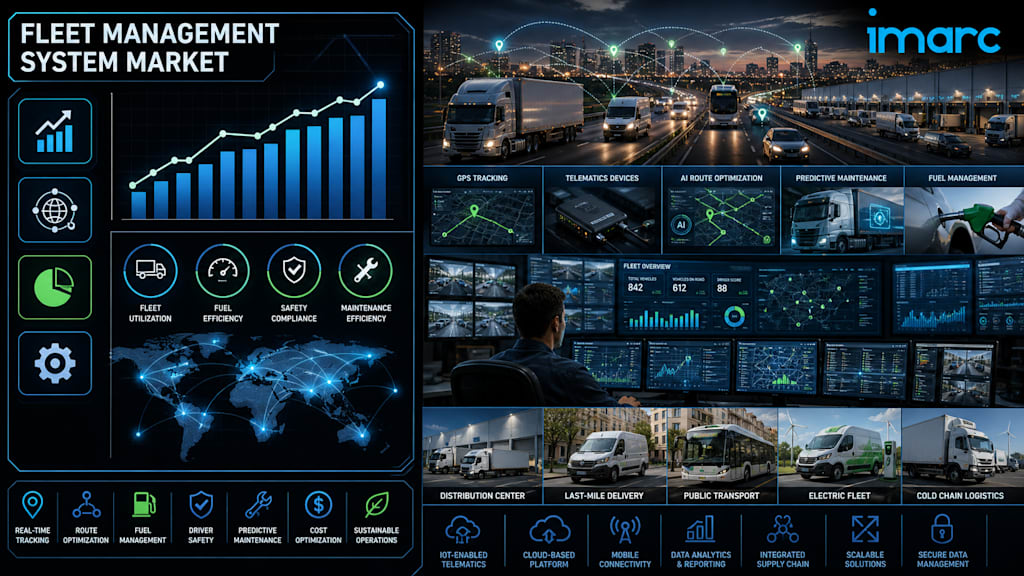
According to IMARC Group's latest research publication, The global fleet management system market size reached USD 31.3 Billion in 2025. Looking forward, IMARC Group expects the market to reach USD 65.4 Billion by 2034, exhibiting a growth rate (CAGR) of 8.28% during 2026-2034.
How AI and Connected Technologies Are Transforming the Fleet Management System Market
- AI-Powered Predictive Maintenance and Downtime Prevention: Artificial intelligence and machine learning algorithms are fundamentally reshaping vehicle maintenance practices across commercial and passenger fleet operations. AI-driven diagnostic platforms analyze real-time sensor data, engine performance metrics, and historical maintenance records to anticipate component failures before they result in costly breakdowns. Fleet operators implementing predictive maintenance solutions are reporting significant reductions in unplanned downtime, translating directly into improved vehicle utilization rates and lower total cost of ownership. This capability is particularly critical for logistics operators managing large commercial vehicle fleets where a single breakdown in a delivery corridor can trigger cascading disruptions across supply chain networks. The progressive deployment of machine learning in maintenance scheduling is reinforcing the solutions segment's dominance within the overall fleet management system landscape.
- Real-Time Vehicle Tracking and Route Optimization: The integration of advanced telematics hardware and GPS-enabled tracking platforms is enabling fleet managers to monitor vehicle locations, driver behavior, fuel consumption, and delivery progress with exceptional precision across large and distributed operations. AI-powered routing engines analyze live traffic conditions, road closures, and delivery windows to dynamically recalculate optimal routes, enabling fleets to cut fuel expenditure and improve on-time delivery performance simultaneously. Transportation and logistics companies deploying these systems report measurable improvements in route efficiency, with several large North American operators documenting multi-million-dollar fleet technology deployments incorporating telematics, video safety systems, and AI-powered routing optimization within a single integrated platform. Real-time visibility has become a non-negotiable operational requirement for enterprises managing mixed fleets across diverse geographies.
- Cloud-Based Deployment and Scalable SaaS Models: The accelerating transition from on-premise infrastructure to cloud-based Software-as-a-Service fleet management platforms is democratizing access to enterprise-grade fleet intelligence for operators of all sizes. Cloud deployment eliminates the need for significant upfront hardware investment while enabling seamless software updates, remote diagnostics, and cross-device accessibility for dispatchers and fleet managers in the field. The subscription-based commercial model allows small and mid-sized fleet operators to access the same analytical capabilities previously available only to large enterprises, leveling the competitive landscape across the transportation and logistics sector. Cloud-based solutions are particularly valued for their capacity to integrate data from diverse vehicle makes and telematics hardware sources into a unified management dashboard, a critical requirement for organizations managing mixed-fleet operations spanning commercial vehicles, passenger cars, and specialized equipment.
- Electric Vehicle Fleet Management and Sustainability Compliance: The accelerating electrification of commercial and passenger vehicle fleets is creating a new and specialized demand category within the fleet management system market. EV-specific management modules address the distinct operational requirements of electric fleets, including AI-driven range prediction, smart charging optimization, battery health monitoring, pre-conditioning scheduling, and total cost of ownership comparisons against internal combustion engine vehicles. Regulatory pressure from governments across North America, Europe, and Asia Pacific mandating reductions in fleet carbon emissions is compelling operators to adopt comprehensive EV fleet management tools as part of broader sustainability compliance strategies. Leading fleet management providers introduced advanced electric vehicle capabilities in January 2025, incorporating AI-driven range prediction and charge point integration as standard features within their core platform offerings.
- Video Telematics and Driver Behavior Monitoring: The convergence of AI-enabled dashcam technology with fleet management platforms is elevating driver safety monitoring from a reactive to a proactive discipline. Computer vision algorithms continuously analyze driver behavior, detecting distracted driving, harsh braking, fatigue indicators, and unsafe lane changes in real time, triggering automated coaching alerts before incidents escalate. In July 2025, Teletrac Navman debuted its Multi IQ Camera, a cloud-based AI dashcam solution delivering 360-degree visibility and real-time safety insights for large commercial vehicles. Insurers are increasingly partnering with fleet management providers to offer usage-based insurance models that reward demonstrably safer driving behaviors with premium reductions, creating a self-reinforcing adoption cycle that strengthens the business case for video telematics investment across fleet categories.
Fleet Management System Industry Overview
North America maintains a dominant position in the global fleet management system market, driven by extensive commercial vehicle operations, early adoption of telematics infrastructure, stringent regulatory compliance mandates including electronic logging device requirements, and the concentrated presence of major technology solution providers. The United States fleet management market alone reached USD 1.4 Billion, reflecting the depth of penetration across transportation, logistics, construction, and utility sectors in the region. Government-imposed compliance frameworks requiring real-time driver hours monitoring, vehicle inspection reporting, and emissions tracking have effectively made fleet management system adoption non-discretionary for commercial operators, providing a structurally stable demand foundation independent of broader economic cycles.
The European market is experiencing parallel growth dynamics, supported by tightening CO2 emission mandates, rising corporate vehicle leasing activity, and the 5G network rollout enabling sub-10-millisecond latency for real-time fleet coordination across dense urban corridors. Asia Pacific represents the fastest-growing regional opportunity, anchored by rapid logistics sector expansion, rising urbanization, and government investments in smart transportation infrastructure across China, India, Japan, South Korea, and Southeast Asia. India's fleet management market, valued at USD 1.2 Billion, exemplifies the region's growth potential as organized logistics operators invest in technology to manage scale, compliance, and cost efficiency simultaneously.
Fleet Management System Market Trends and Drivers
The rising demand for real-time vehicle tracking and operational optimization across transportation, logistics, construction, and energy sectors is the foundational driver sustaining the fleet management system market's expansion trajectory. Fleet operators face intensifying pressure to reduce fuel expenditure, minimize maintenance costs, ensure driver safety compliance, and meet increasingly stringent government reporting requirements, all of which are driving technology adoption across fleet sizes and industry verticals.
The e-commerce boom and last-mile delivery expansion are generating unprecedented demand for scalable fleet management capabilities. The exponential growth of online retail has created complex delivery networks requiring dynamic route optimization, real-time tracking visibility for end consumers, and data-driven dispatching capabilities that traditional manual fleet management approaches cannot efficiently support. Ghost kitchen operators, same-day delivery platforms, and grocery delivery services are among the fastest-growing adopters of cloud-based fleet management solutions, drawn by the operational intelligence these platforms provide across high-frequency, time-sensitive delivery cycles.
Government regulatory frameworks are functioning as powerful non-discretionary growth catalysts across all major markets. Electronic logging device mandates in North America, digital tachograph requirements in Europe, and emerging telematics compliance frameworks in Asia Pacific and the Middle East are compelling fleet operators to deploy certified management systems regardless of their size or technology maturity. In April 2024, Zain KSA launched the first fully Saudi-made fleet management system for the business sector, a cloud-based platform optimizing logistics operations for businesses of all sizes with real-time GPS tracking, route planning, and local data hosting, reflecting the region's strategic commitment to digitizing fleet operations under national technology development mandates.
Strategic mergers and acquisitions are accelerating market consolidation and platform capability expansion at a pace that is reshaping the competitive landscape. In September 2024, Powerfleet acquired Fleet Complete in a USD 200 million transaction, creating a combined entity with over 2.6 million subscribers and estimated combined revenue exceeding USD 400 million. This deal enhanced Powerfleet's presence across North America, Australia, and Europe while scaling its Unity platform with 600,000 new subscribers. In February 2025, Platform Science completed its acquisition of Trimble's global transportation telematics business units, integrating these capabilities into its Virtual Vehicle platform to offer fleets a broader range of telematics and management solutions across diverse vehicle types and operational contexts.
Leading Companies Operating in the Global Fleet Management System Industry
- AT&T Inc.
- Bridgestone Corp.
- Donlen Corp.
- Element Fleet Management Corp.
- Geotab Inc.
- Holman Inc.
- MiX Telematics Ltd.
- Motive Technologies Inc.
- Samsara Inc.
- Solera Holdings LLC
- Trimble Inc.
- Verizon Communications Inc.
Fleet Management System Market Report Segmentation
By Component:
- Solutions (Fleet Telematics, Driver Information Management, Vehicle Maintenance, Safety and Compliance Management, and Others)
- Services (Installation and Integration Services, After-Sales Support Services, and Consulting Services)
Solutions represent the largest component segment, as fleet telematics and safety compliance management platforms deliver the core operational intelligence that drives measurable efficiency and cost reduction outcomes for fleet operators across all industry verticals.
By Vehicle Type:
- Commercial Vehicles
- Passenger Cars
- Aircrafts
- Watercrafts
Commercial vehicles dominate the vehicle type segment, reflecting the concentrated demand from logistics, transportation, construction, and utility operators who manage large, distributed fleets requiring continuous monitoring, compliance management, and maintenance oversight.
By End Use Sector:
- Automotive
- Energy and Utilities
- Manufacturing
- Retail
- Transportation and Logistics
- Construction
- Others
Transportation and logistics leads end use sector demand, accounting for the largest share of fleet management system deployments globally, driven by the sector's fundamental dependency on vehicle uptime, route efficiency, regulatory compliance, and real-time supply chain visibility.
By Technology:
- Cellular System
- GNSS
- Others
By Deployment Type:
- On-Premise
- Cloud
Cloud-based deployment holds the largest deployment type share, reflecting the enterprise and mid-market preference for scalable, low-infrastructure, and continuously updated SaaS fleet management platforms over legacy on-premise installations.
Regional Insights:
- North America (United States, Canada)
- Asia Pacific (China, Japan, India, South Korea, Australia, Indonesia, Others)
- Europe (Germany, France, United Kingdom, Italy, Spain, Russia, Others)
- Latin America (Brazil, Mexico, Others)
- Middle East and Africa
North America exhibits clear dominance in the fleet management system market, supported by mature telematics infrastructure, regulatory compliance mandates, and the concentrated presence of leading global solution providers driving continuous platform innovation.
Recent News and Developments in the Fleet Management System Market
- May 2024: VE Commercial Vehicles formed a joint venture with iTriangle Infotech to develop and deliver fleet management solutions for truck and bus customers, creating industry-leading telematics systems operating on purpose-built hardware devices supplied by iTriangle and targeting India's rapidly expanding commercial vehicle fleet sector.
- September 2024: Powerfleet acquired Fleet Complete in a USD 200 million transaction, creating a combined fleet management entity with over 2.6 million subscribers and estimated combined annual revenue exceeding USD 400 million, substantially expanding Powerfleet's presence across North America, Australia, and Europe.
- December 2024: Continental sold Zonar, its smart fleet management division, to GPS Trackit, aligning with Continental's strategic focus on core automotive competencies while enabling Zonar to accelerate its AI-driven fleet solutions expansion under new ownership with dedicated technology investment resources.
- February 2025: Platform Science completed its acquisition of Trimble's global transportation telematics business units, integrating these capabilities into its Virtual Vehicle platform to deliver a broader suite of telematics and fleet management solutions across diverse vehicle types and commercial operator segments.
- April 2025: Solera launched the Solera Fleet Platform, a unified solution integrating vehicle claims, repair workflows, and fleet management data into a single AI-driven ecosystem, targeting fleet operators seeking consolidated operational intelligence and reduced administrative overhead from managing disconnected technology systems.
- July 2025: Teletrac Navman debuted its Multi IQ Camera, a cloud-based AI dashcam solution delivering 360-degree visibility and real-time safety insights for large commercial vehicles, advancing driver behavior monitoring capabilities for operators prioritizing safety compliance and insurance cost reduction strategies.
Note: If you require specific details, data, or insights that are not currently included in the scope of this report, we are happy to accommodate your request. As part of our customization service, we will gather and provide the additional information you need, tailored to your specific requirements. Please let us know your exact needs, and we will ensure the report is updated accordingly to meet your expectations.
About the Creator
Abhay Rajput
I am working in market research company that provides market and business research intelligence across the globe.
Enjoyed the story? Support the Creator.
Subscribe for free to receive all their stories in your feed.
Comments
There are no comments for this story
Be the first to respond and start the conversation.