
Firearms Market Trends: Smart Weapon Technologies, Military Spending & Forecast to 2034
How rising defense modernization programs, military procurement activities, and security concerns are driving innovation and global demand growth in the firearms market

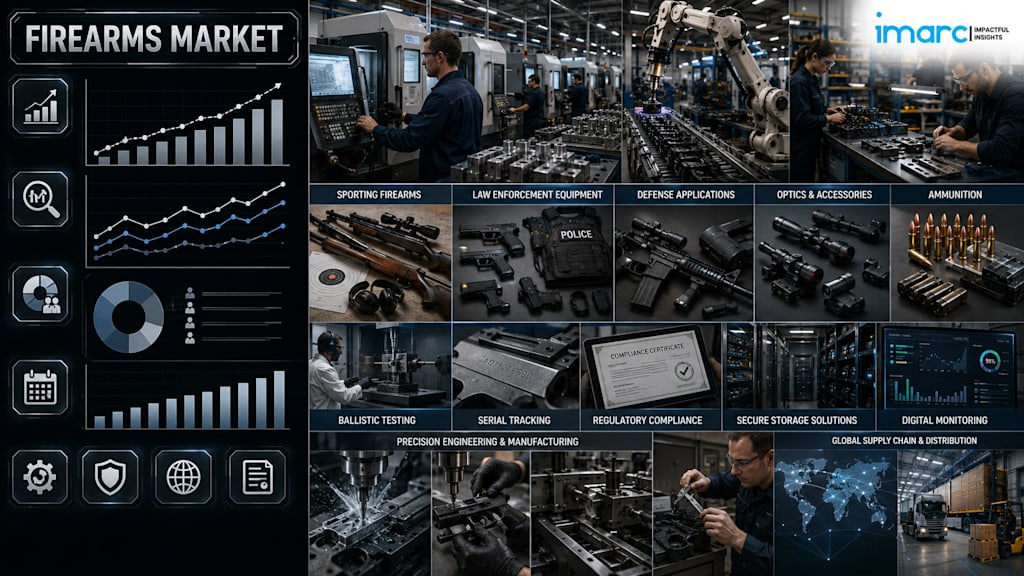
According to IMARC Group's latest research publication, The global firearms market size reached USD 44.0 Billion in 2025. Looking forward, IMARC Group expects the market to reach USD 72.1 Billion by 2034, exhibiting a growth rate (CAGR) of 5.64% during 2026-2034.
How AI is Reshaping the Future of the Firearms Market
- Smart Targeting and Guided Weapon Systems: AI-powered targeting systems are enhancing the precision and operational reliability of guided firearms used by military and law enforcement agencies. Computer-assisted aiming mechanisms, smart scopes, and sensor-integrated guidance systems now enable accurate target acquisition under low-visibility and dynamic combat conditions. Armaments Research Company, Inc. (ARC), in partnership with Sig Sauer, deployed a full-stack Internet of Things (IoT) technology platform in the Next Generation Squad Weapon (NGSW) program of record, providing real-time data on individual weapon health at scale, enabling units to reduce failure rates, extend weapon operational lifetimes, and optimize maintenance scheduling across active deployments.
- Biometric Authentication and Smart Gun Safety Systems: Machine learning algorithms integrated with biometric sensors are enabling firearms to authenticate users through fingerprint recognition, palmprint scanning, and grip pattern analysis before allowing trigger operation. These systems address longstanding safety concerns around unauthorized access and firearm theft. According to a 2020 analysis from the Center for American Progress, 1.8 million guns were stolen from individuals between 2012 and 2017, with an additional 53,900 stolen from dealers, underlining the scale of the problem these technologies are designed to solve. Radio-frequency identification (RFID) systems complement biometric tools by enabling law enforcement and military organizations to track and manage arsenals through automated inventory monitoring.
- IoT-Enabled Operational Transparency and Real-Time Tracking: IoT-integrated firearms are enabling commanders and law enforcement supervisors to access granular operational data during active deployments. Yardarm's smart firearm sensor, located within the handgrip, tracks unholstering events, rounds fired, shooting location, and the direction the firearm is pointed at the time of discharge. The embedded LTE chipset transmits this data in real time, enabling backup requests and improving officer accountability in the field. These capabilities extend visibility into firearm use that was previously inaccessible through conventional tracking methods, creating a new layer of operational intelligence for agencies managing large armed workforces.
Firearms Industry Overview:
The global firearms industry is shaped by the convergence of rising security concerns, defense modernization programs, civilian self-defense demand, and rapid integration of advanced technologies into weapon systems. In urban settings across the United States, 24.5 out of every 1,000 people aged 12 or older were reported as victims of violent crimes, and 157.5 per 1,000 were victims of property crimes in 2021, according to the Bureau of Justice Statistics. These persistent threat levels are sustaining civilian demand for personal protection firearms. In the United States, 40% of men and 25% of women own a firearm, with ownership concentrated in rural areas at 47% compared to 30% in suburban and 20% in urban settings.
Defense budget expansions across major economies are reinforcing institutional procurement volumes. India allocated Rs 5.94 lakh crore to its defense sector, a 13% increase over the prior year, while the European Commission proposed 1.5 billion euros in incentives to encourage joint procurement from European defense manufacturers and support capacity expansion. Indonesia approved a 20% increase in defense spending, raising its allocation from USD 20.75 billion to USD 25 billion, and China raised its defense budget by 7.2% to approximately 1.7 trillion yuan (USD 236.1 billion).
Collaborative manufacturing arrangements are expanding production capacity and enabling technology transfer across emerging defense markets. Adani Group and Israel Weapon Industries established PLR Systems Pvt Ltd, a joint venture to manufacture small arms including the TAVOR assault rifle, X95 assault rifle, GALIL sniper rifle, NEGEV light machine gun, and UZI submachine gun in India. ICOMM announced a partnership with UAE-based CARACAL to manufacture CARACAL's complete line of small arms domestically under India's Make in India and Atma Nirbhar Bharat policy frameworks.
Firearms Market Trends and Drivers:
The increasing concern for personal safety and self-defense among civilians is a primary driver of demand for handguns and compact rifles globally. Rising crime rates and the perceived inadequacy of passive security measures are encouraging households to invest in firearms for home protection. The World Health Organization estimates that approximately 1 in 3 women globally have experienced sexual violence during their lifetimes, and 38% of all female murders are committed by intimate partners. This persistent threat environment is contributing to growing female participation in the firearms market for personal safety, with women representing an expanding and increasingly commercially targeted demographic for manufacturers and retailers.
The recreational and sporting segment is growing steadily alongside civilian safety demand. Activities including competitive target shooting, hunting, and shooting sports events have recorded rising participation rates across multiple regions. The global sports guns market is estimated to reach USD 3.9 Billion, and the shooting ranges market is projected to reach USD 2.3 Billion globally. The growth of dedicated clubs, ranges, and organized events is increasing accessibility and broadening the consumer base for sporting firearms beyond traditional ownership demographics.
Technological innovation is reshaping product development priorities across the industry. Manufacturers are investing in lighter and more durable materials that reduce the overall weight of firearms without compromising structural performance or ballistic accuracy. Modular firearms designs, such as the Special Operations Forces Combat Assault Rifle (SCAR), enable users to reconfigure the same platform from a close-quarters battle rifle to a designated marksman rifle through barrel and attachment swaps, extending the operational range and versatility of a single weapon system. Smart gun development is also gaining traction as a response to firearm-related suicides among younger populations, with technology-based prevention receiving increasing institutional investment.
Leading Companies Operating in the Global Firearms Industry:
- Beretta
- Colt CZ Group
- FN Herstal
- Glock Ges.m.b.H.
- Heckler and Koch (H&K)
- Remington Arms Company
- Sig Sauer
- Smith and Wesson (S&W)
- Sturm, Ruger and Co., Inc.
Firearms Market Report Segmentation:
By Type:
- Pistol
- Revolver
- Rifle
- Machinegun
- Others
Rifle accounts for the largest segment share, driven by its versatility across bolt-action, semi-automatic, and automatic configurations, and sustained demand from military, law enforcement, competitive shooting, and recreational hunting applications.
By Technology:
- Guided
- Unguided
Guided firearms represent the largest technology segment, driven by increasing demand for precision targeting from defense and law enforcement agencies and the integration of AI, sensors, and smart optics into operational weapon systems.
By Operation:
- Automatic
- Semi-automatic
- Manual
Automatic firearms account for the largest operation segment, supported by their widespread adoption across military and law enforcement agencies for suppressive fire, close-quarters combat, and high-intensity tactical operations requiring sustained rapid fire capability.
By End Use:
- Military
- Law Enforcement
- Sports
- Hunting
- Self-Defense
- Others
The military segment holds the largest end use share, driven by sustained institutional procurement of sidearms, rifles, and specialized weaponry, alongside growing investment in research and development to integrate digital and smart technologies into next-generation defense platforms.
Regional Insights:
- North America (United States, Canada)
- Asia Pacific (China, Japan, India, South Korea, Australia, Indonesia, Others)
- Europe (Germany, France, United Kingdom, Italy, Spain, Others)
- Latin America (Brazil, Mexico, Others)
- Middle East
- Africa
North America exhibits clear dominance in the global firearms market, supported by a strong culture of gun ownership, comprehensive legal frameworks, and significant demand from both civilian and defense sectors. Approximately four in ten U.S. adults live in a household with a firearm, and 32% report personally owning one. Asia Pacific is an emerging growth region driven by expanding defense budgets and rising security concerns across both established and developing economies.
Recent News and Developments in the Firearms Market:
- March 2025: The US Army Contracting Command awarded Heckler and Koch a USD 33 million contract for the supply of Compact Semi-Automatic Sniper Systems and Squad Designated Marksman Rifles. The Compact Semi-Automatic Sniper System, designated the M110A1 rifle, is chambered for 7.62 NATO ammunition and is a variant of the company's G28 (HK241) platform.
- June 2024: ICOMM finalized its partnership agreement with UAE-based CARACAL to manufacture CARACAL's complete line of small arms in India, aligning with the Make in India and Atma Nirbhar Bharat government initiatives to expand domestic defense production capacity.
- February 2024: FN America, the US subsidiary of the Herstal Group, fulfilled supply commitments under its USD 119 million Department of Defense contract for over 167,000 M4 and M4A1 carbines, reinforcing its position as a primary supplier to the US military's standard infantry rifle requirements.
Note: If you require specific details, data, or insights that are not currently included in the scope of this report, we are happy to accommodate your request. As part of our customization service, we will gather and provide the additional information you need, tailored to your specific requirements. Please let us know your exact needs, and we will ensure the report is updated accordingly to meet your expectations.
About the Creator
Abhay Rajput
I am working in market research company that provides market and business research intelligence across the globe.
Enjoyed the story? Support the Creator.
Subscribe for free to receive all their stories in your feed.
Comments
There are no comments for this story
Be the first to respond and start the conversation.