
Firearms Market Analysis: Legal Frameworks, Safety Systems & Forecast 2034
How biometric access controls, connected storage systems, and compliance upgrades are influencing the future outlook of the firearms industry.

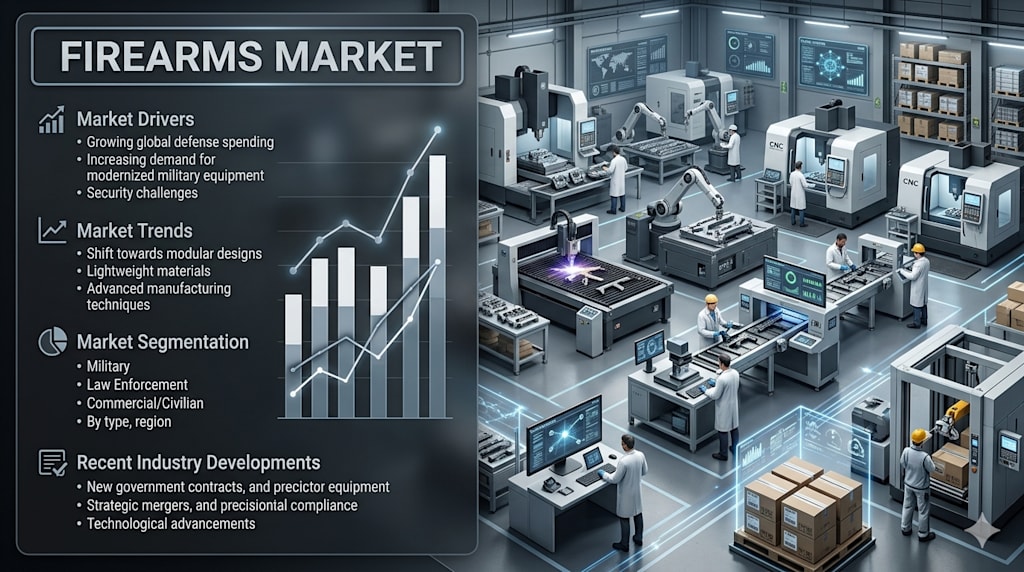
Rising concerns over personal safety, increasing defense expenditure, growing participation in shooting sports, and rapid advancements in smart weapon technologies are driving firearms demand, supported by government modernization programs, domestic manufacturing initiatives, and expanding institutional procurement channels. According to IMARC Group's latest data, the global firearms market size was valued at USD 44.0 Billion in 2025. Looking forward, IMARC Group estimates the market to reach USD 72.1 Billion by 2034. North America currently dominates the market, supported by a strong culture of gun ownership, comprehensive legal frameworks, and a significant presence of industry-leading manufacturers.
The firearms market represents a multi-billion-dollar global industry driven by converging institutional and civilian demand. Defense forces worldwide are accelerating procurement of advanced weaponry to enhance combat readiness and counter evolving security threats. At the same time, rising urban crime, growing female buyer participation, and an expanding shooting sports culture are broadening the civilian base. Technological integration including biometric systems, IoT connectivity, and RFID tracking is further redefining product development. Key end-use segments include military, law enforcement, self-defense, sporting, and hunting, with major manufacturers competing on precision, reliability, safety features, and smart functionality.
Firearms Market Growth Drivers:
Growing Concern Regarding Personal Safety and Self-Defense
Increasing crime rates and perceived personal threats in both urban and rural settings are fueling civilian demand for firearms. In the United States, 40% of men and 25% of women report personally owning a firearm. Ownership is highest among rural residents at 47%, compared to 30% in suburban and 20% in urban areas. A notably fast-growing segment is women buyers, driven by the fact that approximately 1 in 3 women globally have experienced sexual violence, per World Health Organization data, and that 38% of all female murders are committed by intimate partners. Manufacturers are actively designing products tailored to this demographic, contributing to consistent volume growth in the self-defense segment.
Rising Demand from the Defense Sector
Escalating global defense budgets are directly translating into sustained firearms procurement. India allocated Rs 5.94 lakh crore to its defense sector, representing a 13% jump from the prior year, and ranks fourth globally in firepower per the Global Power Index. Indonesia approved a 20% rise in defense spending, lifting its allocation from USD 20.75 billion to USD 25 billion. China raised its defense budget by 7.2%, reaching approximately 1.7 trillion yuan (USD 236.1 billion).
Growing Focus on Sporting and Recreational Activities
An upsurge in recreational shooting activities including target shooting, hunting, and competitive sports events is widening the civilian addressable market. The global sports guns segment is estimated to reach USD 3.9 Billion, while the shooting ranges market is projected to reach USD 2.3 Billion, supported by rapid growth in clubs, events, and dedicated shooting infrastructure worldwide.
Substantial Requirements in Government and Law Enforcement
Government agencies and law enforcement bodies globally represent a large and predictable source of institutional demand. SWAT units, tactical response teams, border security forces, and police departments all require regular firearm procurement, upgrades, and replacements. The quadrupling of FBI terrorism investigations has directly increased procurement needs for specialized weaponry.
Firearms Market Trends:
Integration of Smart and Digital Technologies
The integration of Internet of Things (IoT) connectivity, biometric authentication, and radio-frequency identification (RFID) into firearms is one of the most consequential trends reshaping the industry. Biometric locking systems restrict unauthorized use while enabling rapid access for verified owners, directly addressing regulatory pressure around safe storage. IoT-enabled firearms allow remote diagnostics, performance monitoring, and tracking, which are particularly valuable for military and law enforcement fleet management.
Domestic Manufacturing Initiatives and Strategic Partnerships
Government-led manufacturing programs are creating new dynamics in the competitive landscape. India's "Make in India" and "Atma Nirbhar Bharat" initiatives have catalyzed significant joint ventures in the small arms space. Adani Group and Israel Weapon Industries (IWI) formed PLR Systems Pvt Ltd for high-class small arms production, with IWI weapons including the TAVOR assault rifle, GALIL sniper rifle, and NEGEV light machine gun already deployed with Indian Armed Forces and Central Armed Police Forces.
Premiumization and Advanced Materials Adoption
Manufacturers are investing significantly in materials science and precision engineering to produce firearms that are lighter, more durable, and more accurate. The adoption of advanced lightweight composites and high-strength alloys is reducing carry weight for military and law enforcement users without compromising structural integrity.
Recent News and Developments in the Firearms Market
March 2026: Sig Sauer announced the expansion of its New Hampshire manufacturing facilities to increase production capacity for next-generation modular handguns, following renewed U.S. Army service pistol contracts.
November 2025: Glock unveiled a new line of smart pistols featuring integrated biometric authentication at the MILIPOL Paris defense exhibition, targeting law enforcement and high-security civilian markets across Europe and Asia.
July 2025: India's Ministry of Defence awarded a contract worth over INR 1,700 crore to a domestic consortium for the supply of assault rifles under the Atma Nirbhar Bharat framework, advancing indigenous small arms production goals.
February 2025: FN Herstal secured a multi-year supply agreement with a NATO-aligned European nation for light machine guns and battle rifles, as regional defense spending accelerated amid geopolitical tensions.
September 2024: Smith and Wesson launched a new line of compact, lightweight handguns specifically designed and marketed toward women, citing a 30% increase in female first-time buyer inquiries over the preceding 18 months.
Note: If you require specific details, data, or insights that are not currently included in the scope of this report, we are happy to accommodate your request. As part of our customization service, we will gather and provide the additional information you need, tailored to your specific requirements. Please let us know your exact needs, and we will ensure the report is updated accordingly to meet your expectations.
About the Creator
Suhaira Yusuf
I specialize in Consumer Insights, focusing on transforming detailed market data into strategic business solutions that accelerate growth and improve customer engagement.
Enjoyed the story? Support the Creator.
Subscribe for free to receive all their stories in your feed.
Comments
There are no comments for this story
Be the first to respond and start the conversation.