
Finite Element Analysis Market Shows Promising Potential in R&D
How complex engineering challenges in transportation, energy, and construction sectors are increasing reliance on finite element analysis solutions.

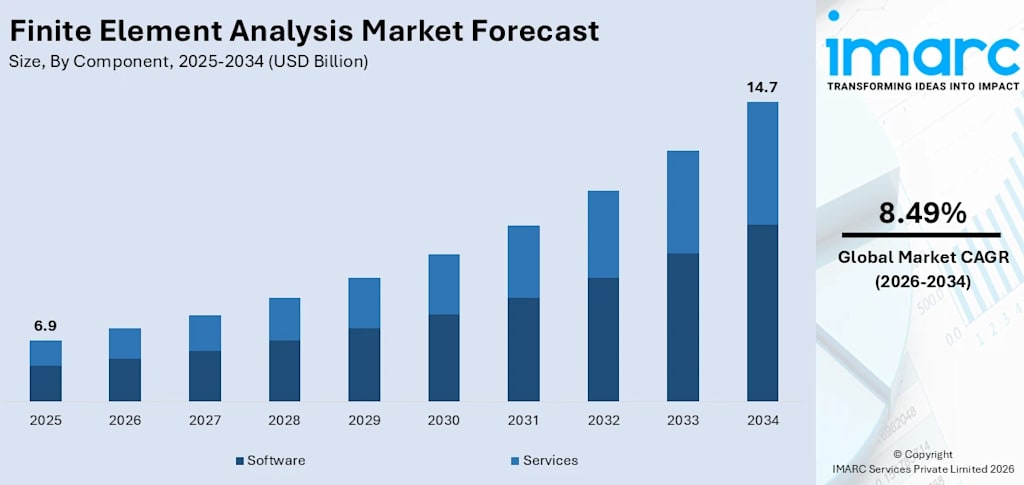
Rising adoption of virtual prototyping, the increasing demand for lightweight and energy-efficient designs, and the growing complexity of product structures are driving finite element analysis (FEA) demand, supported by rapid cloud-based software deployments, advanced computing power, and stringent global regulatory compliance standards across industrial verticals. According to IMARC Group’s latest data, The global finite element analysis market size was valued at USD 6.9 Billion in 2025. Looking forward, IMARC Group estimates the market to reach USD 14.7 Billion by 2034, exhibiting a CAGR of 8.49% from 2026-2034.
Finite element analysis now represents a crucial multi-billion-dollar global industry exceeding USD 6 billion and exhibiting steady year-on-year expansion. Demand is driven by structural safety requirements, automated engineering workflows that minimize physical prototyping, and increased integration with the Internet of Things (IoT) and additive manufacturing networks. Cloud innovations and subscription-based software-as-a-service models, private and public sector aerospace infrastructure investments, and product optimization for stress, thermal, and fluid dynamics are further accelerating uptake.
Finite Element Analysis Market Growth Drivers:
- Increasing Adoption of Virtual Prototyping
Engineers prioritize advanced virtual testing environments to validate structural durability, weight optimization, and stress thresholds before physical production begins. This methodology significantly limits material waste, slashes development timelines, and mitigates structural risks in high-stakes fields like industrial manufacturing and civil engineering. Global industry reports valuation trends highlight the expanding baseline of digital simulation tools to meet strict delivery cycles, as complex industrial machinery requires rigorous, multiphysics verification.
- Rising Demand for Lightweight and Energy-Efficient Designs
Stricter environmental regulations and fuel efficiency targets push automotive and aerospace firms to engineer high-strength, low-weight structural components. Design teams leverage advanced simulation math to isolate points of high stress and eliminate unnecessary material without jeopardizing structural integrity. Global market dynamics reflect heavy industrial reliance on software-backed stress testing to integrate composite materials and complex aluminum alloys. Moving away from traditional solid steel parts requires deep structural insight, and these mathematical modeling tools supply the reliable stress data required to confidently pass physical crash tests and weight compliance.
Get Instant Access to "Finite Element Analysis Market" Growth Insights
- Implementation of Stringent Regulatory and Safety Standards
Government transport boards, defense sectors, and consumer safety watchdogs implement zero-tolerance structural guidelines to protect the general public. Manufacturing firms rely on robust numerical analysis software to ensure compliance with strict stress, pressure, and thermal exposure limits. Industrial research indicates that having a clear digital trail of safety simulations is highly influential during product certification workflows. Regulatory environments worldwide demand clear simulation models for safety equipment and aerospace parts, expanding structural validation tool deployments because organizations require verified mathematical proof to securely launch heavy equipment into consumer markets.
Finite Element Analysis Market Trends:
- Rapid Expansion of Cloud-Based Deployment Models
Engineering firms prioritize scalable, cloud-hosted subscription platforms to replace rigid on-premise hardware infrastructure, granting distributed global design teams instant computational access. Shifting toward cloud ecosystems democratizes high-performance computing power, turning resource-intensive structural simulations into accessible web-browser workflows. Market reports indicate that cloud software adoption influences more than half of system architecture update decisions across specialized engineering firms.
- Integration with Additive Manufacturing and Modern CAD Platforms
Designers seek unified software workflows that blend traditional 3D computer-aided drafting (CAD) platforms with internal simulation solvers and 3D printing configurations. Merging these technologies ensures that generative design models can be checked for structural integrity and manufactured in a single, fluid software sequence. The global market landscape showcases significant software feature updates focusing on real-time physics feedback during the initial conceptual phase. Everyday applications include optimized industrial bracket design, medical implant customization, and complex aerospace lattice validation, allowing engineering teams to refine physical product geometry instantly on screen.
- Advanced Visualization and User-Friendly Software Interfaces
As mathematical simulation expands beyond dedicated analysts, software developers prioritize intuitive dashboards, automatic mesh generation, and high-resolution color-coded stress animations. Modern interfaces lower the technical barrier to entry, letting standard product engineers run localized thermal and stress simulations independently. Industry analysis indicates that high-fidelity graphics and automated error-checking capabilities drive competitive software adoption across mid-sized design firms. These improvements directly support faster internal reviews, allowing engineers to clearly present complex stress distribution findings to non-technical stakeholders, clients, and corporate decision-makers during product reviews.
Recent News and Developments in Finite Element Analysis Market
- September 2025: Dassault Systèmes rolled out a company-wide initiative to significantly reduce processing times across its simulation software portfolio, responding to heightened consumer demand for faster solvers and aligning with broader industry shifts toward real-time generative design tools and improved engineering workflows.
- October 2025: Autodesk Inc. unveiled a major platform update integrating artificial intelligence directly into its automated meshing tools, designed to help engineering teams accelerate structural validation cycles while maintaining high accuracy in stress concentration reporting.
- December 2025: Hexagon AB completed a strategic technology acquisition aimed at deeply embedding real-time predictive material analysis into its core software suite, addressing complex multi-physics design needs across the automotive and aerospace manufacturing sectors.
Note: If you require specific details, data, or insights that are not currently included in the scope of this report, we are happy to accommodate your request. As part of our customization service, we will gather and provide the additional information you need, tailored to your specific requirements. Please let us know your exact needs, and we will ensure the report is updated accordingly to meet your expectations.
About the Creator
Andrew Sullivan
Hello, I’m Andrew Sullivan. I have over 9+ years of experience as a market research specialist.
Enjoyed the story? Support the Creator.
Subscribe for free to receive all their stories in your feed.
Comments
There are no comments for this story
Be the first to respond and start the conversation.