
Fingerprint Sensor Market Set for Strong Growth as Biometric Security Becomes a Global Priority
From Smartphones to Digital Payments, Fingerprint Authentication Is Reshaping the Future of Secure Identity Verification

The world is becoming increasingly digital, and with this transformation comes a growing need for secure, fast, and convenient authentication methods. Traditional passwords and PINs are proving insufficient in protecting sensitive information from cyber threats, identity theft, and unauthorized access. As a result, biometric technologies have emerged as a preferred solution, with fingerprint sensors leading the way.
Fingerprint authentication has evolved from a niche security feature into a mainstream technology integrated into smartphones, laptops, banking systems, healthcare infrastructure, government identification programs, and smart home devices. Today, fingerprint sensors are helping organizations and consumers strike the perfect balance between security and convenience.
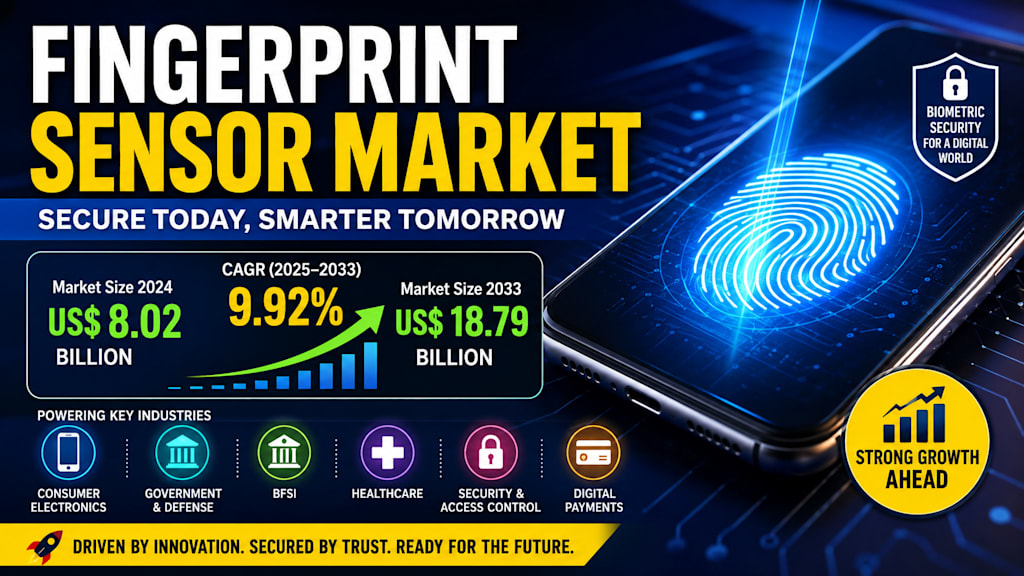
According to Renub Research, the global Fingerprint Sensor Market is projected to grow from US$ 8.02 Billion in 2024 to US$ 18.79 Billion by 2033, expanding at a CAGR of 9.92% during 2025–2033. The rapid growth reflects the increasing adoption of biometric authentication technologies across multiple industries worldwide.
Understanding Fingerprint Sensor Technology
Fingerprint sensors are biometric devices designed to identify and authenticate individuals based on the unique patterns found on their fingerprints. These sensors capture fingerprint images and convert them into digital data that can be analyzed and matched against stored records.
Modern fingerprint sensors utilize various technologies, including capacitive, optical, ultrasonic, and thermal sensing methods. Each technology offers different advantages in terms of accuracy, speed, durability, and security.
The widespread integration of fingerprint sensors into everyday devices has transformed user experiences by enabling seamless authentication while reducing dependency on traditional passwords.
Rising Security Concerns Are Fueling Market Growth
One of the primary drivers behind the expansion of the fingerprint sensor market is the growing concern over cybersecurity and data protection.
Organizations and consumers alike are facing an increasing number of cyberattacks, identity theft incidents, and data breaches. Password-based security systems are often vulnerable to phishing attacks, credential theft, and hacking attempts.
Fingerprint authentication offers a more secure alternative because biometric characteristics are unique to every individual and cannot be easily duplicated. As a result, industries handling sensitive data are increasingly implementing fingerprint-based authentication systems.
Financial institutions, healthcare providers, government agencies, and enterprise organizations are investing heavily in biometric security infrastructure to protect confidential information and enhance user trust.
Smartphones Continue to Lead Adoption
Consumer electronics remain the largest application area for fingerprint sensors.
The introduction of fingerprint recognition in smartphones fundamentally changed how consumers interact with their devices. Unlocking phones, authorizing payments, accessing apps, and securing personal data became faster and more convenient through biometric authentication.
Even as facial recognition technologies gain popularity, fingerprint authentication continues to maintain strong demand due to its reliability, affordability, and user familiarity.
The emergence of under-display fingerprint sensors has further enhanced device aesthetics while improving functionality. These innovations allow smartphone manufacturers to offer bezel-less designs without sacrificing security features.
As smartphone penetration continues to increase worldwide, demand for fingerprint sensor technologies is expected to remain robust throughout the forecast period.
Growth of Digital Payments Strengthens Demand
The rapid expansion of digital payment ecosystems has created significant opportunities for fingerprint sensor manufacturers.
Consumers increasingly prefer contactless transactions, mobile wallets, and online banking services. However, these conveniences require strong security measures to prevent fraud and unauthorized access.
Fingerprint authentication provides an efficient solution by enabling secure payment authorization through biometric verification. Users can complete transactions quickly without remembering complex passwords or entering lengthy PIN codes.
As governments and financial institutions continue promoting cashless economies, fingerprint-enabled payment solutions are expected to gain wider acceptance across developed and emerging markets.
Technological Advancements Are Expanding Applications
Continuous innovation in sensor technology is significantly enhancing market growth.
Manufacturers are developing fingerprint sensors that are smaller, faster, more accurate, and more energy efficient than previous generations. These advancements enable integration into a wider range of devices beyond smartphones.
Wearable devices, smart locks, automotive systems, IoT devices, and healthcare equipment are increasingly incorporating fingerprint authentication features.
Ultrasonic fingerprint sensors, for example, provide superior accuracy by capturing three-dimensional fingerprint data. These sensors offer improved performance even when fingers are wet or dirty.
Similarly, in-display fingerprint technologies have become increasingly sophisticated, providing enhanced user experiences without compromising device design.
As innovation continues, fingerprint sensors are expected to become a standard feature across numerous connected technologies.
Government Initiatives Accelerate Market Expansion
Governments around the world are playing a crucial role in driving fingerprint sensor adoption.
National identification programs, border security systems, voter registration initiatives, and law enforcement databases increasingly rely on biometric authentication technologies.
Many countries have introduced digital identity programs that utilize fingerprint recognition to improve citizen services and reduce fraud.
These initiatives not only create substantial demand for fingerprint sensors but also encourage private-sector organizations to adopt biometric security solutions.
Regulatory requirements related to identity verification, anti-fraud measures, and data protection further strengthen market growth prospects.
India's Growing Influence in the Fingerprint Sensor Market
India represents one of the most promising markets for fingerprint sensor technology.
The country's massive smartphone user base, expanding digital payment ecosystem, and government-led digital transformation initiatives have created a favorable environment for biometric adoption.
Programs such as Aadhaar have demonstrated the effectiveness of fingerprint-based authentication on a large scale. The initiative has helped millions of citizens access government services, financial accounts, and welfare programs through biometric identification.
As India's digital economy continues expanding, fingerprint authentication is expected to remain a critical component of secure identity verification systems.
United States Remains a Key Innovation Hub
The United States continues to play a leading role in fingerprint sensor innovation and adoption.
Organizations across healthcare, banking, government, and consumer technology sectors are investing heavily in advanced biometric solutions.
The increasing focus on cybersecurity and fraud prevention is encouraging businesses to adopt fingerprint authentication for both consumer-facing and enterprise applications.
Innovation in biometric payment cards and secure authentication technologies is expected to further strengthen the U.S. market over the coming years.
Germany Advances Biometric Security Integration
Germany has emerged as a significant European market for fingerprint sensor technologies.
The country's strong emphasis on data protection, privacy regulations, and digital innovation has encouraged widespread adoption of biometric authentication systems.
Fingerprint-enabled payment solutions, secure access control systems, and government-backed digital identity initiatives are helping drive market expansion.
As organizations seek stronger security measures while complying with strict privacy standards, fingerprint authentication continues to gain traction across Germany.
UAE Embraces Advanced Biometric Technologies
The United Arab Emirates has become a regional leader in adopting biometric security solutions.
Government agencies, airports, financial institutions, and healthcare organizations increasingly utilize fingerprint authentication to enhance security and streamline operations.
National digital transformation initiatives and smart city projects are creating additional opportunities for fingerprint sensor deployment.
As the UAE continues investing in advanced technologies, demand for biometric authentication solutions is expected to remain strong.
Challenges Facing the Fingerprint Sensor Industry
Despite strong growth prospects, the fingerprint sensor market faces several challenges.
Integration Complexity
Modern electronic devices are becoming thinner and more compact, making sensor integration increasingly challenging.
Manufacturers must balance design aesthetics, performance requirements, and security capabilities while maintaining device affordability.
Integrating fingerprint sensors beneath displays or into unconventional device designs often requires significant engineering expertise and development costs.
High Cost of Advanced Technologies
Premium fingerprint sensing technologies such as ultrasonic and in-display sensors remain relatively expensive.
The higher production costs can limit adoption in budget and mid-range devices, particularly in price-sensitive markets.
Manufacturers continue working to reduce costs while maintaining performance standards to encourage broader adoption.
Competitive Landscape
The fingerprint sensor market remains highly competitive, with leading companies investing heavily in research and development.
Major market participants focus on improving accuracy, reducing power consumption, enhancing security, and expanding integration capabilities.
Key companies operating in the market include Qualcomm Technologies, TDK Corporation, Vkansee Technology, Egis Technology, Fingerprint Cards AB, Goodix Technology, Idex Biometrics, and NEC Corporation.
Strategic partnerships, product launches, acquisitions, and technological innovations continue shaping the competitive environment.
10 Recent Developments in the Fingerprint Sensor Industry
Samsung Display introduced Sensor OLED technology with embedded fingerprint sensing capabilities.
Goodix Technology expanded its portfolio with new IoT connectivity and sensor solutions.
SmartMetric received U.S. patents for biometric fingerprint-enabled payment card technology.
Mastercard partnered with Mercedes-Benz to enable fingerprint-authenticated vehicle payments.
Qualcomm continued enhancing ultrasonic fingerprint sensor performance for flagship smartphones.
Fingerprint Cards AB expanded biometric solutions for payment cards and access control systems.
Idex Biometrics strengthened collaborations with payment card manufacturers globally.
NEC advanced biometric authentication systems for government and enterprise applications.
Egis Technology expanded its biometric security offerings for mobile and consumer electronics devices.
Several sensor manufacturers accelerated development of AI-enhanced biometric authentication solutions.
Future Outlook
The future of the fingerprint sensor market looks exceptionally promising.
The convergence of digital transformation, increasing cybersecurity threats, expanding IoT ecosystems, and growing demand for frictionless authentication experiences will continue driving market expansion.
As biometric technologies become more affordable and sophisticated, fingerprint sensors are expected to penetrate new application areas including smart homes, connected vehicles, healthcare monitoring devices, industrial systems, and next-generation payment solutions.
With governments, enterprises, and consumers prioritizing security like never before, fingerprint authentication will remain a cornerstone of digital identity verification for years to come.
Final Thoughts
Fingerprint sensors have evolved far beyond their initial role in smartphone security. Today, they serve as a critical technology enabling secure access, seamless transactions, and trusted digital identities across countless industries.
As cyber threats become more sophisticated and digital ecosystems continue expanding, the importance of reliable biometric authentication will only increase. Supported by ongoing technological innovation, favorable government initiatives, and rising consumer awareness, the fingerprint sensor market is positioned for sustained growth throughout the coming decade.
The projected rise from US$ 8.02 Billion in 2024 to US$ 18.79 Billion by 2033 highlights not only the commercial potential of this technology but also its growing significance in shaping a more secure digital future.
About the Creator
Enjoyed the story? Support the Creator.
Subscribe for free to receive all their stories in your feed.
Comments
There are no comments for this story
Be the first to respond and start the conversation.