
Fiber Batteries Market Significant Growth at 19.7%
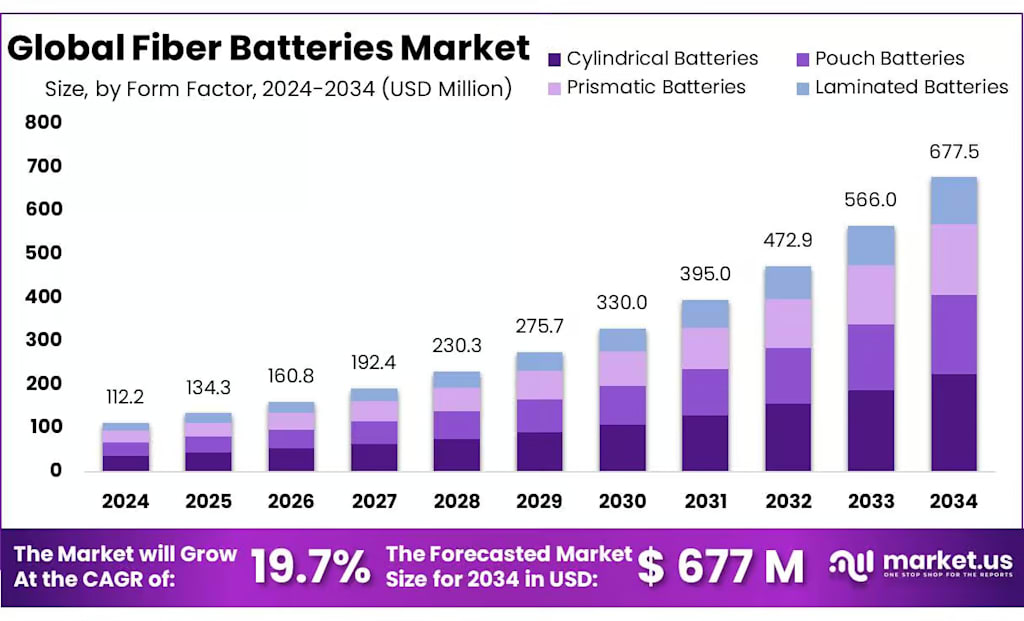
Fiber Batteries Market is to USD 677.5 Mn by 2034, up from USD 112.2 Mn in 2024, CAGR of 19.7%

Market Overview
The global fiber batteries market is projected to reach USD 677.5 million by 2034, rising from USD 112.2 million in 2024, and is expected to expand at a strong CAGR of 19.7% from 2025 to 2034. In 2024, Asia Pacific led the market with a 44.1% share, accounting for nearly USD 49.4 million, supported by rapid electrification across transport, electronics, and advanced materials manufacturing.
Recent laboratory progress has reinforced the commercial credibility of this technology. Research demonstrations show that carbon-fiber structural battery composites can deliver around 30 Wh/kg while maintaining performance for nearly 1,000 charge cycles, highlighting their potential for lightweight mobility and aerospace use cases.
At the materials level, carbon fibers used as electrodes can provide Young’s modulus of nearly 290 GPa and tensile strength of around 3.1 GPa, while glass-fiber separators are reported at approximately 76 GPa modulus and 1.7 GPa tensile strength, supporting their role as true load-bearing battery materials.
Key Takeaways
- Fiber Batteries Market is expected to be worth around USD 677.5 Million by 2034, up from USD 112.2 Million in 2024, and is projected to grow at a CAGR of 19.7%.
- Cylindrical Batteries held a dominant market position, capturing more than a 33.8% share.
- Lithium-Ion Batteries held a dominant market position, capturing more than a 48.5% share.
- Consumer Electronics held a dominant market position, capturing more than a 36.8% share.
- Asia Pacific dominates fiber batteries with 44.1% share, reaching 49.4 Mn on strong electrification momentum.
Segmentation Deep Dive
By Form Factor Analysis
In 2024, cylindrical batteries accounted for the leading 33.8% share of the global fiber batteries market, supported by their strong structural reliability and scalable cell architecture. Their dominance is closely tied to the natural mechanical advantages of the cylindrical design, which offers better stress distribution, enhanced durability, and easier integration into fiber composite systems. Since fiber batteries combine energy storage with load-bearing functions, cylindrical formats are particularly suitable for maintaining structural integrity under mechanical pressure.
By Battery Technology Analysis
By battery technology, lithium-ion batteries dominated the fiber batteries market in 2024 with a 48.5% share, driven by their proven electrochemical performance, high energy density, and strong cycle stability. The segment’s leadership reflects the continued reliance on lithium-ion chemistry for next-generation structural battery systems, where lightweight design and efficient power output are critical.
By Application Analysis
In 2024, consumer electronics emerged as the leading application segment, capturing 36.8% of the global fiber batteries market, supported by strong demand for slim, lightweight, and space-efficient electronic devices. The segment’s growth is largely driven by manufacturers’ increasing focus on reducing device thickness, overall weight, and internal battery footprint without compromising battery life.
Top Use Cases
Electric Vehicles: body panels, roofs, floors, and battery enclosures: The clearest use case for fiber batteries is in electric vehicles, where designers want to remove extra mass from battery packs, housings, and structural parts. Global electric car sales exceeded 17 million units in 2024, and EVs accounted for more than 20% of new car sales worldwide, which shows how large the opportunity has become for lighter battery-integrated vehicle structures.
Drones and UAVs: longer flight time with lower weight: Fiber batteries are also highly relevant for drones and unmanned aerial vehicles, because every gram affects flight time, payload, and stability. In the United States alone, the FAA reports 837,513 registered drones and 481,760 certificated remote pilots, showing a large installed base for commercial and recreational UAV operations. If the airframe itself can store energy, drone makers can reduce separate battery mass and free up room for cameras, sensors, or delivery payloads.
Aerospace and aviation: lightweight structures with embedded power: A third important use case is in aerospace, where lightweight materials already play a major role in improving energy efficiency. IATA notes that the next generation of aircraft could deliver 15% to 20% improvement in energy use in flight, and lighter structures are one of the major pathways to achieve that. NASA also continues to highlight the value of superlightweight aerospace composites for future structures such as tanks, habitats, and trusses.
Notable Company Developments
In FY2024, Hydrofarm reported net sales of USD 190.3 million, compared with USD 226.6 million in FY2023, reflecting a challenging demand environment across its end markets. Despite the sales decline, the company maintained operations with a gross profit margin of 16.9% and reported a net loss of USD 66.7 million, highlighting continued pressure on profitability while still serving power-intensive and controlled-environment applications. This performance underscores the resilience of companies operating in energy-dependent infrastructure ecosystems, even during softer demand cycles.
Separately, in 2025, Practical Cyclopentanone (Pty) Ltd advanced into early-stage battery storage innovation through a regional utility pilot involving a 250 kWh grid-support unit based on iron–chromium electrolyte concepts. This initiative reflects growing interest in next-generation stationary energy storage systems, particularly where lightweight composite materials, advanced electrolyte systems, and emerging fiber battery research may converge. The project also signals how industrial pilot programs are beginning to explore intersections between grid-scale storage, composite energy architectures, and multifunctional structural battery concepts.
Conclusion
In conclusion, fiber batteries are emerging as one of the most promising next-generation energy storage technologies because they combine structural strength with power storage in a single material system. From a market research analyst’s perspective, their long-term value lies in solving a critical engineering challenge: reducing the extra weight and space created by separate battery packs, housings, and support structures. This advantage is becoming increasingly important as electric mobility and lightweight electronics continue to scale globally.
About the Creator
Hayden Kulas
I am blogger, digital marketing pro since 5 years and writes for Market.us. Computer Engineer by profession. I love to find new ideas that improve websites' SEO. He enjoys sharing knowledge and information about many topics.
Enjoyed the story? Support the Creator.
Subscribe for free to receive all their stories in your feed.
Comments
There are no comments for this story
Be the first to respond and start the conversation.