
Fertilizer Market Insights: Sustainable Practices, Carbon Reduction & Industry Growth
How sustainable farming practices, precision agriculture technologies, and rising global food demand are transforming fertilizer consumption patterns and long-term industry growth worldwide

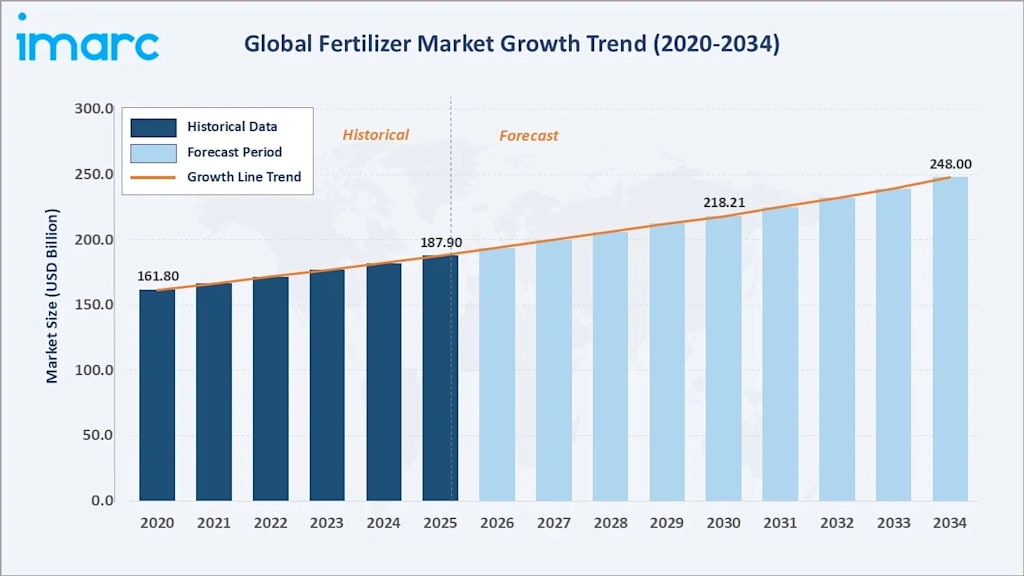
The global fertilizer industry is currently undergoing a phase of structural transformation, balancing the increasing demand for food production with a growing emphasis on sustainable agricultural practices. With the global population projected to approach 8.3 billion by late 2026, the need for efficient and high-yield farming systems continues to rise.
According to IMARC Group’s latest data, the global fertilizer market size was valued at USD 187.90 Billion in 2025. Looking forward, IMARC Group estimates the market to reach USD 248.00 Billion by 2034, exhibiting a CAGR of 3.04% during 2026–2034.
Fertilizers play a central role in maintaining agricultural productivity, particularly across more than 1.5 billion hectares of arable land globally. Nutrients such as nitrogen, phosphorus, and potassium remain essential for improving soil fertility and ensuring consistent crop yields. The market is primarily segmented into nitrogenous, phosphatic, and potassic fertilizers, with chemical-based products continuing to dominate, accounting for approximately 66.6% of total market share.
Fertilizer Market Growth Drivers:
- Escalating Global Food Security Demands
One of the primary drivers of the fertilizer market is the growing need to ensure global food security. With the world population increasing steadily, agricultural output is expected to rise significantly to meet future consumption needs. Estimates suggest that food production may need to increase by nearly 60% by mid-century.
However, the availability of arable land per capita continues to decline, requiring farmers to maximize productivity on existing farmland. Fertilizers play a crucial role in achieving this objective by enhancing soil nutrient levels and supporting higher crop yields.
In 2025, global urea demand exceeded 185 million metric tons, reflecting its importance in cultivating staple crops such as wheat and maize. Governments are also actively supporting fertilizer usage through subsidies and policy measures. For example, India allocated approximately INR 1.64 lakh crore (around USD 20 billion) toward fertilizer subsidies in the 2025–2026 fiscal year to maintain affordability and ensure stable agricultural output.
- Rapid Adoption of Precision Agriculture Technologies
Technological advancements are transforming fertilizer application methods. Traditional broad-based nutrient application is increasingly being replaced by precision agriculture techniques that focus on targeted and efficient use of inputs.
Modern systems incorporating artificial intelligence, soil sensors, and GPS-guided equipment allow farmers to apply fertilizers based on real-time soil conditions. These technologies help reduce waste while improving nutrient absorption efficiency. Research suggests that precision agriculture can enhance application efficiency by up to 7% and reduce fertilizer wastage by approximately 14% under optimized conditions.
The adoption of controlled-release and smart fertilizers is also contributing to this shift. These products provide nutrients gradually over time, ensuring sustained crop nourishment and reducing the frequency of application. As a result, farmers are able to manage input costs more effectively while maintaining productivity levels.
- Expanding Bio-Agrochemical and Organic Farming Initiatives
A significant trend within the fertilizer market is the increasing shift toward bio-based and organic solutions. Growing consumer demand for organic food products, along with stricter environmental regulations, is encouraging farmers to adopt sustainable soil management practices.
Bio-fertilizers, which include microbial and compost-based formulations, are being used to improve soil health and restore nutrient balance naturally. Governments and regulatory bodies, particularly in Europe and North America, are promoting soil conservation initiatives that support the use of non-synthetic fertilizers.
Although the bio-fertilizer segment currently represents a smaller share of the overall market, it is experiencing faster growth compared to conventional products. The expansion of certified organic farming globally is creating additional demand for these sustainable alternatives.
Fertilizer Market Trends:
- Decarbonization and the Rise of Green Ammonia
Environmental sustainability is becoming a major focus area for fertilizer manufacturers. Traditional ammonia production is energy-intensive and contributes significantly to greenhouse gas emissions. In response, the industry is shifting toward the production of green ammonia using renewable energy sources and green hydrogen.
This approach aims to reduce the carbon footprint associated with nitrogen fertilizer production. Several projects across Europe and Australia have already initiated commercial-scale production of green fertilizers. Industry efforts are targeting substantial emission reductions by 2030, supported by regulatory measures such as carbon pricing and border adjustment mechanisms.
- Shift Toward Liquid and Water-Soluble Fertilizers
Farmers are increasingly adopting liquid and water-soluble fertilizers due to their efficiency and ease of application. These formulations are particularly suitable for fertigation, a method in which nutrients are delivered through irrigation systems.
Water-soluble fertilizers allow uniform nutrient distribution and are commonly used in horticulture, greenhouse farming, and regions facing water scarcity. The global market for these products has reached approximately USD 18.3 billion, reflecting their growing adoption in modern agricultural practices.
Liquid fertilizers also enable better integration with crop protection products, making them a practical choice for large-scale farming operations. Their use is expanding in regions such as North America and the Middle East, where efficient resource utilization is a key priority.
Strategic Regionalization and Supply Chain Resilience
The fertilizer industry is also experiencing a shift toward regional production and supply chain diversification. Market disruptions in previous years highlighted the risks associated with dependence on limited export sources.
As a result, countries are investing in domestic production capabilities to improve supply stability. For instance, Brazil, which imported over 45 million metric tons of fertilizer in 2025, is expanding its local mining operations for potash and phosphate resources.
Additionally, adjustments in trade policies and tariff structures are helping stabilize fertilizer prices and improve accessibility for farmers. This trend toward regionalization is expected to enhance resilience against geopolitical uncertainties and energy price fluctuations.
Recent News and Developments:
- January 2026: A major potash producer in Canada completed a USD 1.2 billion mine expansion, increasing the global supply of Muriate of Potash to meet rising demand from agricultural markets.
- February 2026: Yara International introduced a low-carbon fertilizer product line utilizing advanced catalyst technology to significantly reduce emissions during production.
- March 2026: Indian Farmers Fertiliser Cooperative (IFFCO) expanded production capacity for nano urea, focusing on improving efficiency and reducing fertilizer usage intensity in agriculture.
Note: If you require specific details, data, or insights that are not currently included in the scope of this report, we are happy to accommodate your request. As part of our customization service, we will gather and provide the additional information you need, tailored to your specific requirements. Please let us know your exact needs, and we will ensure the report is updated accordingly to meet your expectations.
About the Creator
Andrew Sullivan
Hello, I’m Andrew Sullivan. I have over 9+ years of experience as a market research specialist.
Enjoyed the story? Support the Creator.
Subscribe for free to receive all their stories in your feed.
Comments
There are no comments for this story
Be the first to respond and start the conversation.