
Ferrochrome Market Accelerates Amid Industrial Modernization Trends
How strategic capacity expansions, mining investments, and supply chain modernization are strengthening ferrochrome availability and supporting global market development

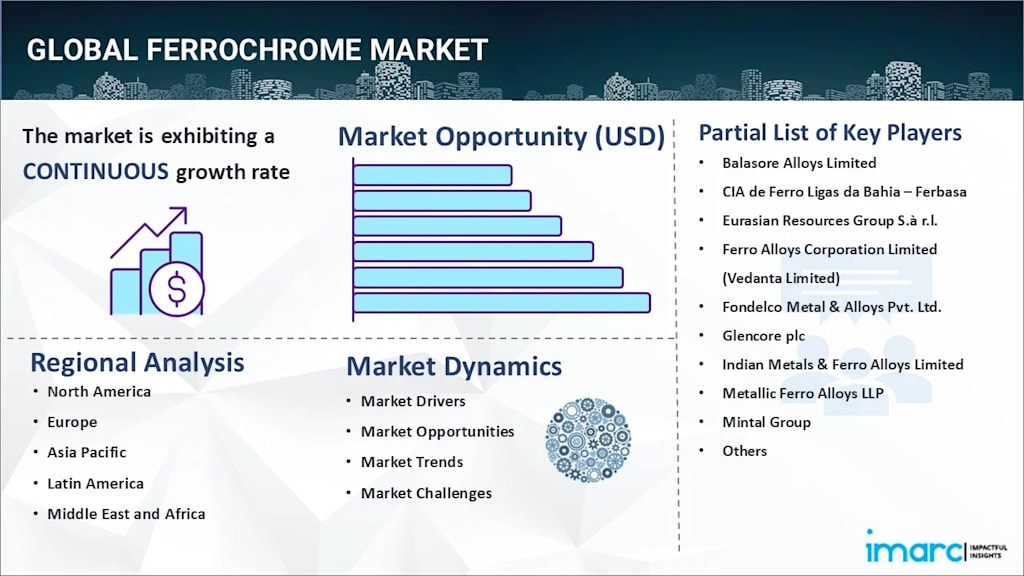
Growing demand for stainless steel across the construction, automotive, and heavy machinery industries drives the global ferrochrome market, supported by massive infrastructure investments, processing innovations, and strategic industrial supply frameworks. According to IMARC Group’s latest data, the global ferrochrome market size was valued at USD 20.57 Billion in 2025. Looking forward, IMARC Group estimates the market to reach USD 29.9 Billion by 2034, exhibiting a CAGR of 4.2% from 2026-2034.
Ferrochrome now represents a vital multi-billion-dollar segment within the global metallurgical and alloying industry, sustaining consistent year-on-year expansion. Fundamental market momentum stems from the non-substitutable nature of chromium in producing corrosion-resistant, heat-resistant, and high-strength stainless steel alloys. Ongoing developments in submerged electric arc furnace technologies, an increased focus on the recycling and valorization of industrial slags, and shifting geopolitical partnerships across mineral-rich nations are further accelerating sector dynamics. The primary market segments span across high-carbon, medium-carbon, and low-carbon ferrochrome variants, with global manufacturing entities prioritizing supply chain resilience, cost-effective energy access, and compliance with increasingly stringent carbon neutrality mandates.
Download the "Ferrochrome Market" Sample PDF for Strategic Insights
Ferrochrome Market Growth Drivers:
- Robust Expansion of Global Stainless Steel Production
Ferrochrome functions as the foundational raw material for virgin chromium units, which provide essential corrosion resistance and structural durability to steel alloys. Global production structures yield approximately 14 to 16 million metric tons of ferrochrome annually to keep pace with structural steel output, which continuously hovers around 1.8 to 1.9 billion tons per year worldwide. This sustained industrial consumption across heavy engineering, transport equipment, and civil infrastructure projects keeps merchant demand active. Smelting operations actively adapt processing lines to maintain reliable volume outputs for downstream stainless steel mills.
- Rising Infrastructure Development and Urbanization In Rapidly Growing Regions
Accelerated commercial construction and transport network modernization across emerging economies significantly pull structural alloys into the regional supply chains. Government-led structural investments and rapid industrialization necessitate vast quantities of high-performance metals capable of resisting weathering and mechanical stress over long deployment lifecycles. Metallurgical facilities rely heavily on stable logistics channels to feed regional projects with specialized high-carbon variants. This building boom establishes a permanent base of industrial consumption that directly underpins smelting activities and raw material trading patterns globally.
- Technological Shift Towards Processing Low-Grade and Fine Ore Residues
Modern engineering adaptations allow smelting operations to successfully beneficiate friable stratiform ores and lower-grade chromium fines that traditional furnaces historically discarded as waste. Rather than relying exclusively on depleting, premium podiform lumpy ores, advanced metallurgical complexes integrate agglomeration, preheating, and direct reduction techniques to expand material efficiency. These processing innovations effectively decouple manufacturing margins from the volatile availability of premium raw minerals. Consequently, producers maximize extraction yields while lowering general raw material costs per ton of finished alloy.
Ferrochrome Market Trends:
- Slag Recycling and Material Valorization Initiatives
Faced with stricter regional environmental supervision, metallurgical operations aggressively deploy structural vector autoregression models and specialized reclamation systems to recover trapped chromium elements directly from historical slag dumps and process dust. Instead of accumulating industrial liabilities in large surface dumps, companies treat technogenic wastes to re-introduce secondary units into active production loops. This transition supports circular economy goals within heavy industry while drastically mitigating regional dust emissions. Such industrial conservation measures maximize localized material efficiency without requiring a proportional increase in primary mining outputs.
- Operational Power Optimization and Carbon Footprint Reduction
Smelting operations implement centralized digital control frameworks and advanced furnace power automation to curb the intense electricity demands traditional submerged arc furnaces require. Because electrical power and reducing agents frequently combine to represent up to half of total manufacturing expenses, upgrading to intelligent grid systems drastically lowers overhead. Facilities increasingly test alternative carbon reductants alongside automated power tuning to lower greenhouse gas indicators per production run. These processing refinements help primary producers remain financially viable during localized energy crunches while aligning operations with national carbon-reduction goals.
- Geopolitical Consolidation and Market Realignment
The international trade landscape exhibits a strategic shift as mineral-rich nations move away from raw ore exports toward high-value localized smelting to safeguard national economic interests. Major processing operations increasingly cluster in areas offering competitive power structures and integrated resource reserves, transforming historical trade routes. Downstream entities continuously adjust their sourcing portfolios to manage regional price volatility on the spot market and mitigate supply vulnerabilities. This structural reorganization leads to long-term supply pacts, asset acquisitions, and joint ventures between resource hubs and consumer markets.
Recent News and Developments in Ferrochrome Market
- September 2025: A leading steel and mining corporation deployed an automated digital furnace control system across its primary production plants, aiming to optimize power consumption during high-carbon smelting operations and counter rising regional electricity rates.
- October 2025: A major industrial consortium announced the commissioning of an advanced slag treatment and recycling unit, engineered specifically to extract residual chromium from historical processing dumps and re-inject the recovered units directly back into the alloy manufacturing cycle.
- December 2025: A multi-national resources enterprise successfully renewed long-term mineral extraction supply agreements with regional steel mills, locking in predictable volumes of charge-grade materials to insulate downstream production from volatile merchant spot pricing.
Note: If you require specific details, data, or insights that are not currently included in the scope of this report, we are happy to accommodate your request. As part of our customization service, we will gather and provide the additional information you need, tailored to your specific requirements. Please let us know your exact needs, and we will ensure the report is updated accordingly to meet your expectations.
About the Creator
Andrew Sullivan
Hello, I’m Andrew Sullivan. I have over 9+ years of experience as a market research specialist.
Enjoyed the story? Support the Creator.
Subscribe for free to receive all their stories in your feed.
Comments
There are no comments for this story
Be the first to respond and start the conversation.