
Fast Food Market Outlook: Digital Ordering Trends and Growth Opportunities
The Fast Food Market is experiencing strong growth driven by rising consumer demand for quick, affordable, and convenient meal solutions.

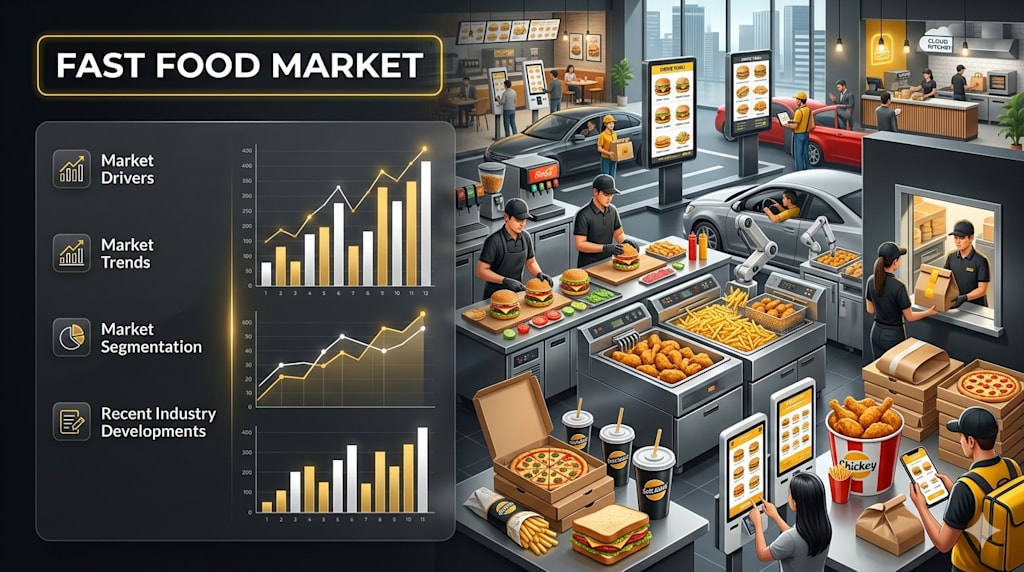
According to IMARC Group's latest research publication, The global fast food market size reached USD 939.0 Billion in 2025. Looking forward, the market is expected to reach USD 1,342.2 Billion by 2034, exhibiting a growth rate (CAGR) of 3.93% during 2026-2034.
How AI is Reshaping the Future of Fast Food Market
- AI-Powered Drive-Thru Voice Ordering: Leading chains are deploying AI voice systems at drive-thrus to handle orders, reducing wait times and improving accuracy. These systems interpret customer speech with background noise, enhance upselling, and address staffing challenges while boosting revenue generation.
- Predictive Ordering and Personalized Menu Recommendations: AI analyzes customer purchase history, preferences, and real-time factors like time of day to suggest personalized meals before orders are placed. This technology transforms apps and kiosks into personal assistants, increasing average transaction values and customer satisfaction.
- Smart Kitchen Operations and Predictive Maintenance: AI sensors monitor equipment like fryers and soft-serve machines to predict failures and alert employees before breakdowns occur. This reduces downtime, prevents waste, and ensures consistent service quality while optimizing energy consumption and operational efficiency.

Fast Food Industry Overview:
The fast food sector is experiencing remarkable transformation driven by digital innovation and changing consumer preferences. Major chains are investing heavily in technology partnerships, with companies like Yum! Brands collaborating with NVIDIA to roll out AI systems across 500 restaurants. McDonald's announced that all 43,000 stores worldwide would integrate AI by 2025, while chains are also adopting mobile ordering platforms that reduce customer time by 3.5 minutes per visit. The industry is balancing technological advancement with human connection, as voice AI systems now handle orders with higher friendliness ratings than traditional methods, though 22% still require employee intervention.
Fast Food Market Trends & Drivers:
The explosive growth of digital ordering and delivery platforms is fundamentally reshaping how consumers access fast food. Mobile ordering apps and third-party delivery services have become essential channels, with platforms enabling ghost kitchen expansion and distributed kitchen networks that reach secondary cities and underserved neighborhoods. Chains are implementing self-service kiosks that reduce lines while providing interactive ordering experiences, with digital systems utilizing machine learning to suggest complementary items and optimize bundle pricing. According to TD Bank's survey of restaurant operators, 42% identified AI and automation as having the greatest impact on the industry in 2025. This digital transformation allows fast food suppliers to serve broader geographic markets through delivery-only models with higher profit margins and greater location flexibility, effectively democratizing access to convenient meal options.
Strategic partnerships and limited-time collaborations are driving unprecedented customer engagement and brand loyalty across the fast food landscape. Chipotle's partnership with TEKKEN 8 offered in-game currency for digital orders and launched a themed Battle Bowl, while McDonald's Pokemon Happy Meal promotion featured exclusive trading cards that drove significant traffic. These creative marketing initiatives extend beyond food items, as demonstrated by Dunkin's collaboration with Urban Outfitters for a limited-edition capsule collection and Culver's partnership with Skittles for specialty frozen desserts. Industry leaders are also forming technology alliances, exemplified by CKE Restaurants Holdings' May 2023 partnership with Presto Automation, OpenCity, and Valyant AI to enhance drive-thru accuracy and speed. According to the National Centre for Health Statistics, 36.6% of adults consumed fast food on a given day between 2013-2016, with younger adults aged 20-39 showing the highest consumption at 44.9%, demonstrating sustained demand that benefits from these innovative engagement strategies.
The expansion of quick service restaurants and franchise business models continues to fuel market growth across diverse demographics and income segments. Fast food affordability appeals broadly, with NCHS data showing 31.7% of lower-income, 36.4% of middle-income, and 42% of higher-income adults eating fast food on a given day. Major chains are aggressively expanding their footprints, with Chipotle planning to nearly double its North American locations from 3,644 to 7,000 stores, opening 315-345 new restaurants in 2025 with 80% featuring order-ahead Chipotlanes. Papa John's International is opening 50 new restaurants by 2028 through strategic partnerships with franchisees, while Popeyes expanded from 500 international locations generating USD 300 million in annual sales in 2017 to nearly 1,300 locations with over USD 1 billion in systemwide sales, with same-store sales increasing 19.4% in Q2 2024. McDonald's operates as the largest chain by sales, followed by Starbucks, both benefiting from strong branding, efficient operations, localized menus, and prime real estate that drives consistent revenue growth and customer loyalty worldwide.
Leading Companies Operating in the Global Fast Food Industry:
- Auntie Anne's (Focus Brands LLC)
- Chipotle Mexican Grill Inc.
- CKE Restaurants Holdings Inc.
- Domino's
- Jack in the Box
- Little Caesar Enterprises Inc.
- McDonald's
- Papa John's International Inc.
- Restaurant Brands International Inc.
- Subway
- The Wendy's Company
- Yum! Brands Inc.
Fast Food Market Report Segmentation:
By Product Type:
- Pizza/Pasta
- Burger/Sandwich
- Chicken
- Asian/Latin American Food
- Seafood
- Others
Burger/sandwich represents the largest segment, as it features items made with buns or bread slices that are easy to hold while consuming and can be assembled and served quickly.
By End User:
- Food-Service Restaurants
- Quick Service Restaurants
- Caterings
- Others
Quick service restaurants hold the largest market share owing to their focused menu, efficient service model, and ability to provide rapid meal solutions for individuals and families seeking convenient dining options.
Regional Insights:
- North America (United States, Canada)
- Asia Pacific (China, Japan, India, South Korea, Australia, Indonesia, Others)
- Europe (Germany, France, United Kingdom, Italy, Spain, Russia, Others)
- Latin America (Brazil, Mexico, Others)
- Middle East and Africa
North America exhibits clear dominance in the fast food market due to strong fast food culture, high consumer spending power, widespread QSR presence, and the establishment of major chains like McDonald's with 350+ outlets and sophisticated franchise business models.
Recent News and Developments in Fast Food Market
- 2025: Yum! Brands announced a groundbreaking partnership with NVIDIA in March 2025 to implement AI-powered voice ordering systems at Taco Bell and Pizza Hut locations. The collaboration utilizes NVIDIA's advanced natural language processing tools to interpret customer speech, with plans to roll out these AI systems to 500 restaurants across its brands by Q2 2025.
- 2024: Chipotle Mexican Grill opened its first restaurant in Kuwait in partnership with Alshaya Group, marking its first entry into a new country in over a decade. The restaurant features a new design format and offers various in-restaurant ordering experiences to introduce its menu to new guests in the region.
- 2024: Papa John's International announced expansion of its North American footprint by opening 50 new restaurants by 2028 in collaboration with franchisee Nadeem Bajwa and The Bajco Group. This strategic partnership aims to broaden Papa John's presence in existing markets and accelerate growth through initiatives like the Back to Growth Program.
- May 2024: Burger King acquired Carrols Restaurant Group, its largest franchisee operating over 1,000 restaurants. This acquisition demonstrates the ongoing consolidation and vertical integration strategies within the fast food industry to enhance operational control and market presence.
- May 2023: CKE Restaurants Holdings forged partnerships with technology companies Presto Automation, OpenCity, and Valyant AI to enhance drive-thru operations. The collaboration implements AI technology like Presto Voice for automated voice ordering, improving accuracy, speed, and revenue generation while addressing staffing challenges nationwide.
Note: If you require specific details, data, or insights that are not currently included in the scope of this report, we are happy to accommodate your request. As part of our customization service, we will gather and provide the additional information you need, tailored to your specific requirements. Please let us know your exact needs, and we will ensure the report is updated accordingly to meet your expectations.
About the Creator
Michael Richard
Michael Richard is a Market Research Expert specializing in market intelligence, competitive analysis, and data-driven insights. He helps organizations understand trends and emerging opportunities through in-depth research.
Enjoyed the story? Support the Creator.
Subscribe for free to receive all their stories in your feed.
Comments
There are no comments for this story
Be the first to respond and start the conversation.