
Fall Protection Equipment Market Expands Rapidly Amid Automation
How industrial automation and smart worksite management are creating new opportunities for advanced fall protection equipment manufacturers

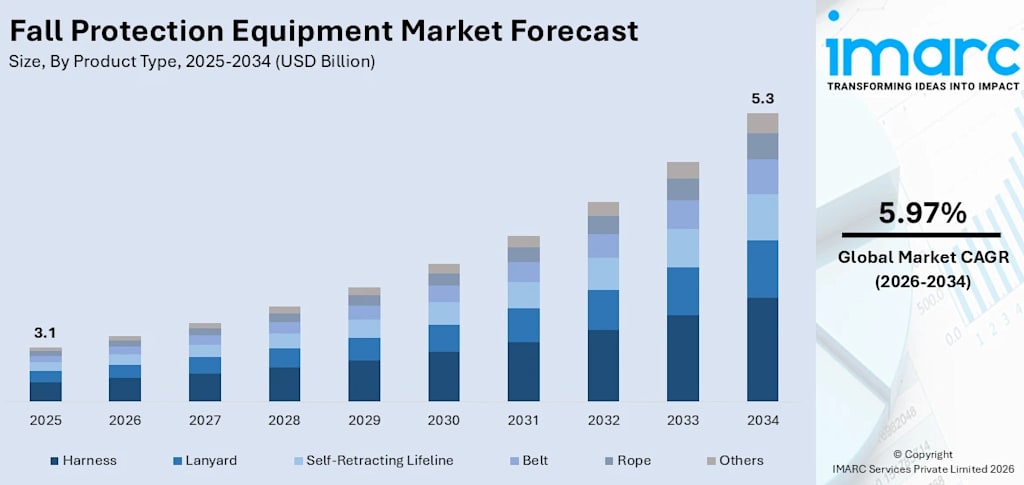
Strict occupational safety regulations, expanding infrastructure development, and a rising corporate focus on minimizing workplace hazards are driving the global demand for fall protection equipment. This growth is heavily supported by the enforcement of strict compliance standards by bodies like OSHA, continuous product innovations such as smart wearable safety gear, and rapid expansion in high-risk sectors including construction, telecom, and energy. According to IMARC Group’s latest data, the global fall protection equipment market size was valued at USD 3.1 Billion in 2025. Looking forward, IMARC Group estimates the market to reach USD 5.3 Billion by 2034, exhibiting a CAGR of 5.97% from 2026-2034.
Fall protection equipment represents a highly critical multi-billion-dollar segment within the personal protective equipment industry, showing consistent year-on-year expansion. The market is fueled by heightened safety awareness among employers and strict regulatory frameworks globally aimed at preventing injuries from elevated work zones. Increased infrastructure spending, telecom tower maintenance, and growth in onshore and offshore oil and gas exploration are further accelerating the deployment of these safety systems.
Get Your Copy of the "Fall Protection Equipment Market" Sample Research
Fall Protection Equipment Market Growth Drivers:
- Enforcement of Stringent Workplace Safety Mandates
Regulatory bodies worldwide are imposing rigorous compliance rules to eliminate preventable injuries on industrial job sites. For instance, the United States Occupational Safety and Health Administration frequently conducts targeted inspections, penalizing organizations that fail to implement secure fall arrest systems. This regulatory pressure forces employers to purchase certified gear like full-body harnesses and heavy-duty anchorage connectors. Industrial data confirms that prioritizing certified safety systems drastically lowers corporate liability and insurance premium costs, prompting multi-national construction firms to adopt comprehensive, standardized safety protocols for all high-altitude activities.
- Rapid Infrastructure Expansion and High-Rise Construction
Global urbanization has sparked a significant increase in high-rise residential and commercial buildings, bridges, and massive public transport networks. Working on elevated scaffolding, steep rooftops, and open structural edges inherently elevates safety risks for laborers. According to recent infrastructure development data, construction applications generate the largest share of industrial safety equipment revenue. Real-world applications see large-scale builders investing heavily in overhead lifelines and robust safety netting.
- Technological Evolution and Integrated Smart Safety Gear
The integration of digital technology into personal protective equipment has transformed basic safety hardware into intelligent risk management tools. Manufacturers are developing next-generation connected harnesses featuring built-in sensors that transmit data to cloud platforms. These smart systems monitor safety status in real time and automatically send cellular alerts to on-site supervisors during an accidental descent. Industrial tech funding data shows billions of dollars flowing into construction technology over recent periods, pushing companies to replace traditional, static lanyards with advanced self-retracting lifelines that react faster to sudden movements.
Fall Protection Equipment Market Trends:
- Market Consolidation for Comprehensive Safety Portfolios
Leading manufacturers are actively pursuing mergers and acquisitions to expand their distribution networks and provide comprehensive personal protective equipment packages. This trend helps companies offer bundled safety packages, simplifying procurement for large corporate buyers. For example, major safety firm KARAM Safety completed the acquisition of Midas Safety India, a prominent developer of industrial hand protection items. This strategic move directly allowed them to combine high-performance hand protection with their existing fall arrest inventory, streamlining global supply lines and meeting the rising corporate preference for single-source safety providers.
- Rising Demand for Self-Retracting Lifelines over Standard Lanyards
Industrial sites are experiencing a distinct shift toward self-retracting lifelines due to their superior mobility and quicker lock-on capability compared to traditional shock-absorbing ropes. These systems operate similarly to a seatbelt, allowing workers to move freely during routine operations but locking instantly if a sudden drop occurs. This mechanism minimizes the necessary free-fall distance, significantly reducing physical impact forces on the body. Job site safety trials demonstrate that these mechanisms heavily reduce tripping hazards on crowded platforms, making them the preferred choice for modern maintenance crews.
- Growth in Engineered Systems and Custom Anchor Points
Rather than relying solely on portable gear, facility managers are focusing on permanent, engineered fallback systems tailored to specific architectural layouts. This includes installing rigid rail systems and horizontal lifelines along factory roofs, airplane hangars, and train maintenance facilities. In early 2025, safety solutions provider SureWerx announced the acquisition of Reliance Fall Protection, adding highly engineered hardware like Skyloc II and specialized protective shields to its corporate catalog.
Recent News and Developments in Fall Protection Equipment Market
- March 2025: SureWerx successfully finalized the strategic acquisition of Reliance Fall Protection, absorbing premium engineered product lines like Skyloc II and MicroLoc to significantly expand its technical safety portfolio and distribution capabilities across heavy industrial sectors.
- October 2024: FallTech officially introduced AXIS, a digitally advanced fall protection architecture featuring built-in precision load monitoring and cloud-integrated data systems to streamline safety compliance tracking and provide proactive field risk management.
- May 2024: KARAM Safety completed a milestone acquisition of Midas Safety India, combining its prominent personal fall arrest manufacturing capabilities with a diverse industrial hand protection catalog to address growing customer demands for single-source safety procurement.
Note: If you require specific details, data, or insights that are not currently included in the scope of this report, we are happy to accommodate your request. As part of our customization service, we will gather and provide the additional information you need, tailored to your specific requirements. Please let us know your exact needs, and we will ensure the report is updated accordingly to meet your expectations.
About the Creator
Andrew Sullivan
Hello, I’m Andrew Sullivan. I have over 9+ years of experience as a market research specialist.
Enjoyed the story? Support the Creator.
Subscribe for free to receive all their stories in your feed.
Comments
There are no comments for this story
Be the first to respond and start the conversation.