
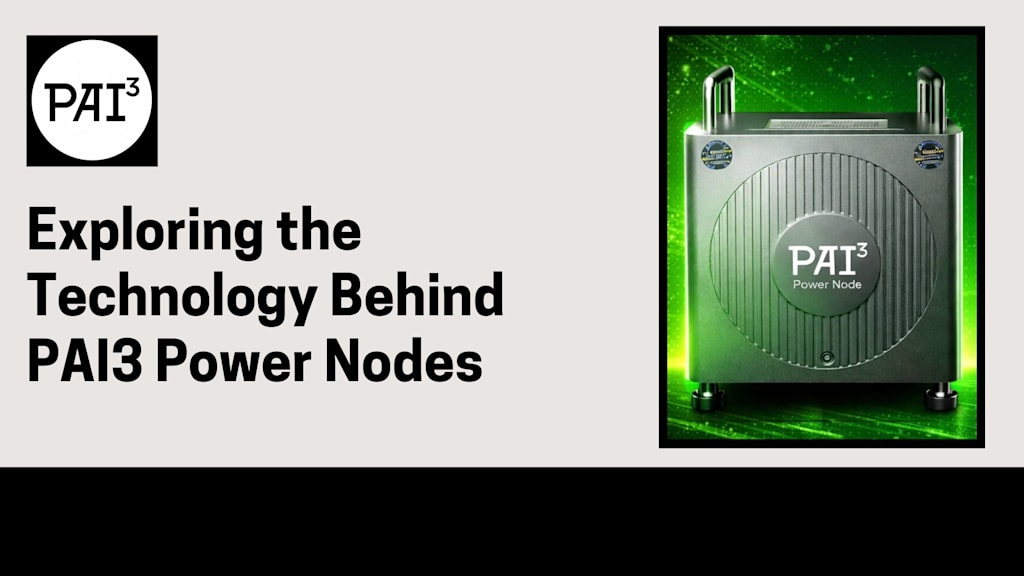
Exploring the Technology Behind PAI3 Power Nodes
Discover how PAI3 Power Nodes use decentralized computing to support scalable, accessible, and efficient AI infrastructure.
Artificial intelligence (AI) is becoming an important part of everyday life. Businesses use AI to improve customer service, automate tasks, analyze data, and make better decisions. As AI continues to grow, it needs powerful computing systems to support it.
Many AI platforms rely on large, centralized data centers. While these systems can be effective, they are often expensive and can limit access to advanced AI tools. PAI3 is taking a different approach by building a decentralized AI network. At the center of this network are PAI3 Power Nodes.
Power Nodes help provide the computing resources needed to support AI services across the network. By sharing resources through a decentralized system, PAI3 aims to make AI more accessible, scalable, and affordable for everyone.
What Are PAI3 Power Nodes?
PAI3 Power Nodes are computing units that help run the PAI3 network. They contribute processing power and resources that can be used for AI-related tasks.
Instead of depending on one central location to handle all AI operations, PAI3 uses multiple Power Nodes connected through a decentralized network. This allows resources to be shared more efficiently and helps the platform grow as demand increases.
Simply put, Power Nodes are an important part of the technology that helps keep the PAI3 ecosystem running.
How Do PAI3 Power Nodes Work?
Distributed Computing
One of the main technologies behind Power Nodes is distributed computing.
In a traditional system, most computing tasks are handled by a central server. With distributed computing, tasks can be shared across many different nodes in the network.
This approach offers several benefits:
- Better use of available resources
- Improved performance
- Easier network growth
- Greater reliability
By spreading workloads across multiple nodes, PAI3 can support more users and applications.
Resource Sharing
AI applications often require a large amount of computing power. Power Nodes help meet this demand by allowing resources to be shared across the network.
When AI tasks need processing, the network can use available resources from different nodes. This helps improve efficiency and reduces pressure on any single part of the system.
Supporting AI Services
Power Nodes help support a variety of AI activities, including:
- Data processing
- AI model operations
- Resource management
- Network support functions
As AI technology continues to develop, having access to reliable computing resources becomes increasingly important.
Key Benefits of PAI3 Power Nodes
Better Scalability
One of the biggest advantages of Power Nodes is scalability.
As more people join the network and contribute resources, the overall computing capacity can increase. This allows the platform to support growing demand without relying only on large centralized facilities.
Greater Accessibility
Many businesses and developers struggle to access advanced AI tools because of high costs and limited infrastructure.
PAI3 aims to make AI more accessible by creating a network where resources can be shared. This can help more people benefit from AI technology.
Improved Reliability
Centralized systems can face problems if a single server experiences issues or downtime.
Because PAI3 uses multiple Power Nodes, the network can continue operating even if one node becomes unavailable. This helps improve overall reliability.
Why Decentralized AI Infrastructure Matters
Growing Demand for AI
AI is being used in more industries every year. Businesses, developers, and organizations are looking for new ways to use AI to improve productivity and create better experiences.
As demand increases, so does the need for computing power.
Decentralized infrastructure offers a practical way to support this growth while making resources available to more users.
Encouraging Participation
One of the strengths of decentralized networks is that they allow more people to contribute.
Power Nodes give individuals and organizations an opportunity to become part of the infrastructure that supports AI services. This creates a more collaborative and connected ecosystem.
Supporting Innovation
Access to computing resources plays a major role in AI development.
By providing a shared network of resources, PAI3 helps create opportunities for developers, startups, and businesses to explore new AI applications and ideas.
Features of PAI3 Power Nodes
Efficient Resource Management
Power Nodes help distribute computing tasks across the network, making better use of available resources.
Decentralized Network Structure
The network operates through multiple connected nodes rather than relying on one central system.
Flexible Growth
As more Power Nodes join the ecosystem, the network can expand its capabilities and support additional users.
Community-Driven Ecosystem
The platform encourages participation from users who contribute resources and help strengthen the network.
The Future of PAI3 Power Nodes
The future of AI depends on having enough computing power to support new technologies and growing demand.
PAI3 Power Nodes are designed to help meet this challenge by creating a decentralized infrastructure that can grow over time. As more people and organizations adopt AI, distributed networks may become an important part of supporting innovation.
By combining AI with decentralized technology, PAI3 is working toward a future where advanced AI resources are available to a wider audience.
Frequently Asked Questions (FAQs)
What are PAI3 Power Nodes?
PAI3 Power Nodes are computing units that provide resources and processing power to support the PAI3 network.
How do Power Nodes help AI services?
They help process tasks, manage resources, and support the infrastructure needed for AI operations.
Why is decentralized infrastructure important?
It helps improve scalability, reliability, and accessibility by distributing resources across multiple nodes instead of relying on a single central system.
Who can benefit from PAI3 Power Nodes?
Developers, businesses, researchers, and organizations looking for AI computing resources can benefit from the network.
How does the network grow?
As more Power Nodes join and contribute resources, the network gains additional computing capacity and can support more users.
Conclusion
AI is becoming a key part of the digital world, and the need for powerful computing infrastructure continues to grow. PAI3 Power Nodes provide a decentralized way to support AI services by sharing resources across a connected network.
With benefits such as scalability, accessibility, and reliability, Power Nodes play an important role in the PAI3 ecosystem. As AI technology continues to evolve, decentralized solutions like PAI3 Power Nodes may help create a more open, efficient, and accessible future for artificial intelligence.
About the Creator
Enjoyed the story? Support the Creator.
Subscribe for free to receive all their stories in your feed.
Comments
There are no comments for this story
Be the first to respond and start the conversation.