
Europe Vending Machine Market Is Evolving Into a Smart, Cashless Retail Channel
Driven by convenience, automation, and changing consumer habits, Europe’s vending machine industry is moving beyond snacks and drinks into a more connected, health-focused, and data-driven retail model.

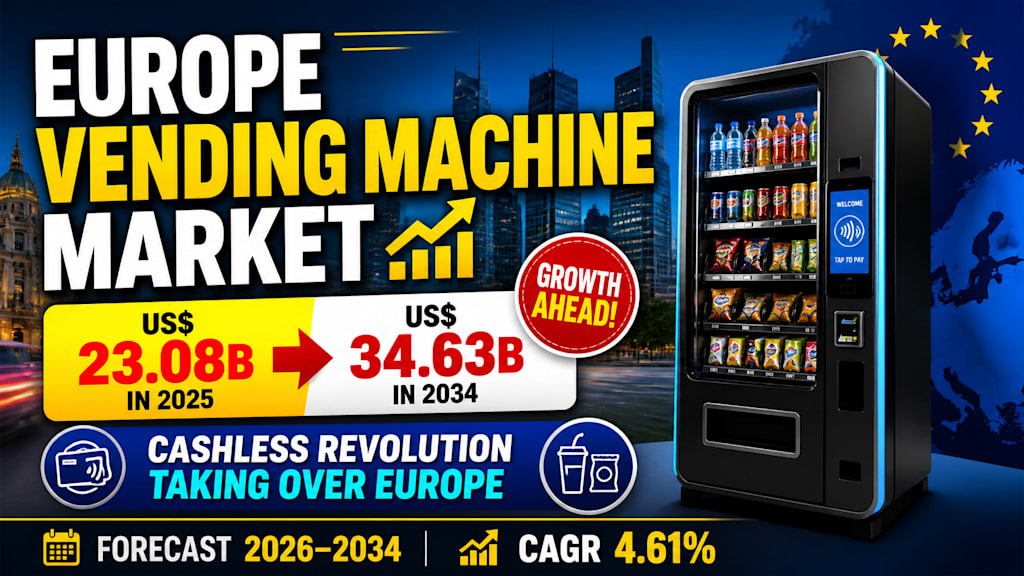
The Europe vending machine market is entering a new phase of growth, shaped by convenience-led consumer behavior, digital payment adoption, and the steady expansion of automated retail across workplaces, transport hubs, hospitals, schools, and public spaces. According to Renub Research, the market is projected to rise from US$ 23.08 billion in 2025 to US$ 34.63 billion by 2034, registering a CAGR of 4.61% from 2026 to 2034. That forecast reflects a market that is no longer limited to chips, cold drinks, and coin slots. It is becoming a smarter, more flexible, and more responsive retail ecosystem.
At the heart of this growth is a simple reality: modern life is moving faster, and consumers want access to food, beverages, and essentials without waiting in line or adjusting their schedules. Vending machines answer that demand with 24/7 availability, compact footprints, and increasingly seamless payment options. In Europe, where commuting, urban density, and workplace mobility are all shaping daily routines, automated retail is finding a stronger and more durable role than ever before.

Why the Europe Vending Machine Market Is Growing
One of the biggest forces behind the market’s expansion is the rise in demand for convenience and on-the-go consumption. In busy cities, at transport hubs, and inside offices or hospitals, vending machines provide immediate access to snacks, drinks, and ready-to-eat options without the cost and labor demands of a staffed retail counter. They are especially attractive in high-footfall locations where speed matters and where consumers expect service to be available around the clock. The market’s appeal is strengthened by the fact that vending machines take up less space and operate with lower labor requirements than conventional retail formats.
This convenience factor is not just about saving time. It is also about matching modern lifestyles. European consumers are increasingly balancing work, travel, family, and urban commuting, which makes “grab-and-go” retail more relevant. The market’s adoption across offices, schools, hospitals, transport junctions, and public areas shows how vending has moved from being a minor utility to a practical part of everyday consumption.
A second major growth driver is the adoption of smart and cashless vending technologies. Today’s vending machines are no longer simple mechanical dispensers. Many now feature touchscreen interfaces, remote monitoring, real-time inventory tracking, and support for debit cards, contactless cards, mobile wallets, and QR-based payments. These upgrades improve speed, reduce downtime, and lower operational inefficiencies by allowing operators to monitor stock and consumer behavior more effectively.
That digital shift is important because it makes vending more reliable for both operators and users. Operators benefit from data-driven restocking and predictive maintenance, while consumers benefit from quicker, cleaner, and more intuitive transactions. In many ways, smart vending machines are becoming micro-retail hubs rather than simple product dispensers.
Another important trend is product diversification. Europe’s vending landscape is expanding beyond traditional packaged snacks and soft drinks to include healthier and higher-value items such as fruit, salad, protein bars, specialty coffee, fresh food, and low-sugar beverages. In some cases, vending machines are also being used for non-food products such as personal care items, electronics, and medical supplies. This diversification is helping the market stay relevant in a consumer environment that increasingly values wellness, convenience, and variety.
Smart Vending Is Redefining the Category
The rise of the smart vending machine segment is one of the clearest signs that this market is evolving rather than simply growing. Smart vending solutions bring together digital payments, IoT connectivity, remote diagnostics, dynamic pricing, and personalized product suggestions. They can also support digital advertising and help operators understand what sells best by location, time of day, or consumer profile.
This matters because vending operators now want more than volume. They want efficiency. They want to reduce waste, optimize inventory, and increase the chance that the right product is in the right machine at the right time. Smart vending technology makes that possible by turning each machine into a source of operational insight. In a market where margins matter, that kind of control can be a major advantage.
Smart vending is also benefiting from the broader shift toward digital infrastructure in Europe. As cashless payments become more common and consumers become more comfortable with contactless transactions, the barriers to adoption continue to fall. For many users, tapping a card or phone is now easier than carrying coins or searching for cash. That convenience is helping smart vending gain momentum in airports, offices, rail stations, and other high-traffic environments.
Public Places and Offices Remain Core Growth Areas
Public place vending machines remain one of the most important application areas in Europe because they provide round-the-clock access to essentials in spaces with heavy foot traffic. These machines need to be fast, reliable, secure, and flexible enough to handle different product mixes. The market here is expanding as cities become more mobile and consumers expect immediate access to drinks, snacks, and even non-food items. Healthy snacks, hot beverages, and fresh options are becoming more common in these machines as consumer expectations change.
Office vending is another strong category. Employers increasingly view food and beverage access as part of the employee experience, not just a side benefit. Machines offering coffee, snacks, and light meals help support productivity and convenience during work hours. The shift toward hybrid work has changed office patterns, but it has not reduced the need for workplace convenience. Instead, it has encouraged flexible, scalable vending models that can be adjusted to different staffing levels and usage patterns.
In offices, there is also a growing preference for healthier product assortments and better-quality coffee. Operators are responding by tailoring product selection to employee preferences and using cashless systems and mobile apps to improve the user experience. As a result, office vending is increasingly viewed as a modern amenity rather than a basic service.
Cashless Payment Is Transforming the User Experience
Cashless payment is one of the strongest practical enablers of market growth. Cards, contactless payments, and mobile wallets make vending faster and more hygienic while also reducing the inconvenience of carrying coins or dealing with cash-only systems. In busy public and workplace environments, that speed can make a real difference in usage rates.
The shift toward cashless vending also supports better security and easier operations. Less cash handling means fewer collection risks, lower theft exposure, and fewer logistical burdens for operators. At the same time, users get a more streamlined experience. Europe’s broader digital payment ecosystem is helping to accelerate that transition, and many vending operators are now choosing hybrid systems that support both cash and cashless payments to maximize accessibility.
That hybrid approach is important because cash has not disappeared. It still matters in rural areas, among older consumers, and in places where connectivity is inconsistent. Machines that accept both cash and digital payments are better positioned to serve a wider audience and reduce the risk of excluding certain users. Even so, cashless usage is clearly becoming the dominant direction of travel across the region.
Key Challenges Still Shape the Market
Despite the positive outlook, the Europe vending machine market faces several meaningful challenges. High initial investment remains one of the biggest barriers, particularly for smart vending systems. Traditional machines are cheaper to install, but smart units come with added costs for hardware, software, connectivity, maintenance, and repairs. For smaller operators, those expenses can make expansion difficult unless sales volumes are strong enough to justify the investment.
Maintenance and vandalism are also concerns. Advanced machines can deliver better performance and data, but they also introduce more points of failure. If they are not properly managed, the benefits of automation can be undermined by repair costs or service interruptions. That is why operators increasingly need stronger service networks and better asset monitoring.
Regulatory complexity is another issue. Food safety, labeling, nutritional rules, hygiene standards, and temperature-control requirements differ across European countries. That makes it harder to scale one standardized operating model across multiple markets. Location constraints also matter, because the best sites are often competitive, tightly regulated, or subject to licensing limitations. In some settings, product restrictions may also apply, particularly in schools or public institutions.
Country-Level Trends Reveal a Diverse Market
France stands out for its strong coffee culture, dense urban environment, and broad use of vending machines in workplaces, transit locations, universities, and hospitals. The French market is increasingly influenced by smart interfaces, cashless options, and a growing appetite for healthy snacks and fresh food. Sustainability is also becoming more important, with attention shifting toward energy efficiency and recyclable packaging.
Germany’s market benefits from its manufacturing strength, large office-based workforce, and emphasis on efficiency. Vending machines are common in corporate offices, industrial sites, transport hubs, and educational centers. German operators are focusing on durability, quality, and temperature performance, while also adopting remote monitoring and analytics to improve replenishment and service.
The United Kingdom is seeing strong demand from corporate, healthcare, transport, and education settings. Cashless and contactless payments are particularly well established, and consumer interest in healthy snacks, fresh food, and premium coffee is supporting machine upgrades. The shift toward flexible and hybrid working is also influencing how office vending is deployed and managed.
The Bigger Story: Vending Is Becoming Micro-Retail
What makes the Europe vending machine market especially interesting is that it is no longer a static category. It is becoming a form of micro-retail that combines convenience, data, automation, and personalization. The machines are smarter, the product mix is broader, and the payment experience is easier. As a result, vending is no longer confined to impulse purchases. It is increasingly part of everyday retail behavior.
This shift is likely to continue as consumers demand faster access, healthier choices, and more flexible shopping options. Meanwhile, operators will keep investing in smart technologies that improve efficiency and profitability. The market’s future will likely depend on how well companies balance convenience with compliance, and innovation with practical cost control.
Final Thoughts
The Europe vending machine market is on a steady upward path, supported by a powerful mix of convenience demand, digital payment adoption, workplace automation, and product innovation. Its forecast growth from US$ 23.08 billion in 2025 to US$ 34.63 billion by 2034 shows that the sector has moved well beyond its old image of coin-operated snack boxes. It is now a modern retail channel that reflects how Europeans shop, work, commute, and consume on the move.
At the same time, the market’s success will depend on how well it handles the practical challenges of cost, maintenance, and regulatory compliance. Companies that can deliver smarter machines, stronger service, healthier assortments, and seamless payment experiences are likely to capture the next wave of growth. In a fast-moving retail world, vending is proving that convenience still has a very strong business case.
About the Creator
Enjoyed the story? Support the Creator.
Subscribe for free to receive all their stories in your feed.
Comments
There are no comments for this story
Be the first to respond and start the conversation.