
Europe SEO Market Set to Surge as Businesses Race for Digital Visibility
From multilingual search strategies to e-commerce expansion, Europe’s SEO industry is entering a new era of growth

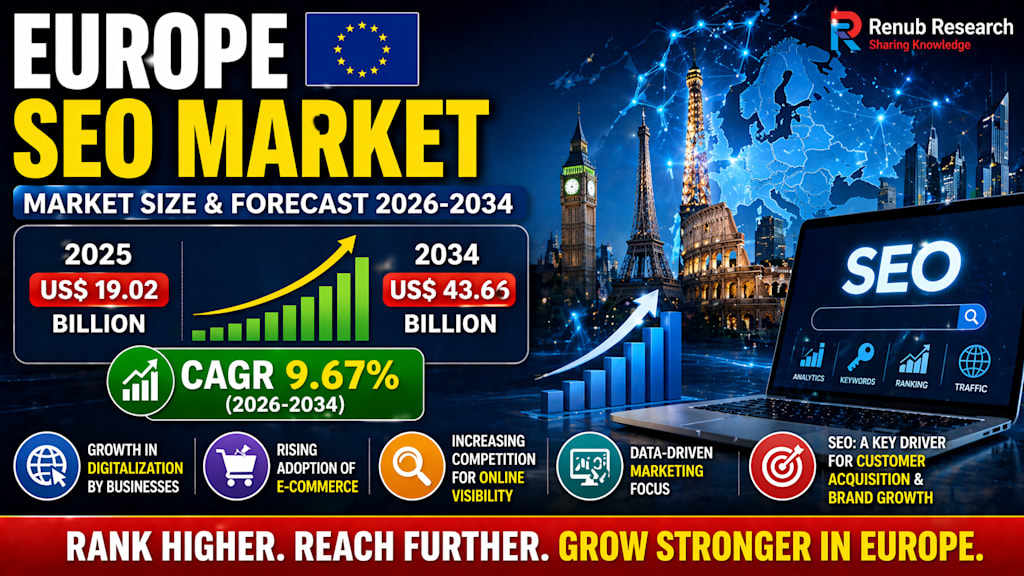
Europe’s digital economy is expanding rapidly, and with it comes an equally strong demand for Search Engine Optimization (SEO). Once viewed as an optional marketing tactic, SEO has now become one of the most essential growth tools for businesses looking to compete online. Whether it is a hotel in Paris, a software company in Berlin, or an online retailer in London, brands across Europe are investing heavily in search visibility.
According to Renub Research, the Europe SEO Market is projected to grow from US$ 19.02 Billion in 2025 to US$ 43.66 Billion by 2034, expanding at a robust CAGR of 9.67% from 2026 to 2034. This impressive forecast reflects how critical SEO has become in customer acquisition, online trust-building, and long-term digital success.
Why SEO Matters More Than Ever
SEO is the process of improving a website’s ranking on search engine results pages. It involves technical performance, keyword optimization, content quality, mobile usability, backlinks, structured data, and user experience.
Unlike paid ads, SEO offers sustainable traffic over time. Businesses that rank well organically often enjoy higher trust, lower customer acquisition costs, and consistent inbound leads.
Across Europe, consumer behavior has changed dramatically. People now rely on search engines to compare prices, read reviews, discover local businesses, book travel, and research services before making decisions. This shift has made SEO a strategic necessity rather than a luxury.

Digital Transformation Is Fueling Growth
One of the biggest drivers behind the Europe SEO market is rapid digitalization across industries.
Retailers are building e-commerce platforms. Banks are improving digital onboarding. Healthcare providers are expanding telehealth visibility. Education companies are promoting online learning platforms. Even traditional sectors such as manufacturing and logistics are competing for B2B search traffic.
As more businesses move online, competition for search rankings intensifies. Companies understand that if they do not appear on the first page of search results, competitors likely will.
The rise of mobile browsing has accelerated this further. Consumers search on smartphones for nearby services, quick purchases, and immediate information. Businesses need optimized websites that load quickly and provide smooth mobile experiences.
This combination of digitization and mobile behavior is creating long-term momentum for SEO agencies, consultants, and in-house marketing teams across Europe.
The Multilingual Advantage of Europe
Europe is one of the most linguistically diverse markets in the world. That creates a unique SEO opportunity—and challenge.
A brand expanding across Europe may need optimized content in French, German, Spanish, Italian, Dutch, Polish, and more. Each country has its own search habits, buying preferences, and cultural expectations.
A direct translation is rarely enough. Businesses increasingly require localized keyword research, region-specific landing pages, culturally relevant content, and country-based link-building strategies.
This has made multilingual SEO one of the fastest-growing specialties in the region. Agencies capable of delivering localization at scale are finding major opportunities.
User Experience Is Now Part of SEO
Modern SEO is no longer just about keywords.
Search engines now reward websites that offer better user experiences. This includes:
- Faster page load speed
- Mobile-friendly design
- Secure browsing (HTTPS)
- Easy navigation
- Accessible layouts
- Helpful and original content
- Clear site structure
European businesses are paying closer attention to these ranking factors, especially as privacy regulations and customer expectations rise.
Consumers want trustworthy digital experiences. If a site is slow, cluttered, or difficult to navigate, users leave quickly—and rankings often suffer.
That is why technical SEO services, UX optimization, and Core Web Vitals improvements are becoming major revenue streams within the Europe SEO market.
E-Commerce Brands Are Leading the Spend
Europe’s e-commerce ecosystem is a major contributor to SEO demand.
Online stores compete intensely for product searches, comparison keywords, category rankings, and review-based traffic. Every click matters, especially when advertising costs rise.
SEO helps retailers reduce dependence on paid ads by generating organic visitors consistently.
Successful e-commerce SEO strategies often include:
- Optimized product descriptions
- Structured product data
- Fast category pages
- Internal linking systems
- Image optimization
- Customer review content
- Localized pricing and language pages
With sustainability-focused shopping also increasing in Europe, many consumers research products carefully before purchasing. This creates more opportunities for informational SEO content such as guides, comparisons, and reviews.
Hospitality and Travel Need Search Visibility
Europe remains one of the world’s most visited travel destinations, making SEO especially valuable for hotels, travel agencies, resorts, and tour operators.
Travel businesses rely on search traffic for:
- Hotel bookings
- City guides
- Seasonal travel deals
- Restaurant discovery
- Experience packages
- Local tourism searches
Many companies now invest in multilingual travel content, city-specific landing pages, and mobile-first SEO because tourists often search while traveling.
SEO also helps hotels reduce reliance on third-party booking platforms that charge high commissions. Direct booking through organic traffic can significantly improve profit margins.
Country Spotlight: France, Germany, United Kingdom
France
France’s SEO market is growing as businesses in retail, food, finance, and services compete for online visibility. French consumers value clarity, trust, and locally relevant information. This increases demand for ethical, user-focused SEO strategies.
Germany
Germany’s advanced economy and strong privacy culture make technical SEO especially important. Businesses value accurate content, structured data, and transparent digital practices. B2B sectors such as manufacturing and healthcare are strong SEO adopters.
United Kingdom
The UK remains one of Europe’s most mature SEO markets. With fierce online competition across finance, property, education, and media, businesses aggressively invest in search performance. London also leads local SEO competition due to dense commercial activity.
Challenges Facing the Market
Despite strong growth, Europe’s SEO industry faces several hurdles.
Constant Algorithm Changes
Search engines frequently update ranking systems. Businesses must adapt quickly or risk losing traffic overnight.
Rising Competition
As more brands invest in SEO, top rankings become harder to secure. Competitive industries may require larger budgets and long-term commitment.
Skills Gap
Advanced SEO now requires expertise in analytics, content strategy, coding, UX, localization, and AI tools. Many smaller businesses struggle to build in-house capability.
Cost Pressure
Professional SEO services—especially technical audits and high-quality content production—can be expensive for SMEs.
AI Is Changing the Future of SEO
Artificial intelligence is transforming how SEO campaigns are built.
Marketers now use AI for:
- Keyword clustering
- Content ideation
- Search intent analysis
- Competitive research
- Automation of routine audits
- Predictive performance modeling
However, AI-generated content alone is not enough. Search engines still prioritize quality, authority, originality, and user value.
The future belongs to brands combining AI efficiency with human expertise.
Final Thoughts
The Europe SEO market is no longer a niche segment of digital marketing—it is now a core engine of business growth.
With Renub Research forecasting expansion from US$ 19.02 Billion in 2025 to US$ 43.66 Billion by 2034, the message is clear: companies that invest in search visibility today are positioning themselves for tomorrow’s digital economy.
From multilingual commerce to travel bookings, from B2B lead generation to local search discovery, SEO continues to shape how Europe buys, sells, and connects online.
About the Creator
Enjoyed the story? Support the Creator.
Subscribe for free to receive all their stories in your feed.
Comments
There are no comments for this story
Be the first to respond and start the conversation.