
Europe's Professional Coffee Machine Market Is Brewing a New Era of Growth
Rising café culture, premium coffee demand, and smart brewing technology are transforming Europe's professional coffee machine industry through 2034.

Walk through almost any major European city and one thing becomes immediately clear: coffee is more than just a beverage. It is a ritual, a social experience, and for many people, an essential part of daily life.
From the historic espresso bars of Italy to the trendy specialty cafés of London, Paris, and Berlin, coffee culture continues to shape consumer habits across the continent. As expectations for premium coffee experiences rise, businesses are investing heavily in professional coffee equipment capable of delivering consistency, speed, and quality.
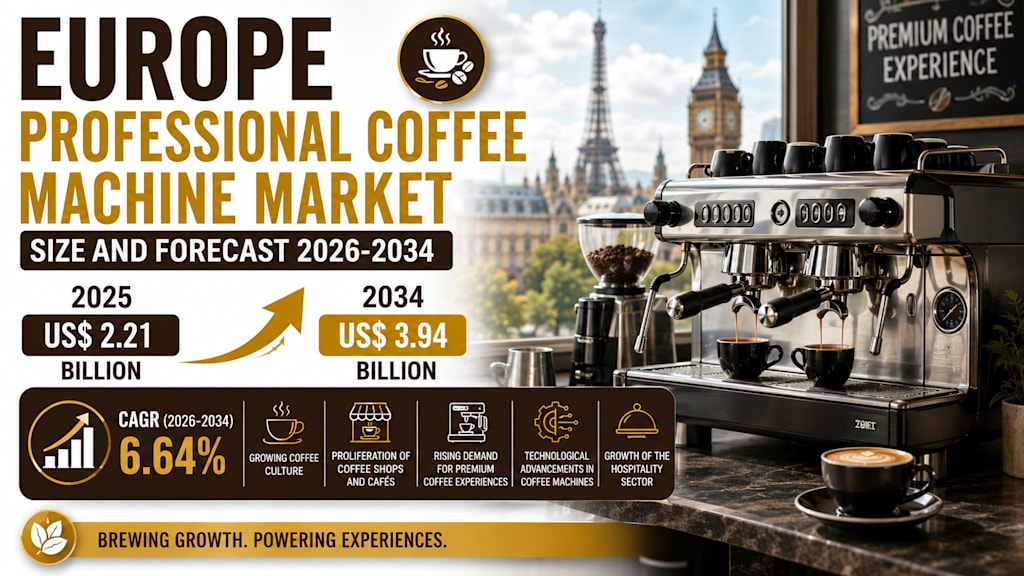
This growing demand is creating significant opportunities for manufacturers, hospitality operators, and coffee service providers. According to Renub Research, the Europe Professional Coffee Machine Market is projected to grow from US$2.21 billion in 2025 to US$3.94 billion by 2034, expanding at a compound annual growth rate (CAGR) of 6.64% between 2026 and 2034.
The numbers reflect more than simple equipment sales. They reveal a broader transformation taking place within Europe's coffee ecosystem—one driven by changing consumer expectations, technological innovation, and the evolution of hospitality experiences.

Coffee Is Deeply Embedded in European Culture
Europe has long been recognized as one of the world's most influential coffee-consuming regions. Coffee shops, cafés, bakeries, restaurants, and hotels have historically played important social and cultural roles throughout European society.
For generations, cafés have served as gathering places where people meet friends, conduct business discussions, read newspapers, or simply enjoy a moment of relaxation. While these traditions remain strong, modern coffee culture is evolving rapidly.
Consumers today are increasingly knowledgeable about coffee origins, brewing methods, roasting techniques, and beverage customization. They expect café-quality drinks that combine flavor, presentation, and consistency.
As a result, businesses are under pressure to deliver premium coffee experiences that meet these heightened expectations.
Professional coffee machines have become a critical tool in achieving this goal. Unlike standard home coffee makers, commercial-grade equipment is designed for high-volume usage while maintaining precise control over brewing variables such as pressure, temperature, extraction time, and milk preparation.
The growing emphasis on quality is encouraging cafés, restaurants, hotels, and offices to invest in increasingly sophisticated coffee equipment.
Specialty Coffee Is Reshaping Consumer Expectations
One of the strongest forces driving market growth is the rise of specialty coffee.
Across Europe, consumers are moving beyond basic coffee consumption and embracing premium beverages crafted with greater attention to quality and detail. Espresso-based drinks, artisanal blends, single-origin coffees, and customized beverages have become increasingly popular among coffee enthusiasts.
This trend has fueled the expansion of specialty coffee shops throughout the region.
Independent cafés and premium coffee chains are competing not only on taste but also on the overall customer experience. Every cup served represents an opportunity to strengthen customer loyalty and build brand reputation.
Professional coffee machines enable businesses to maintain consistency while producing high-quality drinks efficiently. Precision brewing systems help baristas achieve desired extraction levels, ensuring that each beverage meets customer expectations.
As specialty coffee culture continues to spread across Europe, demand for advanced brewing equipment is expected to remain strong.
The Hospitality Industry Is Driving Equipment Investments
Europe's hospitality sector plays a major role in supporting demand for professional coffee machines.
Hotels, restaurants, bakeries, catering services, and quick-service restaurants increasingly view coffee as a key component of the customer experience. In many establishments, coffee is no longer treated as a secondary menu item. Instead, it has become an important contributor to customer satisfaction and revenue generation.
Travelers today expect high-quality coffee whether they are staying in luxury hotels, dining in restaurants, or visiting conference venues. Businesses that fail to meet these expectations risk losing customers to competitors offering superior beverage experiences.
As tourism continues to recover and expand across Europe, hospitality operators are investing in equipment that allows them to serve premium coffee quickly and consistently.
Many hotels now offer professional coffee stations in restaurants, lounges, meeting spaces, and guest rooms. Automated systems help ensure reliable service while reducing labor requirements.
The growing integration of premium coffee services throughout hospitality environments is creating sustained demand for professional coffee equipment across the region.
Technology Is Transforming the Coffee Experience
Modern coffee machines bear little resemblance to the traditional brewing equipment of previous decades.
Today's professional machines incorporate sophisticated technologies that improve performance, consistency, efficiency, and ease of use.
Automation represents one of the industry's most significant developments. Fully automatic and super-automatic machines simplify coffee preparation while maintaining high quality standards. These systems can grind beans, extract espresso, froth milk, and prepare specialty beverages with minimal operator intervention.
For businesses facing labor shortages or high staff turnover, automated systems provide an effective solution for maintaining service quality.
Connectivity is another important innovation.
Many modern coffee machines now feature digital monitoring capabilities that allow operators to track performance, schedule maintenance, monitor usage patterns, and identify potential issues before they affect operations.
Smart technologies are helping businesses reduce downtime, improve efficiency, and optimize equipment performance.
Energy efficiency is also becoming a major purchasing consideration. Rising energy costs and sustainability objectives are encouraging businesses to invest in machines designed to reduce electricity consumption without compromising beverage quality.
As manufacturers continue introducing new technologies, professional coffee machines are becoming increasingly intelligent, efficient, and user-friendly.
Espresso Machines Continue to Lead the Market
Among all professional coffee equipment categories, espresso machines remain the most influential segment.
Espresso serves as the foundation for many of Europe's most popular coffee beverages, including cappuccinos, lattes, macchiatos, and flat whites. As a result, espresso machines play a central role in commercial coffee operations.
Countries such as Italy, France, and Spain maintain particularly strong espresso traditions. In these markets, consumers often have exceptionally high standards regarding coffee preparation and taste.
Professional espresso machines offer precise control over pressure, temperature, and extraction, enabling operators to produce consistent results throughout the day.
Manufacturers continue enhancing espresso equipment with features such as programmable settings, automated milk frothing systems, touch-screen interfaces, and advanced brewing controls.
These innovations help businesses deliver premium coffee experiences while improving operational efficiency.
As demand for specialty beverages grows, espresso machines are expected to remain a dominant force within the professional coffee machine market.
Filter Coffee Machines Maintain Their Relevance
Although espresso-based drinks receive much of the attention, filter coffee machines continue to play an important role throughout Europe.
Hotels, offices, conference centers, cafeterias, and large-scale catering operations often require equipment capable of producing substantial volumes of coffee quickly and efficiently.
Filter coffee machines meet these needs by offering simplicity, reliability, and cost-effectiveness.
Many organizations rely on filter coffee systems to serve employees, guests, and customers throughout the day. These machines are particularly valuable in environments where speed and convenience are essential.
Manufacturers have introduced modern features such as programmable timers, improved temperature controls, and energy-saving technologies that enhance performance while reducing operating costs.
As workplace coffee consumption remains strong across Europe, filter coffee machines are likely to maintain a stable position within the broader market.
Hotels Are Redefining Coffee Service Standards
The hotel sector has become one of the most important end-user segments for professional coffee machines.
Hospitality providers increasingly recognize that coffee quality can significantly influence guest satisfaction. From breakfast service to room amenities, coffee plays a larger role in shaping guest perceptions than many operators once realized.
Luxury and premium hotels are particularly focused on elevating beverage experiences.
In-room coffee machines have become standard features in many properties, while restaurants and lounges increasingly utilize professional-grade brewing equipment to serve specialty beverages.
Automated and super-automatic systems are especially attractive for hotels because they enable consistent service across multiple locations while minimizing staff training requirements.
As competition within the hospitality sector intensifies, investment in professional coffee equipment is expected to remain a strategic priority.
Restaurants Are Embracing Premium Coffee Offerings
Restaurants throughout Europe are also investing more heavily in coffee services.
Historically, many restaurants viewed coffee as a simple after-dinner beverage. Today, however, coffee is increasingly considered an extension of the overall dining experience.
Customers often evaluate restaurants based on the quality of their beverages as much as their food.
Professional coffee machines allow restaurants to offer a wider variety of drinks, including espresso, cappuccino, latte, and specialty beverages. High-quality coffee can increase customer satisfaction, encourage repeat visits, and create additional revenue opportunities.
Both fine-dining establishments and casual dining operators are upgrading equipment to improve beverage quality and operational efficiency.
This shift is helping expand the addressable market for professional coffee machine manufacturers.
Country Spotlight: France
France remains one of Europe's most important coffee markets.
Coffee consumption is deeply woven into French culture, with cafés and bistros serving as central gathering places in cities and towns throughout the country.
The rise of specialty coffee shops and premium beverage experiences is encouraging businesses to invest in advanced brewing equipment capable of meeting evolving consumer expectations.
The hospitality sector also contributes significantly to market growth, particularly as tourism remains an important component of the French economy.
As coffee culture continues evolving, demand for innovative and high-performance coffee machines is expected to remain strong.
Country Spotlight: United Kingdom
The United Kingdom has experienced remarkable growth in coffee consumption over the past decade.
Major cities have witnessed a significant increase in coffee shops, specialty cafés, and international coffee chains. Consumers increasingly seek premium espresso-based beverages, creating demand for professional coffee equipment across commercial settings.
Hotels, restaurants, offices, and cafés all contribute to equipment sales within the UK market.
Technological innovation, including automated brewing systems and smart connectivity features, is further supporting market expansion.
The UK's vibrant coffee culture positions it as one of Europe's most dynamic professional coffee machine markets.
Country Spotlight: Germany
Germany represents another key growth market due to its high coffee consumption levels and strong manufacturing capabilities.
Coffee remains one of the country's most popular beverages, supporting demand across both commercial and residential segments.
German businesses are increasingly adopting fully automatic and super-automatic machines that combine convenience with performance.
The country's reputation for engineering excellence has also contributed to the development of technologically advanced coffee equipment.
As businesses continue prioritizing quality, efficiency, and automation, Germany is expected to remain a major contributor to European market growth.
Challenges Facing the Industry
Despite positive growth prospects, the industry faces several challenges.
One major concern is the high cost of professional equipment. Advanced coffee machines often require substantial upfront investments, making them difficult for smaller businesses and independent operators to afford.
Maintenance costs, repairs, cleaning requirements, and staff training can further increase total ownership expenses.
Market saturation also presents challenges.
Europe's coffee industry is highly developed, with intense competition among equipment manufacturers. Many companies offer similar products and features, making differentiation increasingly difficult.
To remain competitive, manufacturers must continue investing in innovation, reliability, customer support, and sustainability initiatives.
Final Thoughts
Europe's professional coffee machine market is entering an exciting period of growth and transformation.
Consumers are demanding higher-quality coffee experiences, businesses are embracing advanced technologies, and hospitality operators are investing heavily in premium beverage solutions. Together, these trends are reshaping the industry's future.
With the market expected to grow from US$2.21 billion in 2025 to US$3.94 billion by 2034, professional coffee machines are becoming far more than commercial equipment. They are enabling businesses to meet evolving customer expectations while supporting one of Europe's most cherished cultural traditions.
As specialty coffee continues to flourish and innovation accelerates, the professional coffee machine industry will remain at the heart of Europe's thriving coffee culture for years to come.
About the Creator
Enjoyed the story? Support the Creator.
Subscribe for free to receive all their stories in your feed.
Comments
There are no comments for this story
Be the first to respond and start the conversation.