
Europe Game-based Learning Market Set for Explosive Growth as Digital Education Reshapes Classrooms and Workplaces
Interactive learning, AI-powered training, and immersive technologies are transforming Europe’s education landscape through game-based learning solutions.

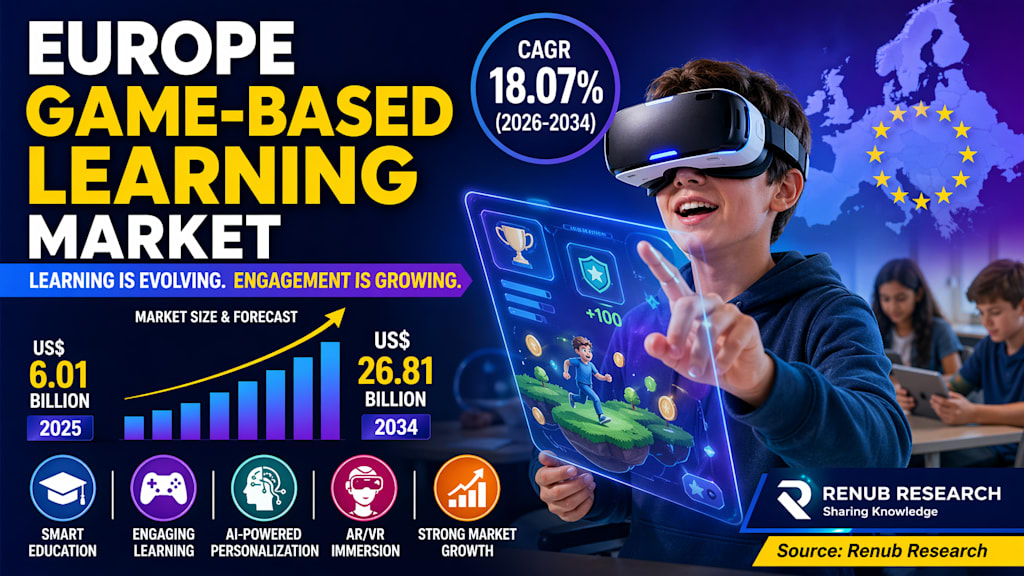
The future of education in Europe is becoming more interactive, engaging, and results-driven. Traditional classrooms and static training modules are steadily giving way to smarter, more dynamic learning experiences powered by digital games, simulations, and immersive platforms. According to the latest market insights, the Europe Game-based Learning Market is expected to grow from US$ 6.01 Billion in 2025 to US$ 26.81 Billion by 2034, expanding at a strong CAGR of 18.07% from 2026 to 2034.
This remarkable rise highlights a major shift in how students, employees, and organizations across Europe are approaching skill development, education delivery, and long-term learning strategies.
What Is Game-based Learning?
Game-based learning (GBL) refers to using games, simulations, challenges, and interactive mechanics to teach knowledge, practical skills, or behavioral outcomes. Unlike passive lectures or textbook-based methods, GBL encourages active participation through storytelling, rewards, competition, critical thinking, and real-time feedback.
This model is now being widely used in:
- Primary and secondary schools
- Universities and higher education institutions
- Corporate employee training
- Healthcare learning environments
- Government skill programs
- Vocational and technical education
By blending education with engagement, game-based learning improves retention, increases motivation, and helps learners apply concepts in real-world scenarios.
Why Europe Is Leading the Shift
Europe has become one of the most promising markets for game-based learning due to strong digital infrastructure, education reform, and growing demand for lifelong learning.
Across the continent, governments and institutions are investing heavily in:
- Smart classrooms
- E-learning platforms
- Tablets and connected devices
- Learning management systems
- AI-based education tools
- Remote and hybrid training models
As a result, schools and businesses are seeking modern learning tools that can improve outcomes while keeping learners interested.
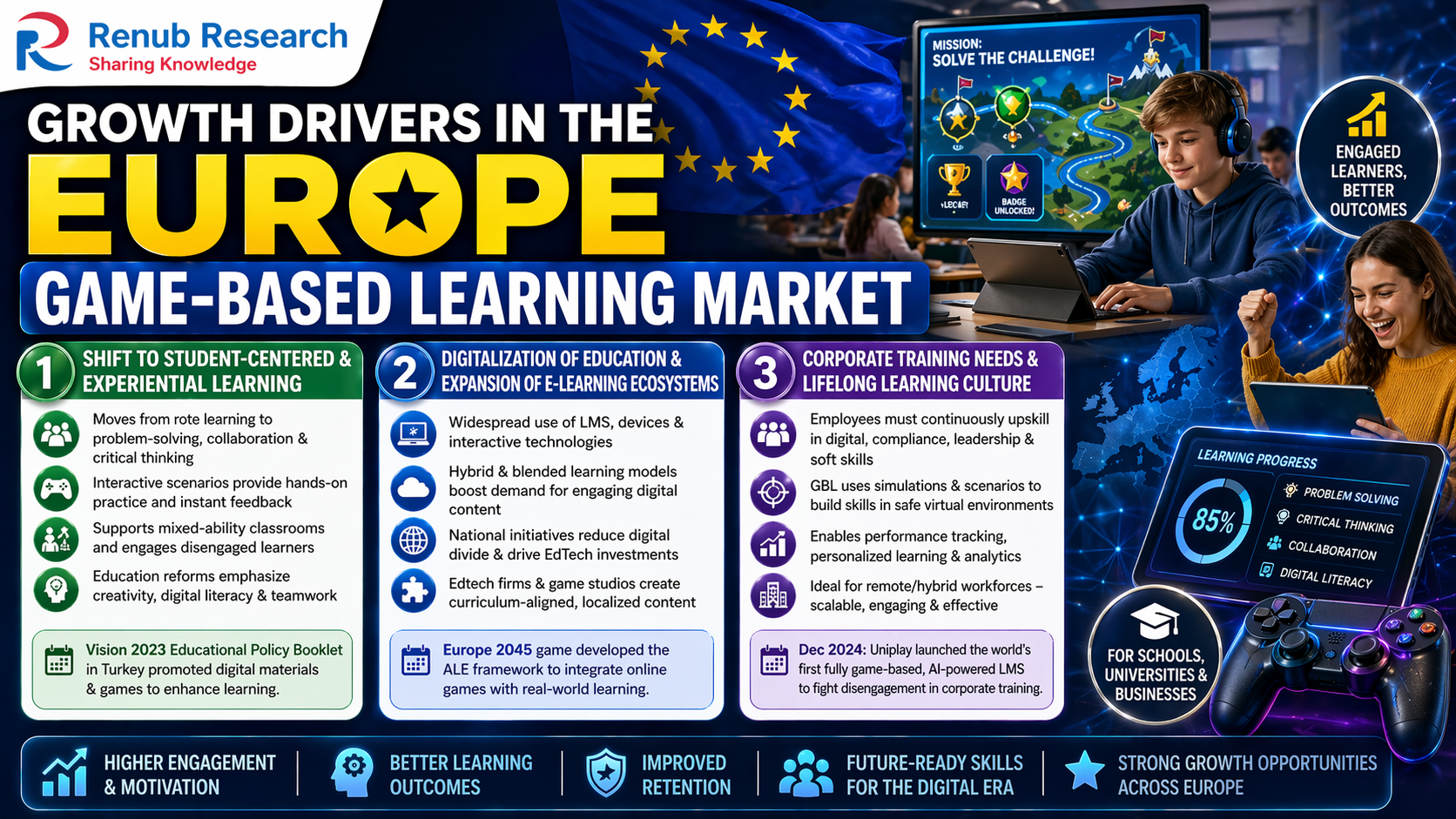
Major Growth Driver: Student-Centered Education
One of the biggest reasons for market growth is Europe’s move away from rote memorization toward learner-focused education.
Modern educators increasingly emphasize:
- Problem-solving
- Creativity
- Collaboration
- Communication skills
- Critical thinking
- Digital literacy
Game-based learning naturally supports these goals by placing learners in interactive environments where they make decisions, solve challenges, and receive immediate feedback.
This is particularly valuable in classrooms with mixed learning abilities, where personalized learning pathways can make a meaningful difference.
E-Learning Expansion Is Fueling Demand
Europe’s growing e-learning ecosystem is another major catalyst.
Universities, schools, and training centers increasingly rely on blended learning models that combine physical instruction with digital access. In this environment, game-based learning provides a perfect bridge between entertainment and education.
Online platforms now offer:
- Achievement badges
- Leaderboards
- Quizzes and missions
- Multiplayer collaboration
- Personalized progress tracking
- Self-paced learning modules
These tools help maintain learner motivation beyond classroom hours, making education more flexible and accessible.
Corporate Europe Is Embracing Game-Based Training
The market is not limited to students. Businesses across Europe are rapidly adopting game-based learning for employee development.
Traditional corporate training methods often struggle with engagement. Slide decks and static manuals rarely create lasting behavioral change. Game-based training, however, allows employees to learn through scenarios, simulations, and role-based challenges.
Popular corporate use cases include:
- Cybersecurity awareness
- Leadership training
- Compliance education
- Customer service development
- Sales training
- Soft skills coaching
Industries such as finance, healthcare, logistics, manufacturing, and public services are increasingly investing in these solutions.
AI Is Revolutionizing Learning Experiences
Artificial Intelligence is becoming one of the most exciting segments within Europe’s game-based learning market.
AI-powered platforms can analyze user behavior and adapt lessons in real time. If a learner struggles, the system can simplify tasks or offer hints. Advanced learners can receive more difficult missions and deeper challenges.
Benefits of AI-powered learning include:
- Personalized learning paths
- Real-time feedback
- Smarter recommendations
- Better progress analytics
- Automated assessments
- Improved retention rates
This makes learning more efficient for both students and organizations.
AR and VR Creating Immersive Classrooms
Augmented Reality (AR) and Virtual Reality (VR) are opening new frontiers for game-based learning.
Students can now:
- Explore ancient civilizations virtually
- Conduct science experiments in digital labs
- Practice surgery simulations
- Train for industrial safety scenarios
- Learn engineering through 3D models
These immersive technologies make difficult or dangerous concepts safer, clearer, and more engaging.
As hardware prices continue to fall, AR and VR adoption is expected to rise sharply across Europe.
Country Spotlight: Key Markets in Europe
France
France benefits from a strong public education system and increasing investments in digital tools. Schools and universities are adopting serious games for mathematics, languages, and history.
United Kingdom
The UK has one of Europe’s most dynamic game-based learning ecosystems, supported by strong edtech startups, world-class universities, and a leading gaming industry.
Germany
Germany’s focus on vocational education, engineering, and apprenticeships makes it an ideal market for simulations and technical training games.
Other Emerging Markets
Countries such as Spain, Italy, Netherlands, Poland, Norway, Portugal, and Belgium are also expanding digital education adoption rapidly.
Challenges Still Exist
Despite strong momentum, the market faces some hurdles.
Budget Limitations
Not all institutions can afford devices, licenses, or fast internet access. Rural and smaller schools may struggle with implementation costs.
Teacher Readiness
Many educators need training to integrate game-based learning effectively into lesson plans.
Curriculum Alignment
Some learning games lack strong academic depth or alignment with national standards, slowing wider adoption.
Still, these are solvable challenges, and ongoing public-private investment is helping reduce barriers.
Future Outlook: Education Will Never Be the Same
The next decade could redefine how Europe learns.
As AI, cloud platforms, mobile access, AR/VR, and analytics continue to mature, game-based learning is moving from experimental pilot programs into mainstream education and workforce development.
By 2034, game-based learning may become a standard part of:
- Every school classroom
- University programs
- Employee onboarding systems
- Vocational skill training
- Government reskilling programs
Europe’s strong digital vision positions it perfectly for this transformation.
Final Thoughts
The Europe Game-based Learning Market is not just growing—it is reshaping the meaning of education itself. Learners today expect engagement, personalization, and measurable progress. Institutions want better outcomes, scalability, and cost efficiency.
With the market projected to rise from US$ 6.01 Billion in 2025 to US$ 26.81 Billion in 2034, the message is clear: learning through play is becoming serious business.
About the Creator
Enjoyed the story? Support the Creator.
Subscribe for free to receive all their stories in your feed.
Comments
There are no comments for this story
Be the first to respond and start the conversation.