
Europe Food Safety Testing Market to Reach US$ 11.32 Billion by 2034 as Regulatory Compliance and Consumer Demand for Safe Food Accelerate Industry Growth
Rising contamination concerns, advanced food testing technologies, and strict European food safety regulations are transforming the Europe food safety testing industry

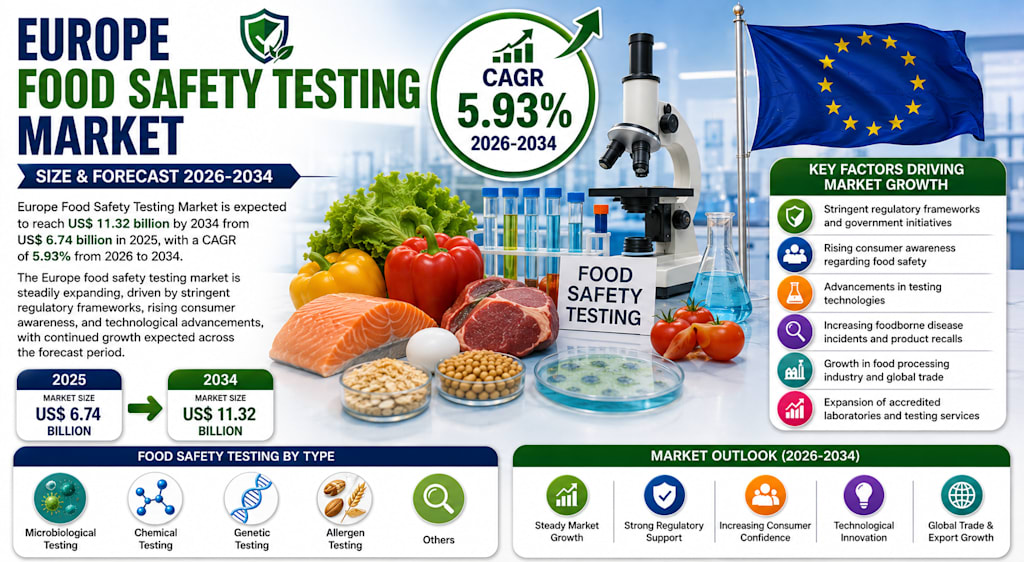
The Europe food safety testing market is expected to witness strong and sustained growth over the coming decade as governments, food manufacturers, and consumers increasingly prioritize food quality, contamination prevention, and regulatory compliance. According to Renub Research, the Europe food safety testing market is projected to grow from US$ 6.74 billion in 2025 to US$ 11.32 billion by 2034, registering a CAGR of 5.93% from 2026 to 2034. Strict regulatory frameworks, rising consumer awareness regarding food safety, and continuous advancements in testing technologies are among the major factors driving market growth across Europe.
The Europe food safety testing industry plays a critical role in ensuring that food products meet strict quality and safety standards before reaching consumers. The market includes a broad range of testing services such as microbiological analysis, allergen detection, GMO testing, chemical testing, residue analysis, and pathogen screening.
As global food supply chains become increasingly complex and interconnected, Europe remains one of the most tightly regulated food markets in the world. Food manufacturers, distributors, and processors are required to comply with extensive regulations covering food contamination, ingredient composition, labeling standards, and product traceability.
These factors continue creating strong long-term demand for accurate, reliable, and technologically advanced food safety testing solutions across the European market.
Strict Regulatory Frameworks Continue Driving Market Expansion
One of the strongest growth drivers for the Europe food safety testing market is the region’s highly stringent regulatory environment.
European regulatory authorities enforce comprehensive food safety standards requiring manufacturers and suppliers to conduct continuous testing and quality monitoring in order to ensure product safety and compliance. These regulations cover a wide range of food safety concerns including microbial contamination, pesticide residues, allergens, chemical contaminants, and ingredient authenticity.
Food companies operating within Europe must maintain strict compliance with regulatory guidelines in order to avoid penalties, product recalls, reputational damage, and restrictions on market access.
The report highlights that harmonized food safety regulations across European countries continue strengthening demand for testing services because food producers must comply with consistent standards across international trade networks.
Additionally, frequent updates to regulatory policies require businesses to continuously improve monitoring and testing procedures.
This highly regulated environment ensures strong demand for sophisticated food safety testing services throughout the forecast period.
Rising Consumer Awareness Is Increasing Demand for Transparency
Consumer awareness regarding food quality and foodborne health risks is significantly influencing the Europe food safety testing market.
Modern consumers increasingly expect safe, transparent, and contamination-free food products. Greater awareness regarding food poisoning, allergens, chemical contamination, and ingredient sourcing has encouraged consumers to scrutinize food quality more closely than ever before.
Consumers across Europe increasingly prefer:
- Organic foods
- Clean-label products
- Minimally processed foods
- Transparent ingredient sourcing
- Certified quality products
This shift in consumer expectations is forcing food manufacturers to invest heavily in rigorous testing systems and quality assurance procedures.
The report highlights that food producers increasingly adopt advanced testing processes not only to ensure compliance but also to maintain consumer trust and protect brand reputation.
Demand for transparency has become especially strong among younger and health-conscious consumers who expect detailed information regarding food ingredients, origins, and production practices.
As consumer expectations continue evolving, food safety testing remains essential for maintaining confidence across the European food industry.
Technological Advancements Are Transforming Food Safety Testing
Technological innovation is rapidly reshaping the Europe food safety testing industry by improving speed, efficiency, and analytical precision.
Modern testing technologies such as rapid diagnostic systems, automated laboratory equipment, and advanced analytical tools are significantly improving contamination detection capabilities while reducing turnaround times.
Laboratories increasingly implement advanced technologies including:
- Polymerase Chain Reaction (PCR)
- Chromatography systems
- Spectrometry analysis
- Immunoassay-based testing
- Automated detection systems
- Digital traceability tools
These technologies allow laboratories to detect contaminants more accurately and efficiently while supporting regulatory compliance requirements.
The report highlights that integration of digital data management systems and supply-chain traceability solutions is also improving food monitoring processes across Europe.
Technological advancements additionally help laboratories manage increasing testing volumes resulting from growing food trade activities and expanding processed food consumption.
As food safety risks become more complex, technological innovation will remain one of the most important growth drivers for the industry.
Pathogen Testing Continues Dominating the Market
Pathogen testing remains one of the largest and most important segments within the Europe food safety testing market.
Foodborne pathogens such as Salmonella, E. coli, and Listeria continue posing serious health risks and can result in costly product recalls and reputational damage for food manufacturers.
As a result, pathogen testing is widely conducted across multiple food categories including:
- Meat and poultry
- Dairy products
- Fruits and vegetables
- Processed foods
- Pet food
- Animal feed
The report highlights growing demand for rapid pathogen detection technologies capable of delivering faster and more accurate contamination analysis.
PCR technologies and advanced molecular diagnostic tools are increasingly helping laboratories improve testing efficiency while strengthening public health protection.
Pathogen testing is expected to remain a major revenue-generating segment throughout the forecast period.
Pesticide and Residue Testing Demand Is Growing Rapidly
The Europe pesticide and residue testing market continues expanding steadily because consumers and regulators increasingly prioritize chemical safety and environmental sustainability.
Agricultural products may contain pesticide residues, veterinary drugs, heavy metals, and industrial contaminants that create potential health concerns. European food safety authorities therefore require strict monitoring and compliance across agricultural and processed food products.
Residue testing has become particularly important across:
- Fruits and vegetables
- Dairy products
- Crops
- Meat products
- Processed foods
Consumers increasingly associate residue-free foods with healthier lifestyles and premium-quality products.
The report highlights that rising demand for organic and clean-label food products is further strengthening the importance of pesticide and residue testing services across Europe.
GMO and Allergen Testing Continue Gaining Importance
The Europe GMO and allergen testing market is also witnessing strong growth because of strict labeling regulations and increasing consumer sensitivity regarding food ingredients.
Consumers increasingly expect transparency regarding genetically modified ingredients and allergenic substances present in food products.
Food manufacturers must therefore conduct specialized testing to ensure accurate labeling and prevent accidental contamination.
Allergen testing remains especially important because even small traces of allergenic ingredients can create serious health risks for sensitive consumers.
The report highlights that rising consumption of specialty foods, gluten-free products, and organic products is increasing demand for advanced allergen and GMO testing technologies.
As dietary preferences become increasingly specialized, these testing segments are expected to experience continued long-term growth.
Processed and Packaged Foods Are Supporting Market Growth
The rapid growth of processed and packaged food consumption across Europe continues supporting demand for food safety testing services.
Consumers increasingly rely on ready-to-eat meals, convenience foods, frozen products, and packaged snacks because of changing lifestyles and urbanization trends.
These products require extensive testing throughout production and distribution stages to ensure food quality and contamination prevention.
The report highlights that increasingly complex food supply chains and rising international food trade activities are also strengthening the need for comprehensive testing solutions.
As processed food demand continues expanding across Europe, food safety testing providers are expected to experience stronger long-term market opportunities.
High Operational Costs Remain a Major Industry Challenge
Despite strong market growth prospects, the Europe food safety testing industry faces several operational challenges.
One of the most significant issues is the high cost associated with establishing and maintaining advanced testing laboratories.
Testing providers must invest heavily in:
- Sophisticated laboratory infrastructure
- Advanced analytical equipment
- Skilled scientific personnel
- Compliance certification
- Staff training
- Digital monitoring systems
These operational requirements significantly increase costs, particularly for smaller organizations and independent laboratories.
The report highlights that frequent regulatory updates further increase financial pressure because laboratories must continuously upgrade systems and testing capabilities.
Maintaining profitability while ensuring testing precision and regulatory compliance therefore remains a major challenge across the industry.
Increasingly Complex Food Supply Chains Create Additional Challenges
The growing complexity of modern food supply chains also presents major operational difficulties for food safety testing providers.
Food products often move through multiple stages including production, processing, transportation, storage, packaging, and retail distribution before reaching consumers.
Global sourcing of ingredients introduces additional risks related to contamination variability and traceability management.
The report highlights that coordinating testing activities across multiple stages and geographic locations requires strong collaboration, efficient systems, and sophisticated monitoring technologies.
Any delays or inconsistencies in testing can negatively affect product quality, compliance, and consumer safety.
As food supply chains become increasingly globalized, maintaining testing accuracy and operational efficiency will remain a critical challenge for the industry.
France Food Safety Testing Market Benefits from Strong Regulatory Standards
France represents one of Europe’s most important food safety testing markets because of its well-established food industry and strict regulatory environment.
French food manufacturers place strong emphasis on quality assurance and product authenticity, creating steady demand for advanced testing services.
The market includes extensive microbiological testing, allergen analysis, chemical residue testing, and ingredient verification.
Growing consumer awareness regarding food quality and organic products continues strengthening demand for testing services throughout France.
The country’s strong agricultural and processed food sectors also contribute significantly to long-term market growth.
Germany Remains a Leading Food Safety Testing Market
Germany continues to represent one of Europe’s largest and most technologically advanced food safety testing markets.
As one of Europe’s largest food producers, Germany requires extensive testing capabilities to ensure compliance across its large-scale food manufacturing industry.
The country benefits from:
- Advanced laboratory infrastructure
- Strong industrial capabilities
- Technological innovation
- Strict quality standards
Demand for processed and packaged foods continues increasing across Germany, further supporting testing service growth.
The report highlights that rising consumer awareness regarding food quality and safety continues encouraging German food manufacturers to invest heavily in advanced testing solutions.
Italy Food Safety Testing Market Benefits from Food Authenticity Focus
Italy’s food safety testing market is strongly influenced by the country’s rich culinary heritage and focus on food authenticity.
Ensuring ingredient quality, contamination prevention, and product authenticity remains a top priority for Italian food manufacturers and regulatory authorities.
The report highlights that Italy’s export-oriented food industry requires strong compliance with international food safety standards, increasing demand for advanced testing services.
Growing demand for organic, specialty, and premium food products also supports continued market expansion across Italy.
Spain Market Continues Expanding Through Export Growth
Spain’s food safety testing market continues growing steadily because of the country’s strong agricultural production and food export activities.
Spanish food producers increasingly rely on testing services to ensure compliance with both domestic and international food safety regulations.
The market covers multiple testing activities including microbiological analysis, chemical testing, allergen detection, and residue analysis.
The report highlights that advancements in testing technologies and laboratory capabilities continue improving testing efficiency across Spain’s expanding food industry.
Recent Developments Highlight Rapid Industry Innovation
Several recent developments reflect the rapid technological advancement occurring within the Europe food safety testing market.
In August 2025, Vienna-based ViruSure introduced a new viral contamination detection test utilizing Oxford Nanopore technology for rapid and sensitive viral screening across biopharmaceutical production systems.
In July 2025, Sysmex Europe SE partnered with SMD GmbH to provide enhanced pathogen identification solutions through the geneLEAD VIII Platform across France, Germany, Austria, and Switzerland.
Additionally, the UK Health Security Agency introduced the mSCAPE metagenomics surveillance system in January 2025, designed to monitor national pathogen outbreaks and treatment resistance through advanced metagenomic analysis.
These developments demonstrate how innovation and digital transformation continue strengthening food safety testing capabilities across Europe.
Key Companies Operating in the Europe Food Safety Testing Market
Major companies operating in the Europe food safety testing market include ALS Limited, Campden BRI, NSF International, SGS SA, Eurofins Scientific, Intertek Group, TÜV SÜD, Fera Science, and Institut Mérieux.
These companies compete through advanced testing technologies, regulatory expertise, laboratory expansion, digital traceability systems, and comprehensive quality assurance solutions.
Final Thoughts
The Europe food safety testing market is entering a period of sustained expansion as food manufacturers, regulators, and consumers increasingly prioritize safety, transparency, and quality assurance.
Strict European regulations, rising contamination concerns, growing processed food consumption, and rapid advancements in testing technologies are all driving long-term market growth. According to Renub Research, the market is projected to reach US$ 11.32 billion by 2034, reflecting the critical importance of food safety testing within Europe’s evolving food industry.
However, testing providers must continue adapting to rising operational costs, increasingly complex supply chains, and evolving regulatory standards. Companies that successfully combine technological innovation, operational efficiency, compliance expertise, and advanced analytical capabilities are likely to lead the next phase of growth within the Europe food safety testing industry.
About the Creator
Enjoyed the story? Support the Creator.
Subscribe for free to receive all their stories in your feed.
Comments
There are no comments for this story
Be the first to respond and start the conversation.