
Europe Food Processing Automation Market Set for Strong Growth as Smart Factories Reshape the Region’s Food Industry
Rising Demand for Processed Foods, Labor Shortages, and Safety Compliance Push Europe Toward Automated Food Production

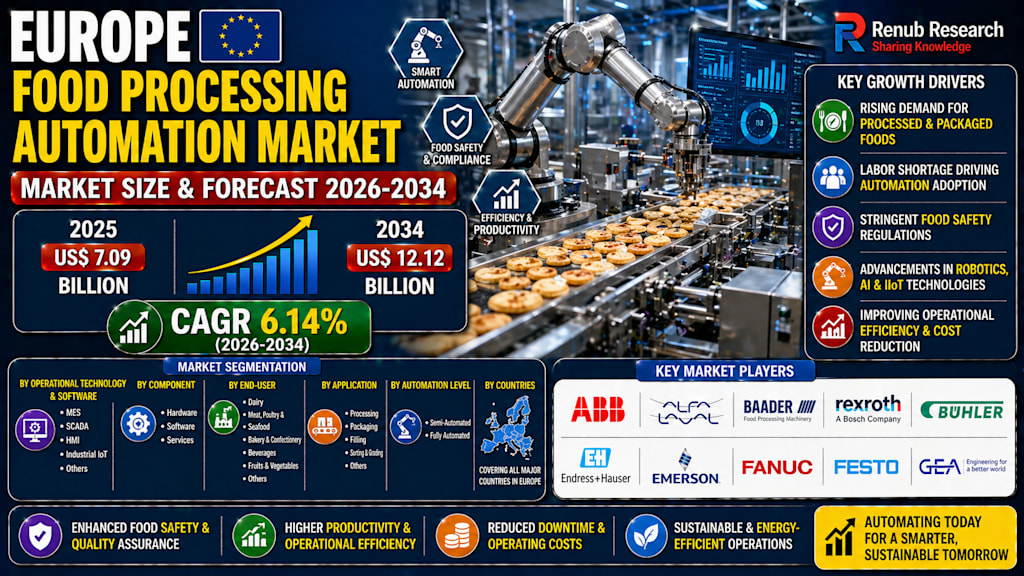
Europe’s food industry is entering a new era—one driven not only by consumer taste but also by machines, sensors, robotics, and intelligent production lines. Across the continent, food manufacturers are modernizing their facilities to meet growing demand for packaged meals, dairy products, baked goods, beverages, and ready-to-eat foods.
According to Renub Research, the Europe Food Processing Automation Market is projected to rise from US$ 7.09 billion in 2025 to US$ 12.12 billion by 2034, expanding at a CAGR of 6.14% during 2026–2034.
That growth signals more than increased machinery sales—it reflects a broad transformation of how Europe produces food. Automation is becoming the answer to some of the region’s biggest challenges: labor shortages, rising operational costs, food safety compliance, and the need for faster, more flexible production systems.
What Is Food Processing Automation?
Food processing automation refers to the use of machines, robotics, sensors, software, and control systems to perform food manufacturing tasks with minimal human intervention.
These automated systems can handle operations such as:
- Sorting raw ingredients
- Mixing and blending
- Slicing and cutting
- Heating and cooking
- Packaging and labeling
- Quality inspection
- Palletizing and warehouse movement
Instead of relying heavily on manual labor, modern factories use connected systems that improve speed, consistency, hygiene, and output.
For Europe, where labor costs are relatively high and regulations are strict, automation is no longer optional—it is becoming essential.
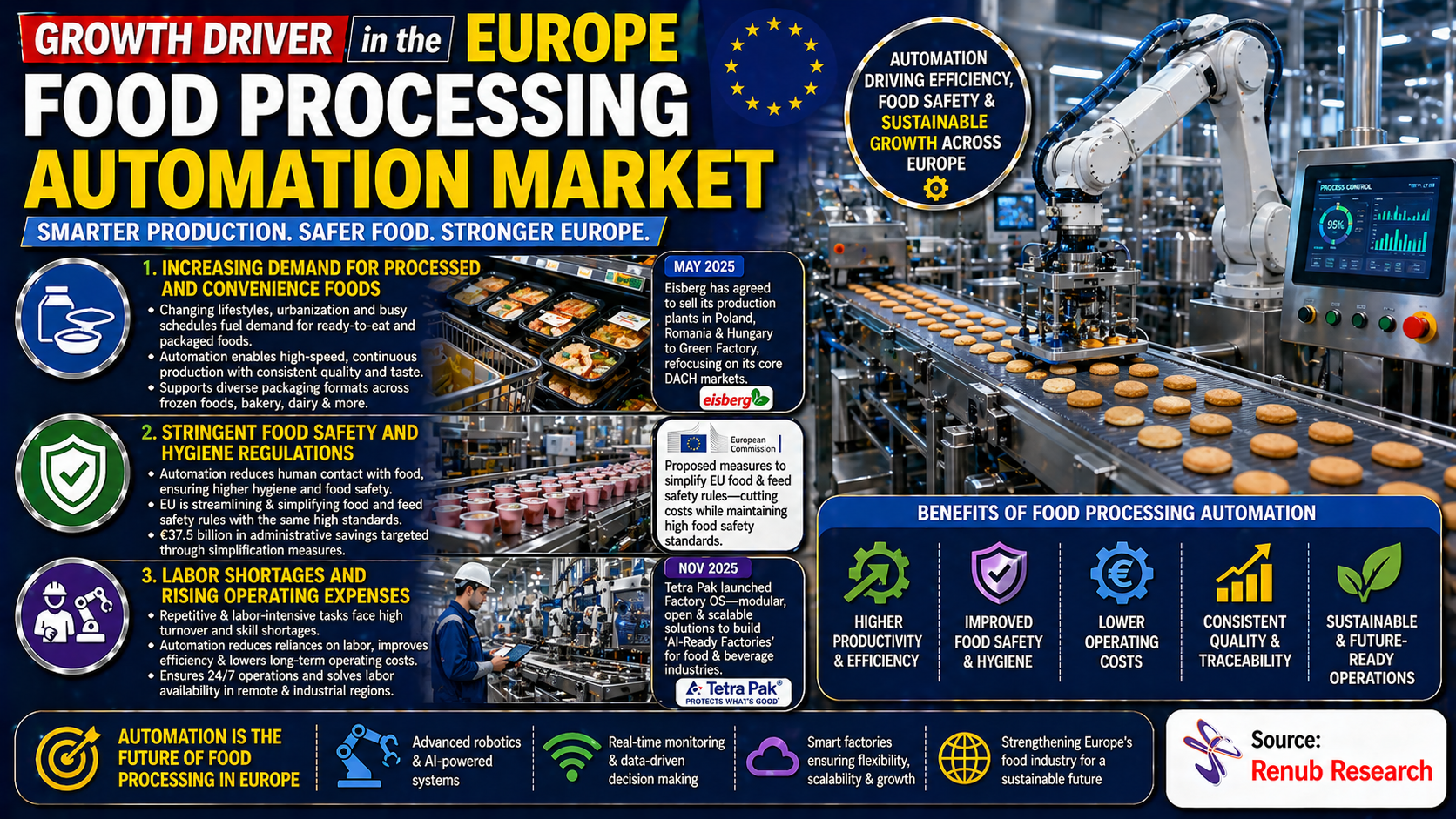
Why Europe Is Investing in Automation Now
1. Growing Demand for Convenience Foods
European consumers are increasingly purchasing foods that save time and fit modern lifestyles. Frozen meals, packaged snacks, bakery products, dairy drinks, salads, and ready-to-eat options are in strong demand.
Urbanization, busy schedules, and dual-income households are changing eating habits. As a result, manufacturers need to produce more volume while maintaining taste, texture, and quality consistency.
Automation helps factories scale production without sacrificing standards. Machines can run continuously, reduce waste, and maintain repeatable product quality.
2. Labor Shortages Across Europe
Many European food processors are struggling to hire workers for repetitive or physically demanding factory roles.
Packaging lines, sorting stations, warehouse handling, and sanitation-intensive processes often face high turnover. With wages rising and skilled workers harder to attract, automation becomes a cost-effective long-term solution.
Robotic systems can operate 24/7, reduce dependency on labor availability, and improve productivity.
This challenge is especially important in rural and industrial zones where workforce availability is limited.
3. Strict Food Safety Regulations
Food safety standards in Europe are among the most rigorous in the world. Producers must comply with hygiene rules, traceability requirements, contamination prevention, and packaging regulations.
Automation reduces direct human contact with food, helping manufacturers improve sanitation and consistency. Smart monitoring systems also track temperatures, movement, processing times, and cleaning cycles in real time.
For regulators and consumers alike, that transparency matters.
Industry 4.0 Is Changing the Factory Floor
Europe has been a global leader in advanced manufacturing, and food processing is now benefiting from the same digital transformation seen in automotive and electronics industries.
Modern food plants are using:
- AI-powered quality inspection
- Predictive maintenance tools
- Smart sensors
- Real-time production dashboards
- Automated storage systems
- Energy optimization software
- Remote equipment monitoring
This Industry 4.0 model allows producers to identify bottlenecks faster, prevent breakdowns, and improve efficiency.
It also supports sustainability goals by reducing water use, energy consumption, and food waste.
Distributed Control Systems Driving Smarter Operations
One of the fastest-growing technologies in the market is the Distributed Control System (DCS).
These systems centralize production management and allow food processors to monitor multiple operations—from ingredient intake to packaging—through a single interface.
DCS platforms are especially valuable in:
- Dairy plants
- Beverage factories
- Ready-meal production
- Continuous cooking lines
- High-volume packaging operations
Benefits include better uptime, reduced errors, traceability, and stronger quality control.
Hardware Still Powers the Market
While software receives much attention, hardware remains the backbone of food automation.
Europe’s market includes strong demand for:
- Industrial robots
- Conveyor systems
- Sensors and transmitters
- Electric motors
- Actuators
- Valves
- Food-grade processing equipment
These machines are increasingly designed for washdown environments, hygienic surfaces, and precise control.
Newer robots can perform delicate handling tasks such as bakery placement, cheese cutting, fruit sorting, and packaging alignment.
Dairy Industry Leads Automation Adoption
Among end-users, the dairy segment stands out as one of the most automated.
Milk processing, pasteurization, fermentation, filling, sealing, and packaging all benefit from advanced control systems. Because dairy products are highly sensitive and tightly regulated, precision matters.
Automation helps dairies maintain:
- Temperature accuracy
- Sterile environments
- Consistent taste and texture
- Efficient bottling and packaging
- Lower contamination risk
Growing demand for yogurt, cheese, flavored milk, and functional dairy beverages continues to support investment in smarter dairy facilities.
Packaging Is Becoming a Major Growth Engine
Packaging and re-packaging systems are another high-growth area.
Manufacturers need packaging lines that can quickly adapt to:
- Private labels
- Seasonal promotions
- Smaller portion sizes
- Sustainability materials
- Multi-language labels
- E-commerce packaging formats
Automated filling, sealing, labeling, sorting, and palletizing systems are helping companies stay competitive while reducing labor intensity.
As Europe’s packaged food market expands, packaging automation will remain a critical investment category.
Fully Automatic vs Semi-Automatic Systems
Fully Automatic Lines
Large manufacturers increasingly prefer fully automated lines for maximum speed, consistency, and scale.
These systems reduce manual involvement, improve hygiene, and support continuous production.
Though capital intensive, they often deliver stronger long-term returns.
Semi-Automatic Lines
Smaller and medium-sized processors often choose semi-automatic solutions.
These combine machine efficiency with human flexibility, making them ideal for:
- Specialty foods
- Regional brands
- Artisanal products
- Lower production volumes
- Gradual modernization strategies
This segment ensures automation growth reaches not only multinational brands but also smaller European producers.
Country Spotlight
Germany
Germany remains one of Europe’s most advanced food automation markets. Strong engineering expertise, Industry 4.0 leadership, and demand for precision manufacturing make it a powerhouse in automated food production.
France
France is expanding automation in bakery, dairy, beverage, and meat sectors, where quality and traceability are highly valued.
United Kingdom
United Kingdom processors are investing in automation to counter workforce shortages and improve efficiency across packaging, bakery, and ready-meal production.
Russia
Russia continues to modernize food manufacturing with growing adoption of automated dairy, grain, and meat processing systems.
Major Companies Competing in the Market
Leading players in Europe’s food processing automation ecosystem include:
- ABB Ltd.
- Alfa Laval AB
- Bosch Rexroth AG
- Emerson Electric Co.
- FANUC Corp.
- Festo SE & Co. KG
- Bühler Holding AG
These companies are developing next-generation robotics, smart factory software, and hygienic processing systems tailored for food manufacturers.
Final Thoughts
Europe’s food processing automation market is no longer about replacing workers with machines—it is about building smarter, safer, cleaner, and more resilient food systems.
With the market expected to grow from US$ 7.09 billion in 2025 to US$ 12.12 billion by 2034, the momentum is clear. Automation is becoming the foundation of modern food production across Europe.
Factories that adopt robotics, AI monitoring, and flexible packaging systems today will likely become tomorrow’s industry leaders.
About the Creator
Enjoyed the story? Support the Creator.
Subscribe for free to receive all their stories in your feed.
Comments
There are no comments for this story
Be the first to respond and start the conversation.