
Essential Oils Market Trends: Aromatherapy Demand, Natural Ingredients & Forecast to 2034
How rising demand for natural wellness solutions, aromatherapy applications, and plant-based ingredients is reshaping consumer preferences and product innovation in the essential oils market

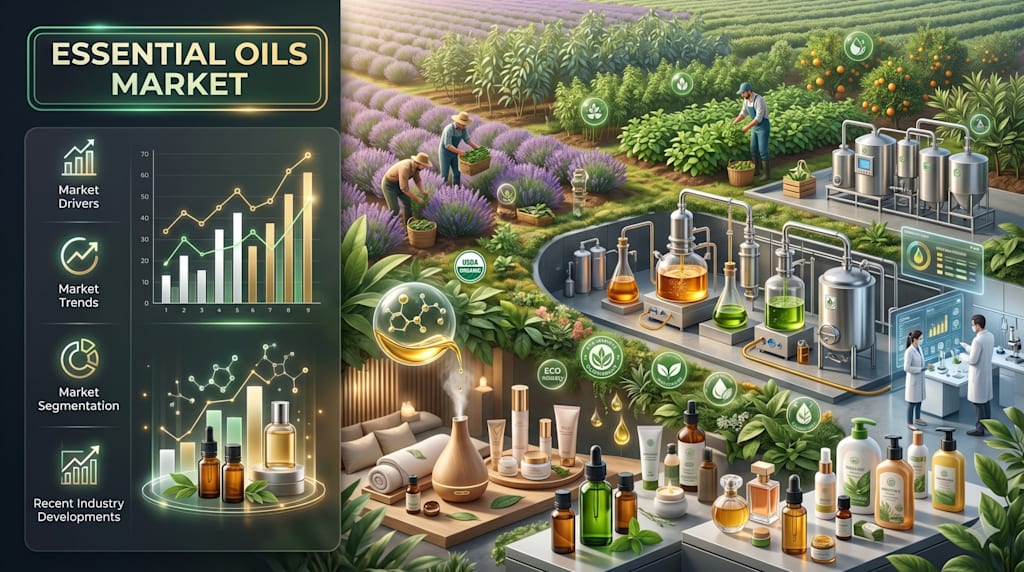
According to IMARC Group's latest research publication, the global essential oils market size was valued at USD 14.3 Billion in 2025 and is projected to reach USD 28.6 Billion by 2034, exhibiting a CAGR of 7.97% during the forecast period 2026-2034.
How AI is Reshaping the Future of the Essential Oils Market
- Precision Extraction and Quality Optimization Through AI: AI-powered systems are transforming how essential oils are extracted and quality-assessed across production facilities worldwide. Machine learning algorithms analyze real-time sensor data from steam distillation and cold-pressing equipment to fine-tune extraction parameters including temperature, pressure, and duration, ensuring maximum yield and purity from each raw material batch. These intelligent systems significantly reduce the occurrence of degraded or off-specification oils entering the supply chain, a critical capability in a market where therapeutic efficacy and aromatic consistency are non-negotiable quality benchmarks for both industrial buyers and end consumers.
- Demand Forecasting and Inventory Planning for Seasonal Raw Materials: Essential oils depend on agricultural inputs that are inherently seasonal and weather-sensitive, making demand forecasting particularly complex. AI-driven forecasting platforms integrate historical sales data, weather pattern analysis, crop yield projections, and global commodity pricing signals to give manufacturers and distributors unprecedented planning accuracy. Companies leveraging these systems are reducing raw material procurement costs, minimizing overstock risks on perishable botanical inputs, and aligning production schedules with actual downstream demand cycles across the personal care, pharmaceutical, food and beverage, and aromatherapy sectors.
- Personalized Consumer Experiences in Aromatherapy and Wellness: AI is enabling a new generation of personalized wellness experiences built around essential oils. Digital platforms and smart diffuser systems now use AI algorithms to analyze user mood inputs, health goals, sleep data, and stress indicators to recommend precise essential oil blends tailored to individual physiological and emotional states. This personalization capability is accelerating adoption of essential oils in the at-home spa and self-care segment, converting occasional buyers into habitual daily users and significantly expanding per-household consumption volumes across North America, Europe, and rapidly urbanizing Asia Pacific markets.
- Supply Chain Transparency and Ethical Sourcing Verification: AI combined with blockchain technology is enabling end-to-end traceability for essential oils sourced from geographically diverse and often remote agricultural regions. Brands can now verify the provenance of lavender from Provence, tea tree oil from Australia, or ylang ylang from Madagascar with full digital audit trails accessible in real time. This capability is particularly commercially significant as approximately 54% of consumers prefer skincare and wellness products with transparent and clean ingredient sourcing, and regulatory bodies across Europe and North America are tightening labeling and certification requirements for natural and organic product claims.
- E-Commerce Personalization and Digital Marketing Amplification: AI-powered recommendation engines are increasing basket sizes and repeat purchase rates for essential oil brands selling through online channels. By analyzing individual browsing behavior, purchase history, and stated wellness preferences, e-commerce platforms dynamically surface relevant essential oil products and application-specific bundles to each shopper. Simultaneously, AI-driven content distribution tools are maximizing the reach of wellness influencer campaigns and scientifically validated health messaging that has become central to essential oils marketing strategies, particularly among the 43% of millennials and Gen Z consumers in the United States who actively prefer natural skincare and personal care formulations over synthetic alternatives.
Essential Oils Industry Overview:
The essential oils market is experiencing strong growth momentum globally, underpinned by an accelerating consumer shift toward natural, organic, and therapeutically validated products across personal care, pharmaceutical, food and beverage, and home cleaning sectors. Europe currently dominates the global market, holding a significant share of over 49.4%, driven by robust consumer demand for organic and sustainably sourced ingredients, a well-established regulatory framework promoting transparent labeling and ethical sourcing, and the concentrated presence of leading manufacturers across Germany, France, and the United Kingdom. The United Kingdom's essential oil imports rose by GBP 6.82 million, representing a 46.9% increase from GBP 14.5 million to GBP 21.3 million between August 2023 and August 2024, reflecting the powerful structural demand dynamics reshaping European consumption patterns.
In North America, the United States accounts for a commanding 93.2% share of the regional market. With 43% of millennials and Gen Z consumers preferring natural skincare over conventional alternatives compared to 31% of the broader population, brand investment in essential oil formulations is accelerating rapidly. The U.S. Food and Drug Administration's classification of numerous essential oils as Generally Recognized as Safe has further unlocked their integration into food and beverage manufacturing as natural flavorings and preservatives, broadening the addressable market considerably beyond traditional wellness and personal care applications. In Asia Pacific, the long heritage of Ayurveda and Traditional Chinese Medicine is creating strong cultural tailwinds for essential oil adoption, with governments in India and China actively promoting dietary diversity and natural wellness initiatives that are driving formal market development. Latin America benefits from exceptional botanical biodiversity that supports indigenous production of eucalyptus, citrus, and other high-value essential oils serving both domestic consumption and global export demand. Across the Middle East and Africa, traditional aromatic oil usage in beauty and wellness rituals is converging with modern aromatherapy and cosmetics trends, while abundant natural resources including tea tree and eucalyptus crops support growing essential oil manufacturing activity for international markets.
A hectare of cultivated crops produces approximately 15 to 25 kilograms of essential oil, generating net annual income of roughly USD 1,200 to USD 1,800 per hectare depending on soil conditions, providing a measurable economic incentive for governments and agricultural development bodies to actively promote essential oil crop cultivation as a rural income diversification strategy across emerging markets.
Essential Oils Market Trends and Drivers
The escalating consumer preference for natural and clean-label products is the foundational driver of essential oils market demand. Approximately 54% of consumers currently prefer personal care and skincare products with transparent ingredient lists, while around 35% actively seek formulations incorporating plant-based ingredients. This behavioral shift is not isolated to niche wellness communities but is now mainstream across demographic cohorts in both developed and emerging economies, creating sustained volume growth across every downstream application segment. Tea tree oil, recognized for its antimicrobial and anti-inflammatory properties, is projected to reach nearly 8 kilotons in demand driven by intensifying consumer interest in natural acne treatment, wound care, and anti-fungal skincare solutions.
The therapeutic and medicinal applications of essential oils are gaining formal institutional recognition alongside traditional wellness usage, creating a structurally broader demand base for the market. Medical professionals and therapists are increasingly incorporating essential oils into clinical treatment protocols for pain management, stress reduction, and immunity support, facilitated by a growing body of peer-reviewed scientific research validating their physiological effectiveness. The spa and relaxation application segment leads all end-use categories with approximately 46.5% market share, reflecting the massive scale of global wellness tourism, professional spa services, and at-home self-care routines that rely on high-quality essential oils including lavender, eucalyptus, peppermint, and ylang ylang as core formulation ingredients.
Retail accessibility and multi-channel distribution are amplifying market reach and accelerating adoption across consumer income segments. Offline stores maintain a leading distribution channel share of approximately 45%, anchored by the consumer preference for in-person product evaluation through scent and texture testing that is particularly relevant in the essential oils category. Simultaneously, the expansion of e-commerce platforms is dramatically improving access in secondary cities and underserved geographies, enabling brands like Young Living and doTERRA to build direct consumer relationships through multi-level marketing networks that combine product education with community-driven sales activation at significant commercial scale.
Favorable government policies supporting organic farming, ethical sourcing certification, and natural ingredient transparency are providing the essential oils industry with a structured regulatory tailwind that reinforces consumer trust and lowers market entry barriers for compliant producers. Government incentives, agricultural subsidies, and institutional funding for natural ingredient production are actively encouraging farmers and manufacturers in key producing regions to scale up essential oil crop cultivation and processing capacity, directly addressing supply-side constraints that have historically limited market expansion in high-demand product categories.
Leading Companies Operating in the Global Essential Oils Industry:
- Biolandes
- doTerra
- Essential Oils of New Zealand Ltd.
- Falcon Essential Oils
- Farotti S.R.L.
- FLAVEX Naturextrakte GmbH
- H. Reynaud and Fils
- India Essential Oils
- Moksha Lifestyle Products
- Rocky Mountain Oils LLC
- Sydney Essential Oil Co.
- The Lebermuth Company
- Ungerer Limited
- Young Living Essential Oils
Essential Oils Market Report Segmentation:
By Product:
- Cedarwood Oil
- Eucalyptus Oil
- Lavender Oil
- Lemongrass Oil
- Rosemary Oil
- Tea Tree Oil
- Ylang Ylang Oil
- Others
Tea tree oil holds the largest product segment share, driven by its broad-spectrum antimicrobial, anti-inflammatory, and skincare properties, widespread adoption across personal care, cosmetics, and pharmaceutical formulations, and the accelerating consumer shift toward chemical-free and naturally derived alternatives in both developed and emerging markets.
By Application:
- Medical (Pharmaceutical, Nutraceuticals)
- Food and Beverages (Bakery and Confectionery, Beverages, Meat, Poultry and Seafood, Others)
- Spa and Relaxation (Aromatherapy, Personal Care, Cosmetics, Toiletries, Others)
- Cleaning (Kitchen Cleaners, Floor Cleaners, Bathroom Cleaners, Others)
- Others
Spa and relaxation dominate the application segment with approximately 46.5% market share, driven by the growing consumer focus on holistic wellness, professional aromatherapy treatments, at-home spa routines, and the expanding integration of essential oils into premium personal care, cosmetics, and toiletry formulations worldwide.
By Sales Channel:
- Offline Stores
- Online Stores
Offline stores lead the sales channel segment with approximately 45.0% market share, supported by the strong consumer preference for in-person product evaluation, immediate availability, personalized customer service, and the trust associated with purchasing therapeutically sensitive products through brick-and-mortar health, wellness, and specialty retail environments.
Regional Insights:
- North America (United States, Canada)
- Europe (Germany, France, United Kingdom, Italy, Spain, Russia, Others)
- Asia Pacific (China, Japan, India, South Korea, Australia, Indonesia, Others)
- Latin America (Brazil, Mexico, Others)
- Middle East and Africa
Europe exhibits clear dominance in the essential oils market, accounting for over 49.4% of global market share, underpinned by high consumer demand for natural and organic products, stringent regulatory standards promoting ethical sourcing and transparent labeling, and the concentrated presence of established manufacturers and innovators across Germany, France, and the United Kingdom who collectively drive both regional consumption and global product development leadership.
Recent News and Developments in the Essential Oils Market
- October 2024: Tholi Oil, an Omaha-based wellness company, launched a fundraising campaign targeting USD 77,000 to complete production of its essential oil-infused sandals, an innovative product format combining therapeutic aromatherapy benefits with everyday footwear. The campaign reflects the expanding creative application of essential oils beyond conventional personal care and supplement formats into novel consumer goods categories.
- October 2024: dōTERRA launched a new wellness-focused product line featuring two Frankincense essential oil products alongside the limited-edition The Escape Series, an essential oil trio targeting consumers seeking premium therapeutic and aromatic experiences. The launch reinforces dōTERRA's strategy of continuously expanding its product portfolio to capture evolving consumer wellness preferences across its extensive global distributor network.
- July 2024: Young Living celebrated its 30th anniversary during the YL30 International Grand Convention held from July 17 to 20 at the Salt Palace Convention Center in Salt Lake City, Utah. The milestone event brought together Brand Partners and wellness enthusiasts from around the world, featured new product introductions, and reaffirmed the company's three-decade commitment to innovation in natural wellness solutions built around essential oils.
- June 2024: Azelis acquired BLH SAS, a French distributor of premium fragrance ingredients, to expand its essential oils and natural ingredient offerings across European and global markets. The acquisition strengthened Azelis' competitive positioning in flavors and fragrances, complementing its earlier acquisitions of Quimdis in France, Vigon in the United States, and Ashapura in India into a cohesive international specialty ingredients platform.
Note: If you require specific details, data, or insights that are not currently included in the scope of this report, we are happy to accommodate your request. As part of our customization service, we will gather and provide the additional information you need, tailored to your specific requirements. Please let us know your exact needs, and we will ensure the report is updated accordingly to meet your expectations.
About the Creator
Abhay Rajput
I am working in market research company that provides market and business research intelligence across the globe.
Enjoyed the story? Support the Creator.
Subscribe for free to receive all their stories in your feed.
Comments
There are no comments for this story
Be the first to respond and start the conversation.