
Enhanced Oil Recovery Market to Reach US$ 68.38 Billion by 2033 as Aging Oil Fields Drive Demand for Advanced Extraction Technologies
Growing energy demand, declining production from mature reservoirs, and technological breakthroughs in thermal, gas, and chemical recovery methods are accelerating the global Enhanced Oil Recovery market through 2033.

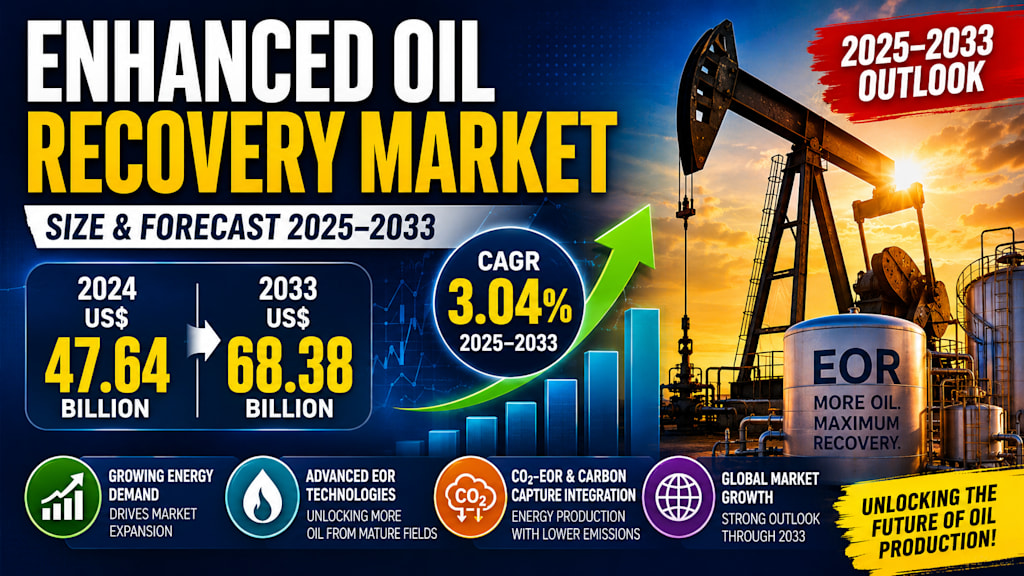
Enhanced Oil Recovery Market Size and Forecast 2025–2033
The global Enhanced Oil Recovery (EOR) Market is poised for steady growth over the next decade as oil producers seek innovative methods to maximize production from aging reservoirs. According to Renub Research, the Enhanced Oil Recovery Market is projected to grow from US$ 47.64 billion in 2024 to US$ 68.38 billion by 2033, expanding at a CAGR of 3.04% during 2025–2033.
As conventional oil fields mature and production rates decline, energy companies are increasingly turning to advanced extraction technologies to unlock previously unrecoverable reserves. Enhanced Oil Recovery has emerged as a strategic solution that helps producers improve recovery rates, extend field life, and generate greater returns from existing assets.
The technology is becoming especially important at a time when global energy demand continues to rise while new large-scale oil discoveries become less frequent. By extracting additional hydrocarbons from mature reservoirs, EOR enables operators to meet market demand without relying solely on costly exploration activities.
Understanding Enhanced Oil Recovery
Enhanced Oil Recovery refers to a set of advanced techniques designed to increase the amount of crude oil that can be extracted from underground reservoirs after primary and secondary recovery methods have reached their limits.
Traditional oil extraction methods typically recover only a fraction of the total oil contained in a reservoir. In many cases, more than half of the oil remains trapped underground due to geological and physical limitations.
EOR technologies overcome these challenges by altering reservoir conditions and improving oil mobility. The three major categories include:
Thermal Enhanced Oil Recovery
Thermal methods inject heat into reservoirs through steam or hot water. The increased temperature lowers oil viscosity, allowing heavier crude to flow more easily toward production wells.
Gas Enhanced Oil Recovery
Gas injection techniques utilize carbon dioxide, nitrogen, or natural gas to reduce oil viscosity and improve displacement efficiency. CO₂-EOR remains one of the most widely adopted approaches globally.
Chemical Enhanced Oil Recovery
Chemical flooding involves injecting polymers, surfactants, or alkaline solutions into reservoirs to improve fluid flow characteristics and increase oil displacement.
These technologies have become essential tools for operators seeking higher recovery rates and greater profitability from mature fields.
Aging Oil Fields Continue to Drive Market Expansion
One of the strongest growth drivers for the EOR market is the increasing number of aging oil fields worldwide.
Many major producing regions, including North America, Europe, the Middle East, and Asia-Pacific, have reservoirs that have been producing for decades. Over time, natural pressure declines, making it increasingly difficult to extract oil economically.
Instead of abandoning these fields, producers are investing in EOR technologies to access substantial remaining reserves. In many mature reservoirs, significant volumes of oil remain trapped after conventional extraction methods have been exhausted.
By implementing advanced recovery solutions, operators can extend field lifespans, increase output, and maximize return on investment while avoiding the risks associated with new exploration projects.
As oil companies focus more on asset optimization, EOR adoption is expected to accelerate globally.
Rising Global Energy Demand Creates New Opportunities
Global energy consumption continues to grow, particularly across emerging economies in Asia, Africa, and Latin America.
Population growth, urbanization, industrial expansion, and increasing transportation needs are creating sustained demand for petroleum products. Despite the global transition toward renewable energy, oil remains a critical component of the world's energy mix.
To satisfy rising demand, oil producers must improve production efficiency and maximize recovery from existing resources.
Enhanced Oil Recovery offers a practical pathway to achieving these goals by enabling companies to increase production without requiring entirely new discoveries.
When oil prices remain favorable, EOR projects become even more attractive because the additional recovered barrels can generate significant revenue while utilizing existing infrastructure.
This economic advantage continues to strengthen investment across the EOR industry.
Technological Innovation Transforming EOR Efficiency
Advancements in science and engineering are significantly improving the effectiveness of Enhanced Oil Recovery operations.
Modern EOR systems now incorporate:
- Artificial Intelligence (AI)
- Machine Learning
- Real-time reservoir monitoring
- Digital reservoir modeling
- Advanced chemical formulations
- Improved injection technologies
These innovations help operators better understand reservoir behavior, optimize injection strategies, and improve overall recovery performance.
Smart reservoir management systems can analyze massive volumes of geological and production data, allowing engineers to make informed decisions that maximize oil recovery while minimizing operational costs.
Recent improvements in CO₂ injection methods, polymer flooding technologies, and surfactant formulations have further expanded the applicability of EOR techniques across different reservoir types.
As technology continues to evolve, recovery rates are expected to improve while project economics become increasingly attractive.
Carbon Capture Integration Strengthens EOR Prospects
An emerging trend reshaping the industry is the integration of Carbon Capture and Storage (CCS) with Enhanced Oil Recovery operations.
CO₂-EOR projects offer a unique opportunity to achieve two objectives simultaneously:
Increase oil production.
Permanently store carbon dioxide underground.
Many governments and energy companies are exploring this dual-benefit approach as part of broader climate strategies.
Captured carbon emissions from industrial facilities can be injected into oil reservoirs, improving oil recovery while reducing atmospheric carbon levels.
This combination of energy production and emissions management is attracting substantial investments and creating new growth opportunities for EOR operators worldwide.
Key Challenges Limiting Market Growth
Despite promising opportunities, the Enhanced Oil Recovery industry faces several challenges.
High Capital and Operational Costs
EOR projects require significant upfront investments in infrastructure, specialized equipment, reservoir studies, and injection systems.
Thermal recovery projects, in particular, consume substantial amounts of energy, while chemical flooding programs require expensive formulations and ongoing monitoring.
These costs can discourage investment, especially during periods of low oil prices when project profitability becomes uncertain.
Smaller operators often struggle to justify the financial commitment required for large-scale EOR deployment.
Environmental and Regulatory Concerns
Environmental considerations also present challenges for the industry.
Chemical-based EOR methods may raise concerns regarding groundwater contamination and chemical disposal. Thermal methods require substantial water and energy resources, while CO₂ projects must comply with strict monitoring requirements.
Additionally, increasing global focus on renewable energy and emissions reduction places greater scrutiny on fossil fuel-related activities.
Operators must therefore balance production goals with environmental responsibility and regulatory compliance.
Regional Analysis of the Enhanced Oil Recovery Market
North America Leads Global Adoption
North America remains the largest Enhanced Oil Recovery market worldwide.
The region benefits from:
- Extensive mature oil fields
- Strong technological capabilities
- Established infrastructure
Significant investment in research and development
The United States, particularly Texas and the Permian Basin, continues to lead global CO₂-EOR deployment.
Growing support for carbon capture projects further strengthens the region's leadership position.
United States
The United States represents the most advanced EOR market globally.
Major operators continue investing heavily in carbon dioxide injection, thermal recovery, and chemical flooding projects.
Government incentives supporting carbon capture initiatives are creating additional opportunities for EOR expansion while helping companies meet sustainability objectives.
United Kingdom
The United Kingdom's EOR activity is primarily concentrated in the North Sea.
As offshore reservoirs mature, operators increasingly rely on advanced recovery methods to maintain production levels and maximize resource utilization.
CO₂-linked EOR projects are attracting growing interest due to the nation's net-zero ambitions.
India
India's growing energy demand and dependence on imported crude oil are driving investments in Enhanced Oil Recovery technologies.
State-owned companies such as ONGC and Oil India are actively implementing EOR programs across mature fields.
Government support for domestic production enhancement is expected to accelerate future market growth.
United Arab Emirates
The UAE remains a regional leader in advanced oil recovery deployment.
Major operators are investing in gas injection and chemical flooding projects to maximize recovery from world-class reservoirs.
The country's strong financial resources, technological capabilities, and strategic focus on production optimization continue to support market expansion.
Recent Developments in the Enhanced Oil Recovery Industry
The EOR sector continues to witness notable technological and strategic advancements:
1. Dow and University of Wyoming (May 2024)
Launched the Wyoming Gas Injection Initiative (WGII) to improve oil recovery through foam-assisted gas injection and CO₂ technologies.
2. ICM and Western New York Energy (May 2024)
Partnered to deploy ICM's FOT Oil Recovery technology at the Medina facility in New York.
3. Baker Hughes
Expanded digital reservoir optimization solutions to improve EOR project efficiency and predictive analytics.
4. Halliburton
Enhanced chemical flooding technologies designed to improve recovery rates in mature reservoirs.
5. Schlumberger
Introduced advanced digital reservoir characterization tools for improved EOR planning.
6. Chevron Corporation
Continued investments in CO₂-EOR operations across key U.S. production regions.
7. Exxon Mobil
Expanded carbon capture and storage initiatives integrated with enhanced recovery projects.
8. Shell PLC
Increased focus on lower-carbon oil recovery technologies linked with carbon management strategies.
9. TotalEnergies SE
Advanced research into sustainable EOR methods utilizing captured carbon emissions.
10. Weatherford International
Developed next-generation reservoir monitoring technologies to improve EOR operational performance.
Competitive Landscape
The global Enhanced Oil Recovery market remains highly competitive, with leading oilfield service providers and energy companies investing heavily in innovation, sustainability, and digital transformation.
Major industry participants include:
- Baker Hughes Company
- BP plc
- Chevron Corporation
- Exxon Mobil Corporation
- Halliburton Company
- Praxair Technology Inc.
- Shell plc
- Schlumberger Limited
- TotalEnergies SE
- Weatherford International plc
These organizations continue to invest in advanced recovery technologies, digital solutions, carbon management initiatives, and strategic partnerships to strengthen their market positions.
Final Thoughts
Enhanced Oil Recovery is increasingly becoming a cornerstone of the global oil industry's strategy for maximizing production from existing assets. As mature oil fields continue to dominate global reserves, operators are seeking efficient methods to extract additional hydrocarbons while controlling costs and improving sustainability.
With technological innovation, rising energy demand, and growing integration of carbon capture initiatives, the EOR market is positioned for steady long-term expansion. Although challenges related to cost and environmental compliance remain, the industry's ability to unlock substantial untapped reserves ensures its continued relevance in the evolving energy landscape.
According to Renub Research, the market's projected growth from US$ 47.64 billion in 2024 to US$ 68.38 billion by 2033 highlights the critical role Enhanced Oil Recovery will play in supporting global energy security and optimizing resource utilization in the years ahead.
About the Creator
Enjoyed the story? Support the Creator.
Subscribe for free to receive all their stories in your feed.
Comments
There are no comments for this story
Be the first to respond and start the conversation.