
Energy Management System Market Witnesses Strong Growth Worldwide
How smart grid integration, AI-powered monitoring, and sustainability initiatives are transforming operational efficiency and energy optimization across the energy management system market

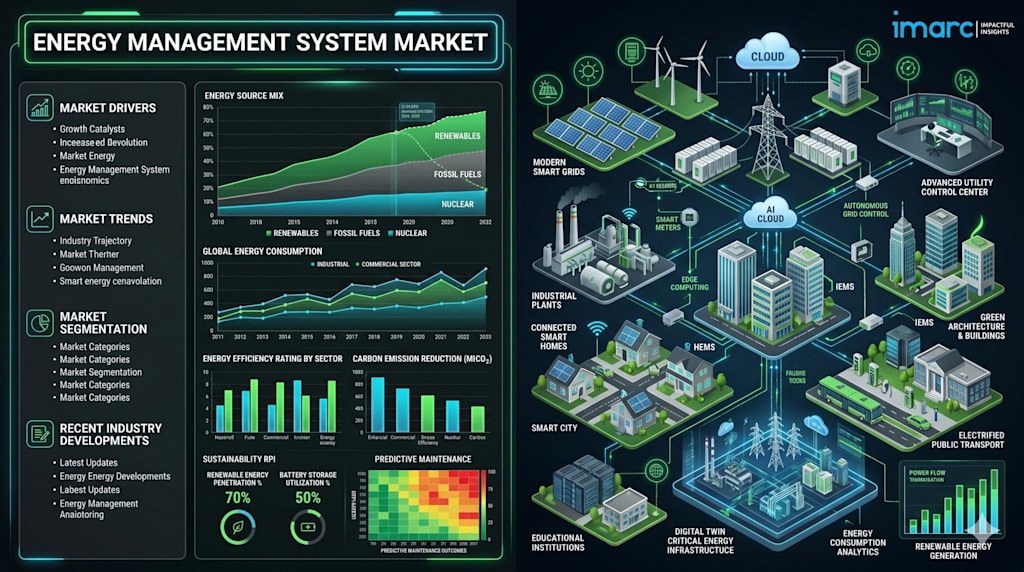
According to IMARC Group's latest research publication, The global energy management system market size reached USD 67.2 Billion in 2025. Looking forward, IMARC Group expects the market to reach USD 169.9 Billion by 2034, exhibiting a growth rate (CAGR) of 10.54% during 2026-2034.
How Technology is Reshaping the Future of the Energy Management System Market
- AI-Powered Predictive Energy Optimization: Artificial intelligence is fundamentally elevating how energy management systems operate, shifting them from reactive monitoring tools to proactive optimization platforms. AI algorithms analyze consumption patterns, equipment performance data, and external variables to predict peak demand periods and adjust energy use before inefficiencies occur. Honeywell Building Automation enhanced its enterprise energy management software suite with upgraded AI-driven analytics for industrial and commercial energy control systems, enabling facilities to reduce energy overhead through anticipatory load management rather than manual intervention. This predictive capability is especially valuable in manufacturing and large commercial buildings where energy waste translates directly into measurable operational cost increases.
- IoT-Enabled Real-Time Monitoring and Control: The proliferation of Internet of Things devices is expanding the granularity and speed of energy data collection across facilities. Smart sensors embedded in production lines, HVAC systems, lighting grids, and utility meters generate continuous streams of operational data that EMS platforms process in real time to identify inefficiencies and trigger automated corrections. The global wireless sensor market reached a value of USD 11.9 Billion and is expected to grow substantially, reflecting the increasing density of connected monitoring infrastructure that underpins modern EMS deployments. This sensor-driven architecture enables operators across industrial, commercial, and residential settings to achieve visibility into energy consumption at the individual asset level rather than relying on aggregate meter readings.
- Cloud-Based Deployment and Remote Accessibility: Cloud-hosted energy management platforms are transforming how organizations access and act on energy data, particularly for enterprises managing multiple sites across geographies. ABB launched its cloud-based energy management system, ABB Ability InSite Energy Pro, hosted on Amazon Web Services, enabling remote real-time monitoring, automated load management, and benchmark analytics for multi-site commercial operations. This cloud-native architecture eliminates the need for on-site server infrastructure, reduces deployment costs, and enables energy managers to monitor and control energy consumption from centralized dashboards regardless of physical location, making sophisticated EMS capabilities accessible to mid-sized commercial operators that previously lacked the resources for on-premises enterprise deployments.
Energy Management System Industry Overview
The global energy management system industry is undergoing a structural transformation as governments, corporations, and utilities worldwide recognize energy efficiency not merely as an operational metric but as a strategic and regulatory imperative. Industrial energy management systems accounted for the dominant share of the market at 73.6% in 2025, reflecting the outsized energy consumption of manufacturing facilities, refineries, and industrial complexes where even marginal efficiency gains translate into significant cost savings and emissions reductions. Vedanta Lanjigarh's implementation of an advanced EMS to monitor critical electrical assets at its alumina refinery exemplifies this industrial priority, supporting the company's Net Zero Carbon commitment by 2050 through real-time digitalization of energy-intensive operations.
North America leads all regions, contributing approximately 35% of global market revenue in 2025, supported by early adoption of smart grid technologies, robust regulatory frameworks mandating energy efficiency, and a concentration of advanced industrial and commercial infrastructure. The United States generated USD 25.46 Trillion in GDP in 2022 according to the Bureau of Economic Analysis, underscoring the scale of the commercial and industrial base that is actively investing in EMS to control energy-related operational costs. Silicon Valley-adjacent tech sectors, large-scale data centers, and federal infrastructure modernization programs all contribute to sustained demand for sophisticated energy monitoring and control platforms.
Energy Management System Market Trends and Drivers
Rising energy costs are among the most consistent drivers of EMS adoption globally, compelling businesses across every sector to treat energy efficiency as a financial priority rather than a sustainability aspiration. As electricity prices increase and fossil fuels, which accounted for approximately 81% of United States primary energy production, continue to face price volatility driven by geopolitical and supply dynamics, organizations are under mounting pressure to identify and eliminate waste across their energy consumption profiles. EMS platforms deliver this capability through continuous monitoring, automated alerts, and data-driven optimization recommendations that generate measurable cost reductions and rapid return on investment. The financial case for EMS is particularly compelling for energy-intensive industries such as manufacturing, data centers, and healthcare, where energy expenses represent a substantial share of total operational overhead.
Technological advancement across IoT, machine learning, and data analytics is simultaneously lowering the barriers to EMS deployment while expanding the sophistication of available solutions. Modern EMS platforms now offer predictive maintenance capabilities, automated load scheduling, and AI-driven demand response features that were previously limited to large enterprise deployments but are increasingly accessible to small and medium businesses. In 2023, the SBA Office of Advocacy recorded 33,185,550 small businesses operating in the United States, representing a vast and largely untapped addressable market for affordable, easy-to-deploy EMS solutions as component costs continue to decline and cloud-based delivery models reduce upfront investment requirements. Siemens expanded its grid-edge energy management solutions portfolio focused on smart factories and data center energy optimization, illustrating how established players are actively developing solutions tailored to the operational contexts of smaller and mid-tier commercial buyers.
Government policy and international sustainability frameworks are providing structural, long-term demand support for the EMS market. Tighter emissions regulations, mandatory energy auditing requirements, and national electrification targets across the United States, European Union, India, and China are compelling organizations to deploy systems capable of measuring, managing, and reporting energy consumption with regulatory-grade precision. France's EUR 750 million funding initiative for 6G research and development under the France 2030 strategy, which includes investments in virtualization and edge computing technologies closely aligned with smart energy infrastructure, reflects the broader public sector commitment to building the technological foundation that advanced EMS platforms require. Johnson Controls strengthened deployment of its OpenBlue Energy Management Solutions across large-scale infrastructure and smart building projects in North America, demonstrating how industry leaders are capitalizing on this policy-driven momentum to accelerate adoption across commercial real estate and institutional facilities.
Leading Companies Operating in the Global Energy Management System Industry
- C3.ai Inc.
- Delta Electronics Inc.
- Eaton Corporation PLC
- Emerson Electric Co.
- General Electric Company
- Honeywell International Inc.
- Johnson Controls International PLC
- Rockwell Automation Inc.
- Schneider Electric SE
- Siemens AG
- Toshiba Corporation
- Yokogawa Electric Corporation
Energy Management System Market Report Segmentation
By Component:
- Sensors
- Controllers
- Software
- Batteries
- Display Devices
- Others
By Product:
- Industrial Energy Management Systems (IEMS)
- Building Energy Management Systems (BEMS)
- Home Energy Management Systems (HEMS)
By Solution:
- Carbon Energy Management
- Demand Response Management
- Utility Billing and Customer Information System
By Industry Vertical:
- Power and Energy
- Telecom and IT
- Manufacturing
- Retail and Offices
- Healthcare
- Others
By End Use:
- Residential
- Commercial
Regional Insights
- North America
- United States
- Canada
- Asia-Pacific
- China
- Japan
- India
- South Korea
- Australia
- Indonesia
- Others
- Europe
- Germany
- France
- United Kingdom
- Italy
- Spain
- Russia
- Others
- Latin America
- Brazil
- Mexico
- Others
- Middle East and Africa
Recent News and Developments in the Energy Management System Market
- March 2026: Schneider Electric North America advanced its AI-enabled EcoStruxure Energy Management platform integration across commercial buildings to improve real-time energy monitoring and operational efficiency, reinforcing its position as a leading provider of intelligent building energy solutions across North America.
- February 2026: Siemens USA expanded its grid-edge energy management solutions portfolio focused on smart factories and data center energy optimization, targeting the growing demand for precision energy control in manufacturing and digital infrastructure facilities.
- January 2026: Honeywell Building Automation enhanced its enterprise energy management software suite with upgraded analytics for industrial and commercial energy control systems, enabling more precise demand forecasting and load management across large multi-site deployments.
- December 2025: Johnson Controls strengthened deployment of OpenBlue Energy Management Solutions across large-scale infrastructure and smart building projects in North America, building on its connected building platform to deliver integrated energy optimization at scale.
Note: If you require specific details, data, or insights that are not currently included in the scope of this report, we are happy to accommodate your request. As part of our customization service, we will gather and provide the additional information you need, tailored to your specific requirements. Please let us know your exact needs, and we will ensure the report is updated accordingly to meet your expectations.
About the Creator
Abhay Rajput
I am working in market research company that provides market and business research intelligence across the globe.
Enjoyed the story? Support the Creator.
Subscribe for free to receive all their stories in your feed.
Comments
There are no comments for this story
Be the first to respond and start the conversation.