
Emotion AI Market Expands Rapidly with Smart Analytics Demand
How sentiment analysis, facial recognition technologies, and behavioral analytics are transforming customer engagement strategies and business intelligence in the emotion AI market

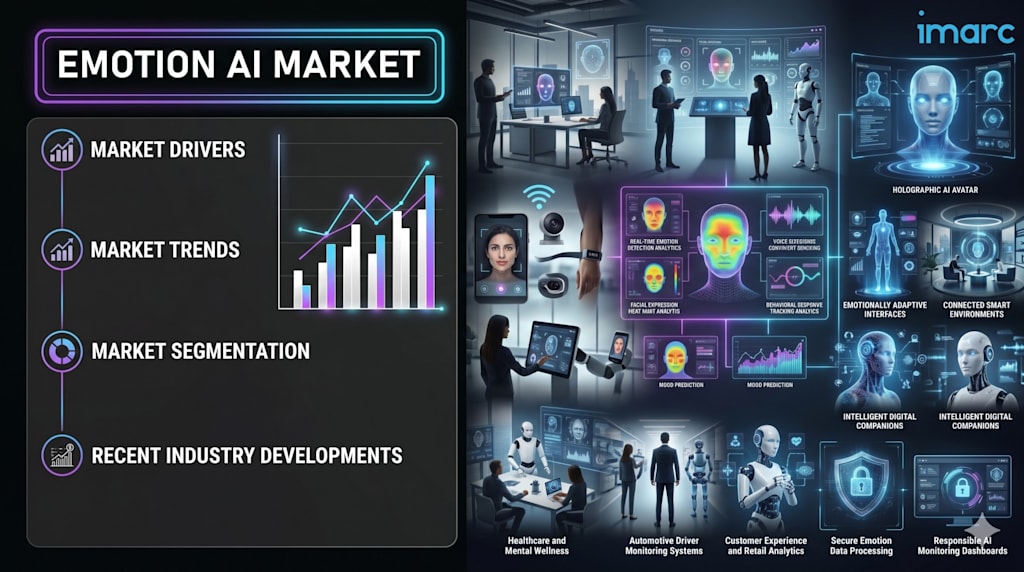
According to IMARC Group's latest research publication, The global emotion AI market size reached USD 3,529.0 Million in 2025. Looking forward, the market is expected to reach USD 19,052.7 Million by 2034, exhibiting a growth rate (CAGR) of 19.99% during 2026-2034, driven by rising demand for personalized customer experiences, rapid evolution in artificial intelligence and machine learning algorithms, and accelerating adoption of emotion recognition technology across retail, healthcare, automotive, and entertainment sectors.
How AI is Reshaping the Future of the Emotion AI Market
- Personalized Customer Experience Through Real-Time Emotion Recognition: AI-powered emotion recognition tools analyze facial expressions, voice tonality, and sentiment signals in real time, enabling businesses to tailor interactions dynamically based on individual emotional states. Retailers deploying emotion-aware systems have reported measurable improvements in conversion rates and customer satisfaction scores, as product recommendations and marketing messages are adjusted to match live emotional context. This capability is shifting customer engagement models from transactional to emotionally responsive, creating stronger brand loyalty and higher lifetime customer value across the Emotion AI Market.
- Mental Health Monitoring and Therapeutic Applications in Healthcare: Emotion AI is emerging as a foundational technology in digital mental health platforms, enabling continuous mood tracking, early stress detection, and therapy personalization without requiring physical clinical visits. Healthtech venture funding reached USD 7.9 Billion in the first half of 2025 across the United States and Europe, with AI-driven mental health applications representing a significant and growing portion of that investment. Platforms using emotion AI for patient engagement can detect deteriorating mental states between appointments, allowing clinicians to intervene earlier and reducing the burden on acute care services significantly.
- Driver Safety Enhancement Through Emotion and Fatigue Monitoring: Automotive manufacturers are integrating emotion AI into in-cabin monitoring systems to detect driver fatigue, stress, and distraction states in real time, triggering safety alerts or adaptive driving assistance responses before accidents occur. These systems analyze eye movement patterns, facial muscle activity, and physiological signals using computer vision and machine learning, all without requiring physical sensors attached to the driver. As automotive OEMs face increasing regulatory pressure around active safety systems in the European Union and other jurisdictions, emotion-aware driver monitoring is transitioning from a premium differentiator to a standard safety requirement.
- Emotion-Based Advertising and Marketing Intelligence: Brands and advertising agencies are deploying emotion AI to measure audience reactions to creative content, replacing recall surveys and focus groups with objective, continuous emotional response data captured through facial and voice analysis. By understanding which creative elements generate genuine engagement versus passive viewing, marketers can optimize campaign effectiveness before large-scale media spend is committed, directly improving return on advertising investment. Media and entertainment companies are additionally using emotion analytics to guide content commissioning decisions, testing audience emotional arcs for new formats and concepts with measurable behavioral data rather than subjective opinion research.
- Education Technology and Student Engagement Optimization: Emotion AI platforms embedded within learning management systems analyze student attention levels, confusion signals, and engagement indicators in real time, allowing adaptive learning engines to modify content difficulty, pacing, and presentation style automatically. Institutions that have piloted emotion-aware educational tools report improvements in learning outcome metrics and reductions in student dropout rates, as early disengagement signals are captured and addressed before they escalate into course abandonment. This application is gaining particular traction in online and hybrid learning environments, where instructors lack the physical cues they would observe in traditional classroom settings.
Emotion AI Market Industry Overview
The global Emotion AI Market is experiencing robust growth momentum, underpinned by a convergence of advanced AI infrastructure, rising cross-sector adoption, and an increasingly favorable regulatory and investment environment. The market fundamentals remain highly favorable as organizations across industries recognize that understanding human emotion at scale represents a competitive advantage that earlier generations of data analytics simply could not deliver.
Government initiatives are actively shaping the conditions for Emotion AI Market expansion. The European Union's Artificial Intelligence Act has established tiered regulatory requirements for emotion recognition systems deployed in high-stakes contexts such as law enforcement and employment screening, creating both guardrails and market clarity for enterprise buyers evaluating responsible deployments. In the United States, the National Institute of Standards and Technology has published AI risk management frameworks that address affective computing systems, providing enterprise procurement teams with compliance benchmarks that accelerate institutional adoption decisions. Japan's Ministry of Economy, Trade and Industry has identified emotion AI as a strategic technology area within its broader Society 5.0 digital transformation agenda, with funded research programs supporting domestic development of culturally calibrated emotion recognition models.
Investment momentum in the sector remains strong. Healthtech alone attracted USD 7.9 Billion in venture capital across the first half of 2025 in the United States and Europe, with AI-driven mental health and patient engagement platforms representing a significant share of that deployment. This level of institutional investment signals durable commercial confidence in emotion AI's clinical and operational value beyond short-term technology enthusiasm.
Product innovation is accelerating the market's reach into consumer segments that were previously the exclusive domain of enterprise deployments. In January 2025, PieX unveiled what it described as the world's first AI Emotion Tracking Pendant at CES 2025, a consumer wearable that uses mmWave radar and on-device AI to monitor stress levels, provide real-time emotional insights, deliver meditation guidance, and support automatic journaling. The device attracted significant attendee interest and positioned emotion AI as a mainstream consumer wellness tool rather than a specialized enterprise capability, broadening the market's addressable audience substantially.
Emotion AI Market Trends and Drivers
The convergence of machine learning, natural language processing, and computer vision has dramatically elevated the performance ceiling of emotion AI systems. Algorithms can now process facial expressions, vocal stress patterns, micro-gestures, and physiological signals with high accuracy across diverse cultural and linguistic populations, overcoming earlier limitations that restricted reliable emotion recognition to narrow demographic groups. These technical advances have made real-time emotion recognition commercially viable at scale for the first time, unlocking deployment in high-volume, high-velocity environments such as contact centers, retail stores, and digital advertising platforms.
The proliferation of smart devices and IoT-connected endpoints has simultaneously expanded the data infrastructure available to emotion AI systems. Billions of connected devices now generate continuous streams of behavioral and physiological signals that can feed emotion recognition models, enabling more granular and contextually aware emotional profiling than single-modality systems could previously achieve. This data richness is accelerating model accuracy improvements and enabling emotion AI vendors to offer increasingly precise, industry-specific solutions rather than generic platforms requiring extensive customization.
Cross-sector adoption is broadening the Emotion AI Market's revenue base in ways that reduce dependence on any single vertical's growth trajectory. In retail and e-commerce, emotion AI is enabling dynamic pricing responses, live ad optimization, and in-store behavior analytics. In IT and ITES, customer service platforms are deploying emotion recognition to route calls based on caller sentiment and equip agents with real-time emotional intelligence coaching. In media and entertainment, streaming platforms are piloting emotion-responsive content recommendation engines that adapt viewing suggestions based on real-time audience emotional state rather than historical viewing patterns alone.
The human-computer interaction application segment is benefiting from accelerating investment in conversational AI and virtual assistant platforms. As voice interfaces become primary interaction layers in consumer electronics, automotive systems, and smart home devices, the ability to detect and respond to emotional nuance in speech becomes a core product differentiator rather than a supplementary feature. Companies developing next-generation virtual assistants are embedding emotion AI capabilities directly into their interaction design frameworks, creating structural demand for emotion recognition technology at the component level.
Leading Companies Operating in the Global Emotion AI Industry
- audEERING GmbH (Agile Robots SE)
- Behavioral Signal Technologies, Inc.
- Emotibot
- Entropik
- Hume AI Inc.
- Morphcast Inc.
- Opsis Pte. Ltd.
- Realeyes
- Smart Eye Group
- Symanto Research GmbH and Co. KG
Emotion AI Market Report Segmentation
By Offering:
- Solution: Emotion Recognition, Emotion AI SDKs and APIs, Emotion Analytics, Others
- Services: Professional Services, Managed Services
The solutions segment leads market revenue, with emotion recognition and analytics tools commanding the highest adoption rates as enterprises prioritize measurable emotional intelligence outputs over infrastructure services.
By Type:
- Text-Focused
- Voice-Focused
- Video and Multimodal
Video and multimodal systems represent the fastest-growing type segment, as simultaneous analysis of facial, vocal, and contextual signals delivers accuracy levels that single-modality approaches cannot achieve independently.
By Technology:
- Machine Learning
- Natural Language Processing
- Computer Vision
- Others
Machine learning underpins the majority of deployed emotion AI systems, while computer vision is gaining ground rapidly as camera-based contactless emotion recognition removes hardware barriers to enterprise adoption.
By Application:
- Customer Experience Monitoring
- Human-Computer Interaction
- Driver Monitoring Systems
- Health and Wellness Monitoring
- Emotion-Based Advertising and Marketing
- Others
Customer experience monitoring leads current application adoption, while health and wellness monitoring is emerging as the highest-growth application category as mental health technology investment accelerates globally.
By End Use Industry:
- Retail and E-Commerce
- IT and ITES
- Healthcare
- Media and Entertainment
- Automotive
- Others
Healthcare and retail represent the two largest end-use verticals by current adoption volume, while automotive is positioned as the fastest-growing sector as regulatory safety mandates accelerate driver monitoring system deployments.
Regional Insights
- North America (United States, Canada)
- Europe (Germany, France, United Kingdom, Italy, Spain, Others)
- Asia Pacific (China, Japan, India, South Korea, Australia, Indonesia, Others)
- Latin America (Brazil, Mexico, Others)
- Middle East and Africa
North America holds clear dominance in the Emotion AI Market, supported by the highest concentration of emotion AI technology vendors, the largest enterprise software adoption base, and a well-developed venture capital ecosystem that funds continuous product innovation. The United States accounts for the majority of regional revenue, anchored by strong demand from retail, healthcare, and media and entertainment sectors alongside an active developer ecosystem building on emotion AI SDKs and APIs.
Europe maintains steady growth, shaped distinctively by GDPR and the AI Act's requirements for transparency and human oversight in emotion recognition deployments. This regulatory environment has driven demand for privacy-preserving, on-device emotion AI processing architectures, creating a differentiated European market for compliant emotion recognition technology that is attracting specialist vendors serving privacy-first enterprise buyers.
Asia Pacific is the standout expansion region for the Emotion AI Market, with China, Japan, India, and South Korea all demonstrating accelerating adoption across retail, automotive, and healthcare verticals. India's growing consumer base for AI wellness applications, illustrated by the launch of WTMF in August 2025, signals an emerging consumer-facing demand layer that adds to existing enterprise adoption momentum across the region.
Recent News and Developments in the Emotion AI Market
- August 2025: India's first emotionally intelligent AI platform, WTMF (What's The Matter, Friend?), launched its beta version, offering empathetic conversational support with mood tracking, AI journaling, and voice call capabilities, redefining emotionally aware AI for mental wellness applications in the Indian consumer market.
- April 2025: Nihilent launched Emoscape, a contactless camera-based emotion AI engine that provides non-invasive emotional insights across healthcare, education, marketing, sports, and corporate wellness applications without requiring physical sensors or manual subject input.
- January 2025: PieX unveiled the world's first AI Emotion Tracking Pendant at CES 2025, a consumer wearable using mmWave radar and on-device AI to monitor stress levels and deliver real-time emotional insights, meditation guidance, and automatic journaling capabilities to mainstream wellness audiences.
Note: If you require specific details, data, or insights that are not currently included in the scope of this report, we are happy to accommodate your request. As part of our customization service, we will gather and provide the additional information you need, tailored to your specific requirements. Please let us know your exact needs, and we will ensure the report is updated accordingly to meet your expectations.
About the Creator
Abhay Rajput
I am working in market research company that provides market and business research intelligence across the globe.
Enjoyed the story? Support the Creator.
Subscribe for free to receive all their stories in your feed.
Comments
There are no comments for this story
Be the first to respond and start the conversation.