
Embedded Analytics Market Trends: Real-Time Insights, AI Integration & Forecast to 2034
How real-time data insights, AI-powered dashboards, and workflow integration are transforming enterprise decision-making and operational efficiency in the embedded analytics market

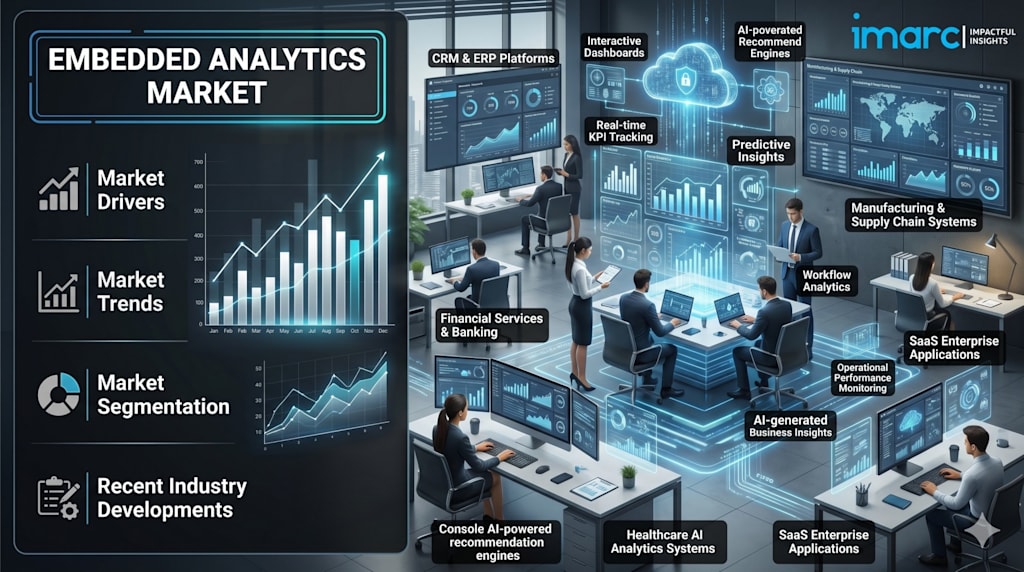
According to IMARC Group's latest research publication, the global Embedded Analytics Market size reached USD 78.5 Billion in 2025. Looking forward, IMARC Group expects the market to reach USD 221.0 Billion by 2034, exhibiting a growth rate of 11.82% during 2026-2034.
How AI is Reshaping the Future of the Embedded Analytics Market
- Automated Insights and Anomaly Detection: AI and machine learning algorithms embedded within analytics platforms are enabling automated identification of anomalies, irregular data patterns, and emerging trends without requiring manual intervention from IT teams. Enterprises deploying AI-driven embedded analytics report faster detection of operational inefficiencies, fraudulent transactions, and supply chain disruptions. According to an industry report, over 75% of enterprises are expected to embed AI-oriented analytics within business applications to enhance decision-making capabilities, signaling a fundamental shift away from reactive reporting toward proactive intelligence generation embedded directly within operational workflows.
- Predictive Analytics and Trend Forecasting: Machine learning systems integrated into embedded analytics platforms analyze historical data patterns to generate forward-looking predictions directly within the applications businesses already use. Financial institutions are leveraging these capabilities to forecast cash flow positions, predict credit risk, and optimize investment strategies without exporting data to separate analytical environments. Healthcare providers are deploying predictive embedded analytics to anticipate patient readmission risks and optimize staff scheduling. This convergence of prediction and application is eliminating the traditional gap between insight generation and operational action.
- Natural Language Processing and Conversational Interfaces: AI-powered natural language processing is enabling business users to query embedded analytics systems using plain language rather than requiring structured queries or technical expertise. Employees across marketing, finance, and operations departments can ask direct questions of their data and receive visual, contextualized answers without engaging IT support. This capability is expanding the effective user base of embedded analytics far beyond data specialists, accelerating the democratization of organizational data access and supporting the broader shift toward self-service analytics that 80% of organizations are projected to prioritize over traditional dashboards.
- Real-Time Data Processing and Streaming Analytics: AI-enhanced embedded analytics platforms are processing continuous data streams from customer interactions, sensor networks, production lines, and financial transactions to deliver insights within application interfaces in milliseconds rather than hours. Retailers are embedding these capabilities directly into point-of-sale and inventory management systems, enabling store managers to respond to demand shifts instantaneously. Cloud infrastructure advances are supporting this shift, with providers continuously improving the processing architecture that underpins real-time embedded intelligence, removing the latency barriers that previously limited analytics to retrospective batch reporting.
- Personalization Engines and User-Specific Dashboards: AI systems within embedded analytics platforms are learning individual user behavior, role responsibilities, and decision-making patterns to automatically surface the most relevant metrics and visualizations for each person within an organization. Rather than presenting identical dashboards to all users, these intelligent systems tailor the analytical experience to individual business functions, reducing cognitive overload and improving the speed with which users act on insights. Marketing teams receive campaign performance views while finance teams see cost variance analysis, all driven by the same underlying embedded analytics engine with AI determining the optimal presentation for each user.
Embedded Analytics Industry Overview:
The global embedded analytics market is experiencing sustained expansion driven by the accelerating adoption of data-driven decision-making across industries, rising demand for real-time operational intelligence, and the increasing integration of cloud infrastructure with enterprise software platforms. North America currently holds the dominant regional position, accounting for 32.6% of the total market share, supported by a dense concentration of technology companies, stringent regulatory requirements in healthcare and finance that mandate real-time data monitoring, and aggressive government support for AI adoption. The Biden administration's budget proposal for the fiscal year allocated USD 3 Billion to federal agencies for ethical development and incorporation of AI solutions, directly stimulating demand for embedded analytics capabilities across government and regulated industries.
Embedded Analytics Market Trends and Drivers
The increasing demand for data security and regulatory compliance is one of the most powerful structural forces driving adoption of embedded analytics solutions globally. Compliance frameworks including GDPR and HIPAA are requiring organizations in healthcare, finance, and government to demonstrate precise data governance, audit trails, and access controls that embedded analytics platforms are specifically architected to support. With 60% of global organizations citing compliance as a top strategic priority, embedding analytics directly within existing applications eliminates the data transfer risks associated with exporting information to separate reporting environments.
The rising adoption of self-service analytics is simultaneously expanding the addressable user base for embedded analytics and accelerating organizational decision-making velocity. Traditional analytics environments required users to submit requests to centralized IT teams, creating bottlenecks that could delay insight generation by days or weeks. Embedded self-service capabilities allow marketing managers, operations supervisors, and financial analysts to create customized reports and monitor live data directly within the applications they use daily, without any technical intermediary. This operational independence is particularly valuable in dynamic market environments where competitors with faster data-to-decision cycles command measurable advantages.
Cloud adoption is transforming the deployment economics of embedded analytics, making sophisticated analytical capabilities accessible to small and medium-sized enterprises that previously lacked the infrastructure investment capacity to deploy on-premises solutions. Cloud-based embedded analytics eliminates the need for dedicated servers, database administrators, and complex software licensing arrangements, replacing capital-heavy infrastructure investments with predictable subscription models that scale with organizational data volumes.
Leading Companies Operating in the Global Embedded Analytics Industry:
- Infor (Koch Industries Inc.)
- International Business Machines Corporation
- Logi Analytics Inc. (Insightsoftware Inc.)
- Microsoft Corporation
- Open Text Corporation
- Oracle Corporation
- QlikTech International AB
- SAP SE
- Sisense Inc.
- Tableau Software LLC (Salesforce.com Inc.)
- TIBCO Software Inc.
- Yellowfin
Embedded Analytics Market Report Segmentation:
By Solution:
- Software
- Services
Services held the biggest market share in 2025, as businesses require expert support for implementation, customization, and ongoing management of analytics solutions, particularly as cloud migration and AI integration increase the complexity of deployment environments.
By Analytics Tool:
- Dashboard and Data Visualization
- Self-Service Tools
- Benchmarking
- Reporting
Dashboard and data visualization accounted for the largest share, as businesses require clear, real-time interfaces to monitor key metrics, track operational performance, and present complex data in formats accessible to non-technical users across all departments.
By Deployment Mode:
- On-Premises
- Cloud-Based
Cloud-based deployment dominates the market owing to its flexibility, scalability, and cost efficiency, enabling businesses of all sizes to integrate analytics capabilities without heavy IT infrastructure investment or dedicated maintenance overhead.
By Business Function:
- Finance
- Human Resources (HR)
- Marketing and Sales
- Production
- Others
Marketing and sales lead the overall market, as businesses depend on embedded analytics to track user behavior, measure campaign effectiveness, identify high-value leads, and personalize outreach strategies using real-time data insights.
By Organization Size:
- Small and Medium-sized Enterprises (SMEs)
- Large Enterprises
Large enterprises account for the majority of current deployment activity owing to their extensive data volumes, complex operational requirements, and higher budgets for AI-focused analytics integration across cloud, on-premises, and hybrid environments.
By Industry Vertical:
- BFSI
- IT and Telecommunication
- Retail and Consumer Goods
- Healthcare and Life Sciences
- Manufacturing
- Government
- Energy and Utilities
- Others
BFSI accounted for 24.0% of the market share, as financial institutions rely on real-time embedded analytics to detect fraud, manage risk, ensure regulatory compliance, and deliver personalized banking and insurance experiences to customers.
Regional Insights:
- North America (United States, Canada)
- Asia Pacific (China, Japan, India, South Korea, Australia, Indonesia, Others)
- Europe (Germany, France, United Kingdom, Italy, Spain, Russia, Others)
- Latin America (Brazil, Mexico, Others)
- Middle East and Africa
North America exhibits clear dominance in the embedded analytics market, accounting for 32.6% of the global share, owing to the concentration of major technology vendors, strict data governance regulations, and high enterprise investment in AI and cloud-based analytics infrastructure.
Recent News and Developments in the Embedded Analytics Market
- September 2024: Oracle launched more than 50 AI-driven agents within the Oracle Fusion Cloud Applications Suite, improving capabilities across finance, HR, supply chain, and customer experience functions. The new AI agents were designed to enhance cash forecasting, streamline workflows, and support faster decision-making, with the features included at no additional cost to existing customers targeting improvements in productivity, operational efficiency, and revenue expansion.
- June 2024: SAP announced plans to double its embedded AI applications to 100 by year-end, concentrating expansion efforts across sourcing, supply chain management, customer experience, and sales functions. SAP CEO Christian Klein emphasized that business AI capabilities would differentiate the company's applications, highlighting that the suite already featured more than 50 pre-trained AI applications integrated directly into its service offerings.
- April 2024: Insightsoftware launched Logi AI and Logi SaaS as additions to its Logi Symphony platform, strengthening embedded analytics capabilities through generative AI integration and a fully managed SaaS offering. Logi AI delivered personalized AI-oriented insights for business users, while Logi SaaS simplified the deployment and management process, with the combined update aimed at reinforcing Logi Symphony's competitive standing in the embedded business intelligence segment.
Note: If you require specific details, data, or insights that are not currently included in the scope of this report, we are happy to accommodate your request. As part of our customization service, we will gather and provide the additional information you need, tailored to your specific requirements. Please let us know your exact needs, and we will ensure the report is updated accordingly to meet your expectations.
About the Creator
Abhay Rajput
I am working in market research company that provides market and business research intelligence across the globe.
Enjoyed the story? Support the Creator.
Subscribe for free to receive all their stories in your feed.
Comments
There are no comments for this story
Be the first to respond and start the conversation.