
Electric Vehicle Market Trends: Fast-Charging Networks, OEM Strategies & Forecast to 2034
How fast-charging technologies, increasing driving range, and growing consumer awareness are reshaping purchasing decisions and boosting adoption in the electric vehicle market worldwide

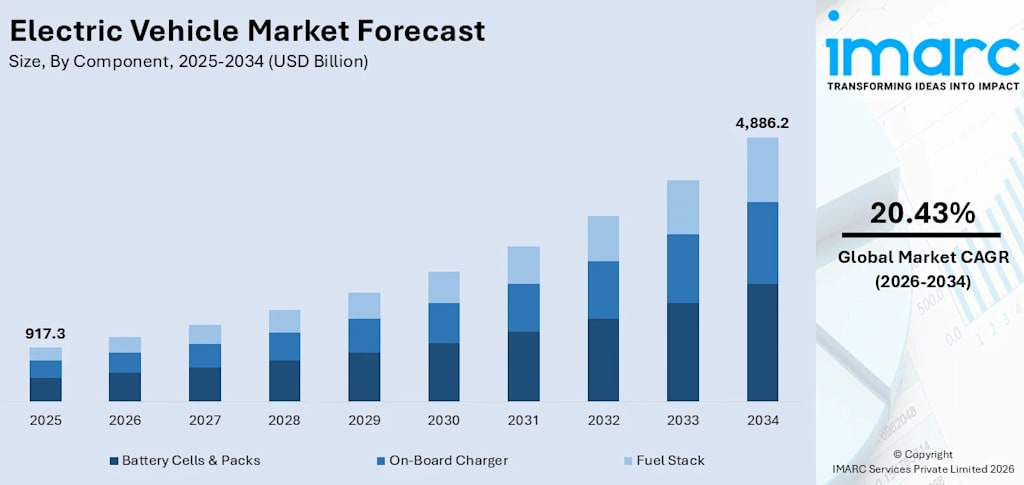
Global concerns over environmental sustainability and the urgent need to reduce carbon emissions are fueling a transformative shift in the automotive landscape. As nations transition away from fossil fuels, the adoption of electric vehicles (EVs) is being accelerated by rapid advancements in battery technology, expanding charging networks, and supportive policy frameworks. According to IMARC Group’s latest data, the global electric vehicle market size was valued at USD 917.3 Billion in 2025. Looking forward, IMARC Group estimates the market to reach USD 4,886.2 Billion by 2034, exhibiting a CAGR of 20.43% from 2026-2034.
The electric vehicle sector has matured into a nearly trillion-dollar industry, defined by a transition from niche enthusiast adoption to mass-market integration. This evolution is driven by significant improvements in energy density, allowing modern lithium-ion batteries to provide longer ranges that meet the daily needs of urban and rural commuters alike. Government-led initiatives, such as China’s extension of purchase tax exemptions and Germany’s social-focused incentive programs, are making these vehicles more accessible to a broader demographic.
Electric Vehicle Market Growth Drivers:
- Aggressive Decarbonization and Emission Mandates
Global climate commitments are forcing a total rethink of transportation. With passenger vehicles alone emitting nearly 4.6 metric tons of CO2 annually, governments are implementing strict mandates to phase out internal combustion engines. In the United States, federal goals aim for half of all new vehicle sales to be zero-emissions by 2030. This regulatory pressure, combined with local "clean air zones" in major cities, creates a massive tailwind for EVs. Manufacturers are responding by pivoting their entire production lines toward electrification to avoid heavy non-compliance penalties and meet corporate ESG targets.
- Breakthroughs in Battery Efficiency and Costs
The cost of batteries, which traditionally accounts for a large portion of an EV’s price, has dropped significantly as production scales. Global battery demand exceeded 750 GWh recently, driven by innovations in lithium iron phosphate (LFP) chemistry and solid-state research. These advancements not only lower the entry price for consumers but also extend the vehicle's lifespan and charging speed. Enhanced energy storage capacity now allows many mid-range models to exceed 300 miles on a single charge, making them a practical, cost-competitive alternative to gasoline cars for the average household.
Grab Your Free Copy of the "Electric Vehicle Market" Analysis Now!
- Expansion of High-Speed Charging Infrastructure
A vehicle is only as useful as its ability to refuel, and the rapid deployment of public infrastructure is changing the game. Public charging points are projected to reach nearly 25 million by 2035, moving beyond simple home units to ultra-fast highway hubs. These stations utilize advanced power electronics to deliver high-kilowatt charging, drastically reducing wait times. As networks become more dense and reliable, fleet operators and long-distance travelers are increasingly comfortable making the switch, knowing that a "refill" is now as convenient as a quick coffee break during a journey.
Electric Vehicle Market Trends:
- Socially Targeted Incentives and Affordability Programs
A new wave of government policy is focusing on making EVs inclusive rather than just a luxury for the wealthy. For instance, Germany’s 2026 incentive program specifically targets households with annual incomes under €80,000, offering subsidies up to €4,500. By lowering the upfront cost barrier for middle- and lower-income families, these schemes are expanding the total addressable market. This trend is mirrored in emerging economies where "trade-in" grants and tax exemptions are being used to stimulate demand for affordable, entry-level electric models, particularly in the two- and three-wheeler segments.
- Strategic Regionalization of Supply Chains
In response to global trade complexities and high tariffs such as the 25% automobile tariffs introduced in some regions automakers are moving toward "local-for-local" production. Companies are investing billions in regional manufacturing hubs to produce batteries and vehicles closer to their end markets. This shift reduces reliance on long-distance logistics, minimizes the impact of geopolitical trade tensions, and helps manufacturers tailor vehicle specifications to local climate and infrastructure needs. We are seeing a surge in domestic "Gigafactories" across North America and Europe to secure the critical minerals and components required for sustained growth.
- Diversification into Heavy-Duty and Commercial Fleets
Electrification is no longer limited to small cars; it is rapidly moving into the heavy-duty sector. In China, battery-electric heavy trucks recently hit a record 15% monthly sales share, supported by battery-swapping technology that eliminates long charging downtimes. Fleet operators are finding that while the initial purchase price is higher, the total cost of ownership is significantly lower due to reduced fuel and maintenance expenses. From electric delivery vans in urban centers to hydrogen fuel cell trucks for long-haul logistics, the commercial sector is becoming a primary engine for high-volume battery demand.
Recent News and Developments in Electric Vehicle Market:
- March 2026: Rivian announced that its highly anticipated R2 SUV will begin arriving in mid-2026. The dual-motor AWD setup is designed to offer 656 hp and 330 miles of range, targeting a competitive price point to capture the mid-size SUV market.
- January 2026: The German federal government launched its new €3 billion EV incentive program. This initiative is designed to support the registration of approximately 800,000 vehicles through 2029, focusing on social inclusivity and household energy transitions.
- December 2025: Lucid Motors shared details on its upcoming midsize platform, "Cosmos," with production slated for late 2026. The platform aims to expand Lucid's reach into more accessible utility vehicle segments beyond its luxury sedan lineup.
Note: If you require specific details, data, or insights that are not currently included in the scope of this report, we are happy to accommodate your request. As part of our customization service, we will gather and provide the additional information you need, tailored to your specific requirements. Please let us know your exact needs, and we will ensure the report is updated accordingly to meet your expectations.
About the Creator
Andrew Sullivan
Hello, I’m Andrew Sullivan. I have over 9+ years of experience as a market research specialist.
Enjoyed the story? Support the Creator.
Subscribe for free to receive all their stories in your feed.
Comments
There are no comments for this story
Be the first to respond and start the conversation.