
Eclipse of the Void
When the Stars Dimmed, the Universe Awoke

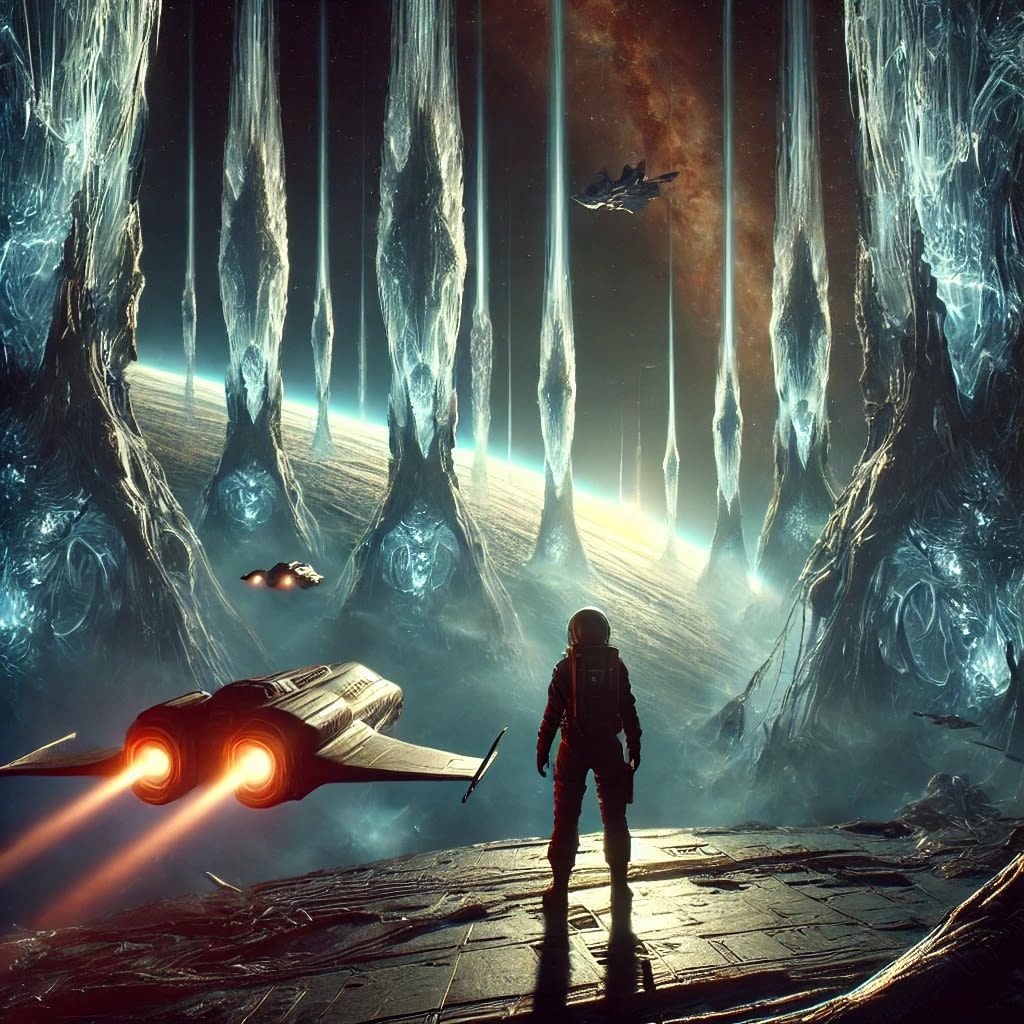
The day the stars vanished from the sky was the day humanity realized they were no longer alone. It began as a subtle shift in the night’s canvas—a few missing points of light, almost unnoticeable at first. But soon, the patches of darkness grew, spreading across the cosmos, consuming constellations, and sending scientists into a frenzy. The world's greatest observatories became useless, their once-proud telescopes aimed at an empty void.
At first, explanations were simple. Perhaps a nebula had passed in front of Earth’s view of the galaxy. Maybe it was a cosmic dust cloud obscuring our perspective. But as days turned into weeks, and then months, it became clear that this was no ordinary celestial event. The darkness was growing, creeping in like a living entity, swallowing galaxies whole, and leaving nothing behind. Humanity's view of the universe had gone dark.
In a state-of-the-art research facility hidden beneath the ice caps of Antarctica, Dr. Elara Thorn was leading a team tasked with understanding this anomaly. She had spent her life studying dark matter and the hidden forces of the cosmos, but even her expertise had limits. The “Void,” as it had come to be called, was beyond comprehension. It defied every law of physics, every model humanity had ever created to explain the universe.
Her team, a group of the brightest minds on the planet, worked around the clock, combing through data from satellites, deep-space probes, and ground-based observatories. But the data was meaningless. It was as though the universe itself had begun to fold in on itself, collapsing inward into an unfathomable abyss. Communication with other planets and star systems ceased. Colonies on Mars and the moons of Jupiter, which had thrived just months before, went silent.
Then came the signal.
It was faint at first, buried deep within the noise of the collapsing universe. But after weeks of analysis, Elara and her team were able to isolate it—a repeating pattern, unmistakably artificial. Something—or someone—was trying to communicate from within the Void.
The signal, once deciphered, was a simple message: “We are waiting.”
Elara couldn’t believe it. After centuries of searching for extraterrestrial life, the answer had come in the most unlikely of forms—an intelligence born from the heart of the darkness itself. And it was inviting them into the Void.
Against the advice of her peers, Elara pushed forward. She believed the Void was not just a destructive force, but a gateway—an invitation to explore a dimension beyond human comprehension. She assembled a team of engineers, scientists, and explorers to embark on a mission unlike any other. They would travel into the Void, using the most advanced spacecraft humanity had ever created, the Eclipse, capable of warping space-time itself.
Their journey into the unknown began with trepidation. As the Eclipse approached the edge of the Void, the stars disappeared one by one, and the ship was surrounded by an all-encompassing darkness. Time seemed to warp and stretch. Days felt like hours, and hours like seconds. There was no reference point, no stars to guide them, only the endless black.
Then they crossed the threshold.
Inside the Void, nothing was as it seemed. Elara’s instruments no longer obeyed the laws of physics. Space was twisted and folded in ways that defied logic, but it was not empty. There were structures—massive, towering constructs that stretched across light-years. These monolithic entities pulsed with energy, emitting a light that was both blinding and soothing. It was as if the Void was alive, a living organism vast beyond comprehension, and they had been swallowed into its belly.
Suddenly, the ship was no longer moving. They had reached something—a boundary, or perhaps a center. Elara could feel the presence of something vast, ancient, and intelligent watching them. A voice, or maybe a thought, entered her mind. It was neither threatening nor welcoming, just… curious.
“We created this space to understand the universe,” the entity communicated. “Your kind is ready to see beyond the limits of your reality.”
The next few days—or what felt like days—were spent in awe and terror. Elara and her crew were shown visions of other worlds, alternate dimensions where the laws of physics changed like the seasons. They saw the birth of stars, the collapse of galaxies, and the endless cycle of creation and destruction that the universe had hidden from them for so long. They realized that the Void was not an absence, but a bridge—a nexus that connected all possible realities.
But there was a cost.
The entity, which Elara came to call the Architect, had once been a species much like humanity. In their quest for knowledge, they had created the Void to study the universe from every angle, every possibility. But in doing so, they had become trapped within their own creation. Now, they sought others—beings capable of understanding the Void's nature—to help them escape their eternal prison.
Elara knew the decision before her. To leave the Void was possible, but to stay meant becoming part of something greater than humanity had ever dreamed. Her team could unlock the secrets of the universe, see realities beyond imagination, but they would never return. They would become like the Architects, eternal explorers, forever bound to the Void.
Elara made her choice.
When the Eclipse was found drifting near the edge of the Void months later, the ship was empty. No trace of Elara or her crew remained. But the stars had returned to the sky, and the universe was whole once more.
Some say the Void still exists, hidden beyond the reach of human eyes, waiting for the next generation of explorers to find it. And perhaps, somewhere deep within that endless darkness, Dr. Elara Thorn is still out there, guiding humanity toward its next evolutionary leap.
About the Creator
Enjoyed the story? Support the Creator.
Subscribe for free to receive all their stories in your feed.
Comments
There are no comments for this story
Be the first to respond and start the conversation.