
E-Waste Management Market Trends: IT Asset Disposal Growth & 2034
How stricter recycling regulations, growing data center upgrades, and secure IT asset disposal needs are reshaping the e-waste management market worldwide.

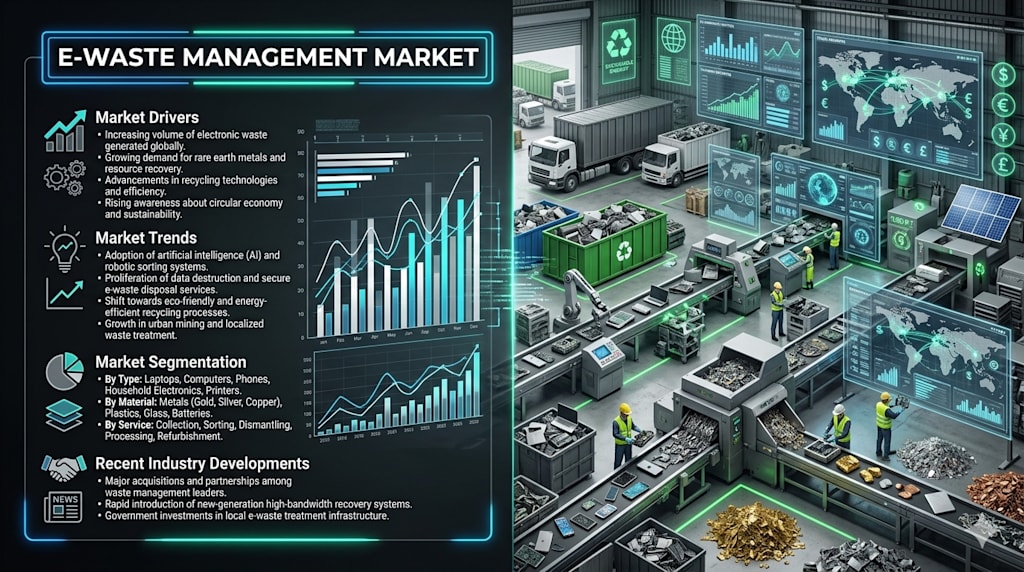
E-Waste Management Market Growth, Trends, and Key Insights
Rising volumes of discarded electronics, stricter government regulations, and growing awareness about hazardous waste disposal are driving e-waste management demand, supported by resource recovery economics, technological innovations in recycling, and expanding formal collection and processing infrastructure globally. According to IMARC Group's latest data, The global e-waste management market size was valued at USD 88.8 Billion in 2025. Looking forward, IMARC Group estimates the market to reach USD 225.0 Billion by 2034, exhibiting a CAGR of 10.56% during 2026-2034. Asia Pacific currently dominates the market, holding a significant market share of over 47.8% in 2025.
The e-waste management market represents one of the fastest-growing segments within the global environmental services industry, driven by surging volumes of discarded consumer and industrial electronics. The UN's Global E-waste Monitor revealed that electronic waste is generated five times faster than it is formally recycled, with a record 62 million tonnes produced in a single monitored period. Only 20% of global e-waste is officially documented as properly collected and recycled, with the remaining 80% ending up in landfills or informally processed.
E-Waste Management Market Growth Drivers:
Rapid Technological Advancements and Planned Obsolescence
Consumer electronics, from smartphones to laptops and televisions, are being replaced at increasingly shorter intervals as manufacturers introduce new models with enhanced performance, features, and design. Smartphones now average a lifespan of just 4.8 years, while desktop computers last approximately 5.7 years and multi-function printers around 5.6 years. Even televisions, once considered long-lasting products, have seen their expected lifespan shrink significantly over recent decades.
Growing Environmental Concerns and Regulatory Pressure
E-waste contains hazardous substances including lead, mercury, cadmium, and flame retardants. When improperly disposed of in landfills or incinerated, these materials leach into soil and groundwater, posing serious public health and environmental risks.
Resource Scarcity and Urban Mining Economics
Electronic devices are rich repositories of gold, silver, platinum, copper, palladium, and critical rare earth elements used across circuit boards, connectors, and wiring. As global demand for these materials intensifies, particularly for use in semiconductors and clean energy technologies, recovering them from e-waste offers a cost-efficient and geopolitically strategic alternative to conventional mining.
E-Waste Management Market Trends:
Expansion of Formal Collection Infrastructure
As regulatory frameworks tighten and EPR obligations increase, brands and governments are jointly investing in structured take-back programs, certified drop-off networks, and reverse logistics systems. Japan's Home Appliance Recycling Law mandates consumer-paid disposal of televisions, refrigerators, washing machines, and air conditioners, creating a self-financing collection mechanism.
Automation and AI-Driven Sorting Technologies
Advanced recycling facilities are increasingly deploying automated dismantling systems, robotic sorting arms, and AI-powered material identification tools to improve throughput and recovery precision. These technologies reduce reliance on manual labor for hazardous disassembly tasks while increasing the purity and yield of recovered metals and plastics.
Rise of Corporate ESG-Driven Recycling Commitments
As ESG (Environmental, Social, and Governance) reporting becomes mainstream for publicly listed companies, electronics manufacturers, retailers, and large enterprises are formalizing commitments to reduce the environmental footprint of their product portfolios. Corporate sustainability initiatives are driving producer-funded take-back programs, refurbishment partnerships, and third-party certified recycling agreements.
Recent News and Developments in E-Waste Management Market
March 2025: The European Commission finalized updated targets under its revised WEEE Directive, requiring member states to increase e-waste collection rates and mandating stricter documentation and tracking of cross-border shipments to close loopholes that previously allowed hazardous devices to be exported under the label of usable second-hand goods.
January 2025: Apple expanded its global trade-in and recycling program by deepening partnerships with certified e-waste processors in Southeast Asia, routing millions of recovered device components into structured material recovery and refurbishment streams as part of its broader environmental commitments.
September 2024: India's Central Pollution Control Board intensified enforcement of EPR compliance for electronics manufacturers, issuing notices to over 200 companies for failing to meet mandated collection and channelization targets under the country's E-Waste Management Rules.
Note: If you require specific details, data, or insights that are not currently included in the scope of this report, we are happy to accommodate your request. As part of our customization service, we will gather and provide the additional information you need, tailored to your specific requirements. Please let us know your exact needs, and we will ensure the report is updated accordingly to meet your expectations.
About the Creator
Suhaira Yusuf
I specialize in Consumer Insights, focusing on transforming detailed market data into strategic business solutions that accelerate growth and improve customer engagement.
Enjoyed the story? Support the Creator.
Subscribe for free to receive all their stories in your feed.
Comments
There are no comments for this story
Be the first to respond and start the conversation.