
E-Fuels Market Set for Rapid Growth as Industries Accelerate the Shift to Synthetic Energy
Driven by regulatory mandates, technological innovation, and rising demand from aviation and shipping, the global e-fuels industry is entering a new phase of commercial expansion.

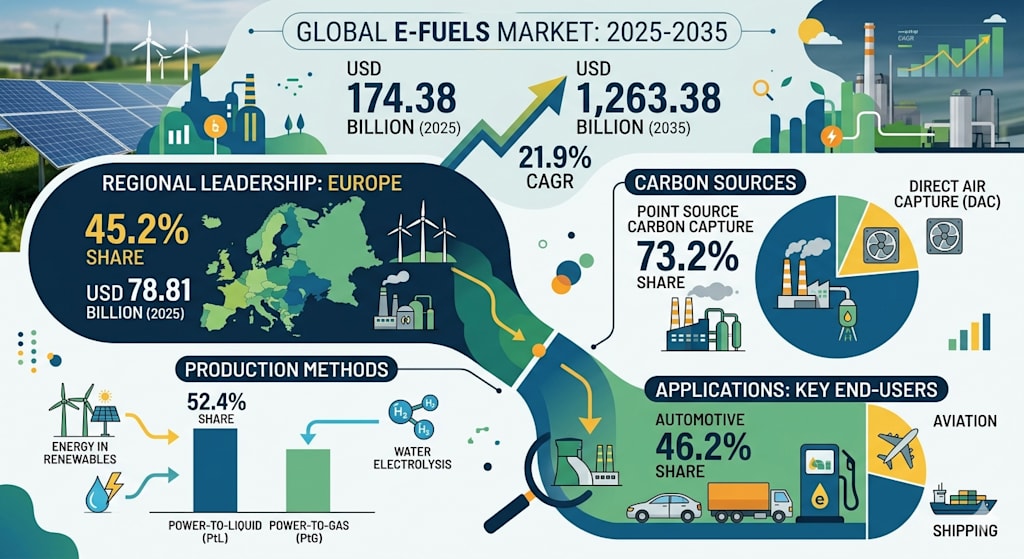
The global energy transition is creating opportunities for technologies that can reduce emissions without requiring a complete overhaul of existing infrastructure. Among the most promising solutions are e-fuels, synthetic fuels produced using renewable electricity, captured carbon dioxide, and green hydrogen. These fuels are emerging as a practical pathway for sectors that cannot easily switch to battery-powered alternatives, including aviation, marine transport, and heavy industry.
The E-Fuels Market is projected to grow from USD 174.38 billion in 2025 to approximately USD 1,263.38 billion by 2035, representing a compound annual growth rate (CAGR) of 21.9% during the forecast period. This remarkable expansion reflects growing confidence among governments, investors, and industrial buyers that synthetic fuels will play a critical role in achieving long-term climate goals.
Market Highlights
- Europe dominates the market with a 45.2% share, valued at USD 78.81 billion in 2025.
- The Point Source Carbon Capture segment leads the carbon source category with a 73.2% share.
- The Power-to-Liquid production method holds the largest share at 52.4%.
- Automotive applications account for the dominant share of 46.2%.
Why Synthetic Fuels Are Gaining Momentum
Unlike conventional fossil fuels, e-fuels are created using renewable energy sources. Producers generate green hydrogen through electrolysis and combine it with captured carbon dioxide or nitrogen to create liquid or gaseous fuels such as e-methanol, e-kerosene, e-diesel, and e-hydrogen.
One of the strongest advantages of these fuels is compatibility. Many e-fuels can be used in existing engines, vehicles, aircraft, and fuel distribution systems with little or no modification. This allows industries to reduce emissions without replacing expensive infrastructure.
The market is also benefiting from a shift in corporate purchasing behavior. What began as small-scale pilot programs has evolved into long-term supply agreements between producers and major transportation companies. Airlines, shipping firms, and automotive manufacturers are increasingly securing future fuel supplies to meet regulatory requirements and sustainability commitments.
As demand accelerates, concerns are emerging about future supply constraints. Industry observers note that production capacity must expand rapidly to prevent shortages as more companies compete for access to certified synthetic fuels.
Government Regulations Are Reshaping Demand
Perhaps the most important growth driver is regulation. Across Europe, new policies are transforming synthetic fuels from an optional sustainability initiative into a compliance requirement.
The European Union’s ReFuelEU Aviation regulation requires increasing levels of sustainable aviation fuel in the coming decades, while FuelEU Maritime establishes progressively stricter emissions targets for shipping operators. These measures create guaranteed demand for synthetic fuels through 2050.
Such regulatory certainty is changing investment dynamics. Project developers can secure financing more easily when future demand is backed by law rather than voluntary commitments. Financial institutions view long-term fuel contracts as evidence of predictable revenue, improving the bankability of major projects.
The impact extends beyond Europe. Countries across Asia-Pacific, North America, and Latin America are developing hydrogen and synthetic fuel strategies to position themselves within emerging global supply chains. As more governments introduce emissions reduction policies, demand is expected to broaden geographically.
Technology and Production Trends Driving Market Expansion
Advancements in production technology are helping improve efficiency and reduce costs. Among various production methods, Power-to-Liquid technology currently leads the market, accounting for more than half of total production activity.
This process uses renewable electricity, hydrogen production, and fuel synthesis technologies to create liquid hydrocarbons that can directly replace traditional fuels. Because the resulting products require minimal refining and work within existing fuel systems, they are particularly attractive for aviation and transportation applications.
Large-scale facilities are already demonstrating commercial viability. Projects in Denmark, Chile, Finland, and other regions are proving that industrial-scale production is achievable when supported by abundant renewable energy resources and long-term customer commitments.
Applications Across Transportation and Industry
Transportation remains the largest application area for synthetic fuels, with automotive use currently representing the largest share of demand. Existing vehicle fleets can immediately utilize e-gasoline and e-ethanol blends, making the automotive sector an important early market.
However, aviation is widely viewed as the most significant long-term opportunity. Commercial aircraft have limited alternatives for deep decarbonization, making synthetic aviation fuels an essential component of future emissions reduction strategies. Airlines are increasingly signing long-term agreements to secure supply and ensure compliance with future regulations.
The maritime industry is also emerging as a major growth segment. Global shipping companies face mounting pressure to reduce greenhouse gas emissions and comply with international standards. As a result, demand for e-methanol and e-ammonia is rising, particularly for newly built vessels designed to operate on alternative fuels.
Industrial users represent another promising market. Synthetic gases such as e-hydrogen and e-methane can help decarbonize manufacturing processes, industrial heating systems, and power generation facilities without requiring extensive infrastructure replacement.
Together, these diverse applications create a broad and resilient demand base that supports continued industry growth.
Regional Markets and Emerging Investment Hotspots
Europe currently leads the global industry, accounting for more than 45% of total market value. Strong regulatory frameworks, ambitious climate targets, and active investment in renewable energy projects have positioned the region at the forefront of synthetic fuel adoption.
Asia-Pacific is rapidly building momentum. Countries including Japan, South Korea, China, India, and Australia are investing heavily in hydrogen infrastructure and Power-to-X technologies. Australia, in particular, is leveraging its vast renewable energy potential to develop export-focused synthetic fuel projects.
Latin America has emerged as another important growth region. Chile and Uruguay are attracting international attention due to abundant wind and solar resources that enable low-cost renewable electricity generation. These advantages make the region highly competitive for large-scale fuel production aimed at export markets.
Meanwhile, the Middle East is exploring opportunities to use its strong solar resources and existing energy infrastructure to establish itself as a future supplier of synthetic fuels to global markets.
Major investments continue to flow into the sector. Financial commitments from infrastructure funds and energy companies indicate growing confidence that synthetic fuels will become an essential component of the global energy mix over the next decade.
Challenges That Could Influence Future Growth
Despite strong momentum, several challenges remain. The most significant is cost. Producing synthetic fuels requires substantial amounts of renewable electricity, making them more expensive than conventional fossil fuels in many markets.
Carbon capture infrastructure also remains limited in several regions. Developers must secure reliable sources of carbon dioxide while simultaneously building production facilities, adding complexity and expense to new projects.
Project economics can be sensitive to changes in energy prices, financing costs, and customer demand. Some planned facilities have been delayed or canceled due to rising costs and insufficient long-term purchase agreements. These cases highlight the importance of securing strong commercial partnerships before moving forward with large-scale investments.
Nevertheless, continued technological improvements, falling renewable energy costs, and supportive policy frameworks are expected to gradually improve competitiveness over time.
The Road Ahead
The future of the E-Fuels Market appears increasingly tied to global decarbonization efforts. As governments tighten emissions regulations and industries seek practical pathways toward net-zero goals, synthetic fuels are moving from experimental projects to mainstream energy solutions. Their ability to work within existing infrastructure provides a unique advantage, particularly in sectors where electrification remains difficult.
While challenges related to cost, infrastructure, and scale remain, the combination of regulatory support, technological progress, and rising commercial demand is creating a powerful growth foundation. Over the next decade, synthetic fuels are expected to become a critical bridge between today’s energy systems and a lower-carbon future, helping industries reduce emissions while maintaining operational flexibility and energy security.
About the Creator
Yash Mule
SEO Specialist with 10+ years of experience at Evolvance Market Research. Expert in technical SEO, content strategy, and data-driven optimization, with a proven track record of significantly increasing organic traffic and search rankings.
Enjoyed the story? Support the Creator.
Subscribe for free to receive all their stories in your feed.
Comments
There are no comments for this story
Be the first to respond and start the conversation.