
eDiscovery Market Trends: AI-Powered Legal Analytics, Compliance Demand & Forecast to 2034
How AI-powered document review, predictive coding technologies, and compliance requirements are transforming legal workflows and operational efficiency in the eDiscovery market

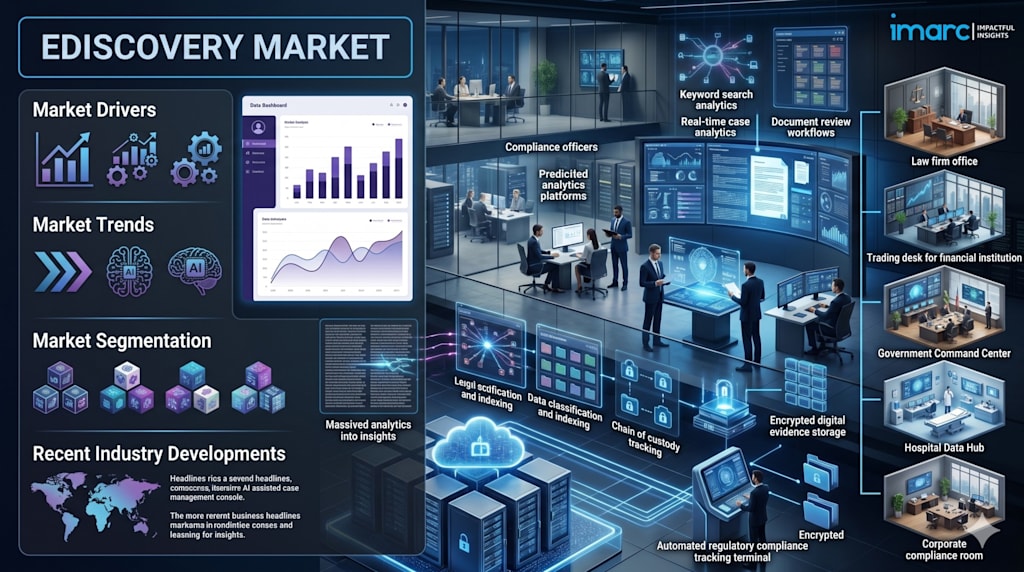
According to IMARC Group's latest research publication, the global eDiscovery market size reached USD 15.4 Billion in 2025. Looking forward, IMARC Group expects the market to reach USD 28.5 Billion by 2034, exhibiting a growth rate (CAGR) of 6.70% during 2026-2034.
How AI is Reshaping the Future of the eDiscovery Market
- Predictive Coding and Automated Document Review: AI-powered predictive coding systems are fundamentally transforming how legal and compliance teams approach document review in eDiscovery workflows. Machine learning models trained on attorney-coded sample sets can now classify and prioritize millions of documents within hours, dramatically reducing the time and cost associated with large-scale litigation reviews. Organizations adopting AI-driven predictive coding have reported substantial reductions in manual review hours, enabling legal teams to focus analytical resources on the most legally significant materials rather than sifting through entire document populations. This capability is particularly valuable for government agencies and large enterprises managing high-volume regulatory investigations where review timelines are constrained and evidentiary accuracy is non-negotiable.
- Natural Language Processing for Unstructured Data Extraction: AI-powered natural language processing engines are enabling eDiscovery platforms to extract, classify, and contextualize information from the full spectrum of unstructured data sources, including collaboration tools, encrypted messaging applications, audio transcripts, video recordings, and social media content. As organizations increasingly conduct business across platforms such as Slack, Microsoft Teams, and WhatsApp, legal and compliance teams face mounting pressure to surface relevant communications that traditional keyword search methodologies consistently miss. NLP-driven eDiscovery tools can identify conceptual relationships, sentiment patterns, and entity connections across fragmented data sets, delivering far more defensible and comprehensive discovery outputs than conventional search approaches.
- AI-Driven Early Case Assessment and Litigation Analytics: Artificial intelligence is enabling legal teams to conduct rapid early case assessment by analyzing document populations, identifying key custodians, flagging privilege risks, and estimating discovery scope within days rather than weeks. AI-powered litigation analytics platforms now provide attorneys with data-driven insights into case strength, opposing counsel strategies, judicial tendencies, and settlement probabilities drawn from historical case outcomes and real-time document analysis. These capabilities are reshaping how law firms and corporate legal departments allocate resources and develop litigation strategy, shifting the practice from intuition-driven to evidence-driven decision-making at the earliest stages of case preparation.
- Cloud-Integrated AI Platforms for Scalable Data Processing: The convergence of cloud computing infrastructure and AI-powered processing is enabling eDiscovery platforms to scale dynamically in response to the surging volumes of electronically stored information generated across modern enterprises. Cloud-native eDiscovery solutions equipped with AI orchestration capabilities can ingest, process, deduplicate, and index massive data sets from geographically distributed sources simultaneously, without the physical infrastructure constraints that limit on-premises deployments. This scalability is proving especially critical as over 97% of business records are now generated and stored digitally, and global email traffic has reached nearly 250 billion messages each day, requiring eDiscovery platforms capable of handling data volumes that would overwhelm legacy processing architectures entirely.
- AI-Powered Compliance Monitoring and Regulatory Risk Management: As data privacy regulations such as GDPR in Europe and CCPA in the United States impose increasingly stringent requirements on how organizations identify, preserve, and produce electronically stored information, AI-powered compliance monitoring tools embedded within eDiscovery platforms are enabling proactive rather than reactive legal risk management. These systems continuously scan organizational data environments to identify potential compliance exposures, flag improperly retained personal data, and generate audit-ready documentation trails that satisfy regulatory reporting requirements. For sectors including BFSI, healthcare, and government, where a single compliance failure can trigger investigations, penalties, and reputational damage, AI-driven eDiscovery compliance capabilities are transitioning from a value-added feature into an essential operational requirement.
eDiscovery Industry Overview:
The global eDiscovery market is experiencing steady growth driven by the convergence of three powerful structural forces: the escalating volume and complexity of electronically stored information, the tightening of legal and regulatory compliance obligations across industries, and the rapid maturation of artificial intelligence and cloud computing technologies that are making sophisticated eDiscovery capabilities accessible to organizations of all sizes. It is estimated that over 97% of business records are now generated and stored digitally, while global email traffic has reached nearly 250 billion messages daily, a figure that excludes the rapidly growing volumes of text messages, collaboration platform communications, and social media content that organizations must now be prepared to collect and produce in litigation and regulatory proceedings. Government agencies and federal bodies remain the largest end-user segment, as their broad legal mandates, freedom of information obligations, and continuous involvement in investigations and audits make eDiscovery tools a core operational necessity rather than a situational procurement. The Federal Rules of Civil Procedure in the United States continue to define rigorous standards for electronic evidence management and production, compelling law firms and corporate legal departments to invest in platforms capable of meeting defensibility requirements at scale. In Europe, the General Data Protection Regulation has added a parallel dimension of complexity to eDiscovery obligations, as organizations must simultaneously satisfy legal discovery requirements and data minimization and privacy protection mandates that can conflict with broad document collection practices. The Asia Pacific region is emerging as a high-growth area for eDiscovery adoption, driven by rapid digitalization, expanding data privacy legislation in markets including India, China, and Singapore, and a rising incidence of cross-border corporate litigation and regulatory investigations that demand multilingual, jurisdiction-aware discovery capabilities.
eDiscovery Market Trends and Drivers
The increasing complexity and volume of electronically stored information is the foundational driver reshaping the eDiscovery market. It is no longer sufficient for organizations to manage emails and word processing documents alone. Legal and compliance teams must now contend with data generated across cloud storage platforms, enterprise collaboration tools, encrypted messaging applications, IoT-connected devices, and social media channels, all simultaneously. This proliferation of data sources, formats, and storage environments has rendered traditional keyword-search-based discovery methodologies inadequate, as they consistently fail to surface relevant information embedded within unstructured multimedia content, fragmented conversations, or geographically dispersed cloud repositories. The pressure to ensure defensible, comprehensive discovery across this increasingly complex data landscape is driving sustained demand for advanced eDiscovery solutions capable of adapting to evolving data environments while maintaining full compliance with regional and sector-specific legal requirements including GDPR and CCPA.
Rising litigation activity and the intensification of regulatory compliance requirements across virtually every industry sector represent the second structural driver sustaining the eDiscovery market's robust growth trajectory. Organizations in the BFSI sector face continuous scrutiny from financial regulators requiring detailed transaction records, communications archives, and audit trails that must be produced rapidly and accurately. Healthcare organizations must navigate HIPAA-mandated data governance obligations alongside increasing litigation exposure related to patient data handling. Government entities at federal, state, and municipal levels face mounting freedom of information requests alongside criminal and civil investigations that require systematic electronically stored information retrieval. The global expansion of data protection legislation, with new frameworks being enacted across Latin America, the Middle East, and the Asia Pacific region, is further extending the eDiscovery compliance obligation to organizations that previously operated in less regulated environments, expanding the addressable market for solution providers with internationally capable platforms.
Continuous technological advancements in artificial intelligence, machine learning, and cloud computing are the third driver accelerating adoption and expanding the functional boundaries of the eDiscovery market. AI has automated critical workflow components including predictive coding, document tagging, privilege log generation, and custodian identification, delivering speed and accuracy improvements that make large-scale discovery economically viable for organizations that previously could not afford the manual review costs associated with complex litigation. Cloud-based eDiscovery platforms have democratized access to enterprise-grade discovery capabilities by enabling small and mid-sized organizations to process and review large document populations through cost-effective subscription models without the capital expenditure of on-premises infrastructure. The integration of remote collaboration features into cloud-native eDiscovery platforms has also proven particularly valuable as hybrid work environments have become the operational standard, allowing legal teams and outside counsel to conduct joint reviews, annotations, and productions across geographic boundaries in real time.
Leading Companies Operating in the Global eDiscovery Industry:
- Arctera
- Casepoint
- Commvault Systems Inc.
- Conduent Incorporated
- CS DISCO, Inc.
- Deloitte
- FTI Consulting, Inc.
- KLDiscovery
- KPMG
- Logikcull
- Open Text Corporation
- Relativity ODA LLC
eDiscovery Market Report Segmentation:
By Component:
- Services
- Software
Services represent the largest segment, as the increasing complexity of processing and analyzing vast volumes of electronically stored information drives sustained demand for consulting, implementation, managed review, and support services that help organizations navigate legal requirements, reduce operational risk, and optimize their eDiscovery workflows efficiently.
By Deployment Type:
- On-premises
- Cloud-based
- Hybrid
On-premises deployment accounts for the largest market share, as organizations operating in data-sensitive sectors including finance, healthcare, and government prioritize the granular control, security, and regulatory compliance enforcement that on-premises infrastructure provides, enabling them to align eDiscovery data handling with strict internal security policies and regulatory mandates.
By End-User:
- Government/Federal Agencies and Legal and Regulatory Firms
- Enterprises
Government and federal agencies along with legal and regulatory firms represent the largest end-user segment, driven by their extensive legal mandates, continuous involvement in investigations and audits, and statutory obligations to systematically collect, preserve, review, and produce electronically stored information in compliance with established procedural and evidentiary standards.
By Vertical:
- BFSI
- Retail and Consumer Goods
- Manufacturing
- Legal
- IT and Telecommunication
- Government
- Energy and Utilities
- Healthcare and Life Science
- Others
The government sector accounts for the largest vertical share, driven by the breadth and criticality of its data management obligations spanning criminal and civil investigations, freedom of information requests, regulatory audits, and public accountability requirements that demand robust, scalable, and defensible eDiscovery capabilities across diverse document types and data formats.
Regional Insights:
- North America (United States, Canada)
- Asia Pacific (China, Japan, India, South Korea, Australia, Indonesia, Others)
- Europe (Germany, France, United Kingdom, Italy, Spain, Russia, Others)
- Latin America (Brazil, Mexico, Others)
- Middle East and Africa
North America leads the global eDiscovery market, underpinned by the advanced legal infrastructure of the United States, the Federal Rules of Civil Procedure establishing rigorous electronic evidence management standards, a dense concentration of multinational corporations generating substantial litigation and compliance activity, and the presence of leading eDiscovery technology and service providers that continuously drive innovation and raise industry capability benchmarks.
Recent News and Developments in the eDiscovery Market
- May 2025: eDiscovery AI joined the EDRM Trusted Partner Network, reinforcing its position as a specialized provider of AI-powered legal technology solutions. The partnership underscores the growing centrality of privacy-focused, AI-enabled discovery tools in addressing the evolving demands of litigation, compliance, and investigation workflows within hybrid work environments requiring secure data handling and cross-jurisdictional collaboration capabilities.
- February 2025: BRG expanded its cyber forensics and eDiscovery services across the Asia Pacific region through the strategic appointment of a senior cybersecurity expert based in Hong Kong. The expansion strengthens BRG's capacity to deliver end-to-end solutions spanning data security, compliance, risk management, and incident response, responding directly to intensifying demand across the APAC region for integrated eDiscovery capabilities paired with cybersecurity expertise to address complex legal and regulatory pressures in digital environments.
- September 2024: Reveal launched its Logikcull platform across European markets, introducing a self-service eDiscovery solution alongside its enterprise-grade platform, both powered by advanced artificial intelligence. The dual-platform strategy provides legal teams with greater operational flexibility in managing investigations and legal discovery workflows, while Reveal's European market entry strengthens the competitive landscape and expands access to scalable, AI-powered eDiscovery technology tailored to the diverse legal requirements of European organizations.
- April 2024: Commvault Systems Inc. launched a new cloud-based cleanroom recovery service enabling businesses to restore disaster recovery and ransomware-affected data from any location into a secure, quarantined cloud environment. The solution directly addresses growing enterprise demand for resilient data management infrastructure that supports both cybersecurity incident response and the preservation of electronically stored information required for litigation and regulatory compliance.
- April 2024: Conduent Incorporated announced a strategic collaboration with Microsoft to embed generative artificial intelligence into its global client services portfolio through the Microsoft Azure OpenAI Service. The partnership is designed to drive measurable improvements in quality, productivity, and processing velocity across healthcare claims management, customer service operations, fraud detection, and other critical compliance-oriented workflows that intersect directly with eDiscovery data processing and regulatory reporting requirements.
Note: If you require specific details, data, or insights that are not currently included in the scope of this report, we are happy to accommodate your request. As part of our customization service, we will gather and provide the additional information you need, tailored to your specific requirements. Please let us know your exact needs, and we will ensure the report is updated accordingly to meet your expectations.
About the Creator
Abhay Rajput
I am working in market research company that provides market and business research intelligence across the globe.
Enjoyed the story? Support the Creator.
Subscribe for free to receive all their stories in your feed.
Comments
There are no comments for this story
Be the first to respond and start the conversation.