
Dreamina AI: Co-Creating Virtual Spaces and the Future of Friendship
The Infinite Canvas of Intimacy: Moving from 'Staying in Touch' to Building Worlds

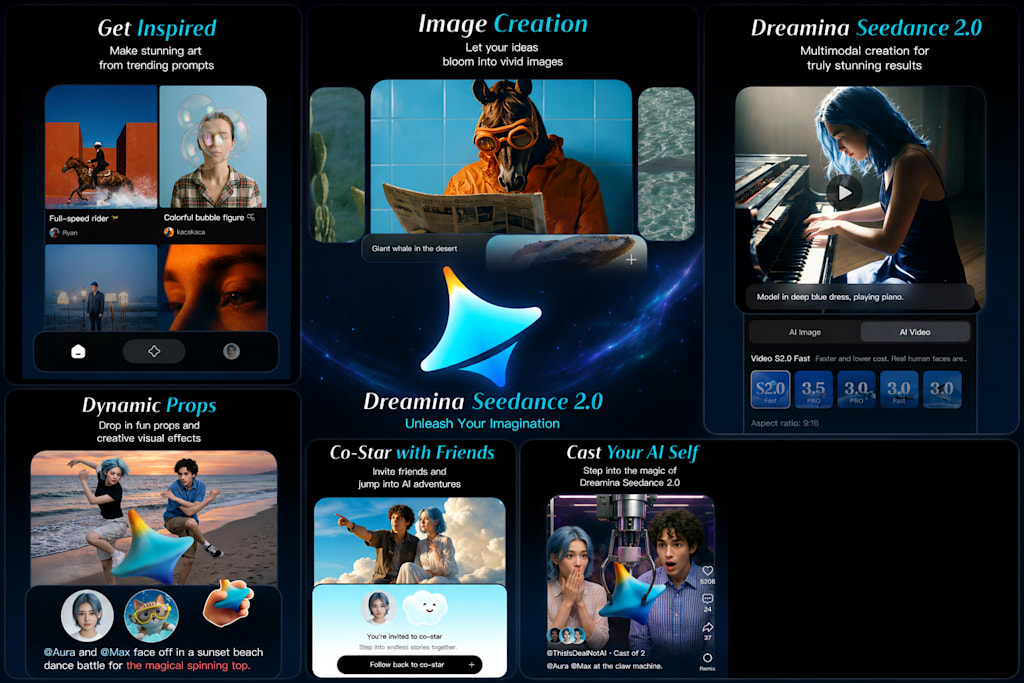
We’ve long been told that artificial intelligence would make the world a lonelier place—that screens would isolate us and algorithms would replace genuine human interaction. But what happens when the technology shifts from a solitary text prompt into a shared creative sandbox?
Enter Dreamina AI, ByteDance’s powerful multimedia creative suite.
Originally born as a desktop web tool, Dreamina has quietly taken a massive leap into our pockets. With the official rollout of its standalone mobile app, the platform is undergoing a radical evolution. Powered by the hyper-coherent Seedance 2.0 video model, Dreamina is moving far beyond simple solo image generation. Instead, it is becoming a digital hangout—a place where creators are building "co-created virtual spaces" to visualize, simulate, and deepen real-world friendships.
From cross-sharing unique character seeds to casting digital twins into synchronized dance routines or simulated action sequences on the Infinite Canvas, the app is fundamentally redefining what it means to collaborate.
The History of Dreamina AI: From Web Interface to Handheld Reality
To understand how Dreamina became a tool for friendship, we have to look at its evolutionary timeline. It didn't start as a mobile application; it was engineered through a strategic desktop-to-mobile pipeline.
Late 2025 – Early 2026 (The Web & Beta Era): ByteDance ran Dreamina primarily through browser platforms (dreamina.capcut.com). Mobile versions (v1.0.1 through v1.0.9) were highly restricted utility tools primarily used for testing single image rendering and cloud synchronization.
April 2026 (The Standalone Mobile Release): ByteDance officially launched "Dreamina: AI Image & Video Maker" as a standalone app, pushing versions 2.0.0 and 2.0.1. This update introduced the specialized video interface, making high-fidelity generative video accessible right from a smartphone screen.
Global Rollout: Countries, Regions, and Storefronts
ByteDance did not execute a uniform global drop. Instead, due to rigorous local data regulations, server constraints, and intellectual property frameworks, the app’s mobile deployment was restricted to a select network of 14 initial launch countries and regions.
The Storefront Distribution
Region Storefront Status Active Launch Countries
Europe & UK Google Play (Live) / iOS (Coming Soon) United Kingdom, France, Germany
North America Google Play (Live) / iOS (Coming Soon) Canada
Latin America Google Play (Live) / iOS (Coming Soon) Brazil, Mexico
East Asia & Oceania Google Play (Live) / iOS (Coming Soon) Japan, South Korea, Australia
Southeast Asia Google Play (Live) / iOS (Coming Soon) Thailand, Malaysia, Philippines, Vietnam, Indonesia
The U.S. Storefront Exception
While creators in Canada and the UK can easily download the native mobile app from their local Google Play Store, the United States is completely excluded from the mobile app storefront launch.
Because of intense regulatory scrutiny, data privacy laws, and shifting policy landscapes surrounding ByteDance properties in the US, a standalone Dreamina mobile app remains non-existent on American iOS and Google Play stores. While US creators can access the enterprise web framework via desktop web browsers, they lack the native mobile ecosystem that international friends are using to seamlessly share, prompt, and generate together on the go.
Why "Co-Creation" is the Casting Feature
In the context of this app, co-creation isn't just a marketing buzzword—it is driven entirely by the "Meet Cast" feature. The introduction of the Cast tool in the mobile environment completely changed how users interact. It shifted the app from a solitary AI tool into a multiplayer social platform.
Here is exactly why the Cast feature is the engine behind co-creation:
1. Locked-In Temporal Character Consistency
The Cast feature, powered by the Seedance 2.0 model, processes your facial geometry directly into the core AI architecture. It creates a permanent AI Digital Twin from a single uploaded selfie. When the AI generates the video, it doesn't paste a face onto a body; it builds the character as you frame-by-frame, ensuring that clothes, lighting, physics, and facial expressions remain completely consistent through the entire clip.
2. Multi-Subject Casting (Co-Starring with Friends)
The true breakthrough for digital friendship is that the Cast tool isn't limited to a single user. The app allows you to link up with friends within your active region and invite them to join your videos. By pulling in a friend's saved digital twin profile via their user handle, you can prompt the app to generate a video where both of you are present in the same virtual scene.
The Evolution of Connection: Moving Beyond Legacy Communication Models
To truly appreciate what Dreamina is accomplishing, we have to look at how we got here. For decades, digital friendships have been forced to survive inside traditional communication models—paradigms that are inherently limited by how they handle time, presence, and attention.
Historically, we’ve been stuck in flat, passive models, constantly fighting to maintain a genuine connection over phone calls, video calls, and text messages. Because of busy schedules and intense time constraints, even trying to meet up locally or in person feels like a chore. We end up micro-managing our relationships based on "read receipt timing"—staring at our screens, anxiously wondering when they are going to get a message back or if they're too bogged down by life to reply.
With Dreamina AI, the old communication frameworks instantly look flat. Because your friends can see everything that is happening in the workspace as it unfolds, the agonizing wait times vanish. As time keeps evolving, superficial small talk simply doesn't go anywhere. In fact, people are actively thinking about ditching small talk altogether on iMessage, standard video calls, and FaceTime.
But it goes deeper than that. There is a common misconception that when digital communication fails, simply telling someone to "meet up in person" is the magic fix. We assume that physical presence automatically equals deep connection. But the truth is, fighting to maintain connections in person can turn completely flat as well. When you sit across from someone just to fall back on realistic, routine questions like "Hey, how are you?" or "What are you doing in life?", you're still just trapped in small talk. Physical presence alone doesn't save a relationship if the interaction model itself remains uninspired.
Even the newer social models built on active live streams are starting to show their limitations. Take TikTok Live, for example. Millions of users tune into TikTok daily, yet the interactions have become incredibly transactional, commercialized, and emotionally flat. Creators participate in head-to-head TikTok live matches or organize massive multi-guest "box battles." In these setups, one person sits in a visual slot, or a group fills up a grid of boxes, entirely dependent on viewers screaming for gifts, spending real money on digital coins, and competing for algorithmic placement.
The Financialization of Attachment
What is happening in these live boxes isn't true human connection; it’s an entertainment loop fueled by the commercialization of intimacy. When you buy and send high-tier virtual gifts to a creator during a battle, you are literally spending real money to purchase a brief, artificial micro-moment of recognition. The creator screams your name or flashes a quick reaction before immediately pivoting back to the stream to demand more coins. It creates a hollow illusion of a bond, pushing people to pay money just to feel seen and build an attachment through a transactional gate.
Even when a host invites you directly into a live box to sit in the grid with a group, the connection remains flat. You are instantly dropped right back into a wall of awkward, surface-level small talk while background noise takes over. It is performative proximity—sitting on a digital stage where everyone is hyper-focused on the audience and metrics rather than each other. It is completely anti-co-creative. You aren't blending ideas or building anything together; you are just occupying a space where human interaction has been reduced to a ledger bar.
Look at the tools we have used to maintain bonds up until now, and notice how profoundly the model has shifted:
The Communication Spectrum
Asynchronous Tools (iMessage, WhatsApp): Completely detached from real-time presence. You send a text bubble out into the void and wait. It’s deeply fragmented, operating under massive time constraints and the constant friction of waiting for a response against a busy schedule.
Synchronized & Immersive Tools (FaceTime, Video Calls): A minor leap, but you're still an observer sitting on opposite sides of a flat glass pane. You are trapped making standard, everyday small talk about your day, getting nowhere.
Transactional Social Frameworks (TikTok Box Matches & Live Battles): A multi-user space that feels fast-paced but remains emotionally hollow. Interactions are defined by digital gifting metrics and competitive mechanics, dropping guest participants straight back into rigid small talk within an open, chaotic broadcast grid.
Traditional In-Person Meetups: Though physically close, these interactions can easily fall flat under the weight of routine. Reverting to basic, standard life updates over a table creates a passive dynamic that mimics digital isolation.
The Co-Created Model (The Dreamina App): A shared ecosystem where creative ideas run live. Instead of asking what someone did, you simply look at the canvas and build on top of it. Small talk is entirely replaced by pure, collaborative action.
Dissolving the Grid: The Shared Sandbox vs. Physical Reality
What makes this feature truly revolutionary is how it completely shatters traditional geographical zones, physical constraints, and time barriers.
In the past, keeping a long-distance creative partnership vibrant meant dealing with massive friction. It meant relying heavily on synchronized scheduling, finding overlapping free hours across distant time zones, or spending thousands of dollars on plane tickets just to sit in the same physical studio.
Dreamina removes those geographical zones, provincial borders, and time constraints completely without the need to ever fly on a plane. With Dreamina's co-created spaces, you are literally entering a virtual room together. By bringing creators together on a single virtual canvas, it dissolves the boundary between physical isolation and collaborative digital presence.
Mapping the Dissolved Grid: From Coast to Coast
To see just how massive this shared sandbox is, look at how a single creative project can instantly bridge thousands of miles. A single production can connect a core circle of friends across every single Canadian province, map across a sprawling network of US cities, and tap into an incredibly dense hub of creators collaborating directly out of Virginia.
1. The Global Friendship Circle
Inside an AI-native studio workspace, physical distance disappears. You can sit in your room and instantly co-direct a high-impact, synchronized three-person dance routine or an intense, physically consistent martial arts sequence with your core creative crew. By utilizing advanced image-to-video tools, multi-modal reference frameworks, and precise temporal tracking, everyone takes on an active role:
Maya manages the character seeds, baseline styling, and facial geometry to ensure perfect visual continuity.
Chloe drives the prompt engineering, managing atmospheric lighting and cinematic environment styles.
Marcus fine-tunes the physical motion parameters, frame rates, and action choreography to ensure every movement feels weighted and natural.
2. Across Every Province of Canada
Your collaborative network doesn't have to be down the street anymore. Because these cloud-based canvases process rendering on remote servers, your team can log into the exact same project file from any corner of the country, spanning all ten Canadian provinces:
British Columbia
Alberta
Saskatchewan
Manitoba
Ontario
Quebec
New Brunswick
Nova Scotia
Prince Edward Island
Newfoundland and Labrador
3. Across the Sprawling Cities of the United States
At the exact same time, other members of your creative network can feed assets, keyframe references, and structural storyboards into the sandbox from major tech hubs and cultural centers stretching across the United States:
Region Collaborative Hub Cities
West Coast & Southwest Los Angeles, CA • Seattle, WA • Denver, CO • Phoenix, AZ • Austin, TX
Midwest & Northeast Chicago, IL • Boston, MA • New York, NY
The South Atlanta, GA • Miami, FL
4. Deep in the Creative Hub of Virginia, USA
Because the mid-Atlantic region is packed with incredible creators, your shared sandbox can be flooded with inputs from a massive, hyper-connected list of cities right across the Commonwealth of Virginia. Whether blending coastal aesthetics, mountain backdrops, or northern tech energy, your network can cast in from a massive list of cities:
Virginia Beach
Chesapeake
Arlington
Norfolk
Richmond (The Historic Capital Hub)
Newport News
Alexandria
Hampton
Roanoke
Portsmouth
Suffolk
Lynchburg
Centreville
Dale City
Reston
Harrisonburg
McLean
Leesburg
Ashburn
Charlottesville
Blacksburg
Woodbridge
Annandale
Manassas
Danville
Winchester
Fredericksburg
Staunton
Salem
Williamsburg
From "Staying in Touch" to "Co-Creating Reality"
With these decentralized creative spaces, long-distance interaction undergoes a profound psychological shift. It moves groups away from stagnant "How has your week been?" small talk and transitions them straight into an active, collaborative relationship framework.
It completely changes the conversation from "What did you do today?" to:
"What are we going to be co-creating today?"
Honestly, this reality-bending capability goes way beyond even meeting up with local friends in person. When you hang out locally, you are completely bound by the physical limits of reality. Think about it: how many times have you met up just to go through the motions? You meet at the same neighborhood coffee shop, walk the same familiar streets, or sit in the same living room. Let’s be completely real—having repetitive, shallow small talk over a cup of coffee is boring. It gets your relationships absolutely nowhere, and it feels just as flat as a text thread left on read, an awkward FaceTime call, or a noisy, commercialized live stream box battle.
But inside the Dreamina mobile app, you and your friends become the ultimate directors of your own reality. Instead of exchanging predictable status updates, begging for virtual gifts, or waiting for currency to drop, you bring raw creativity into a shared space to take your relationships to a brand-new level.
On this canvas, you can take your digital twins and cast yourselves into high-octane martial arts choreography, design a complex, perfectly synchronized Soca dance routine, or build a surreal fantasy kingdom frame-by-frame.
Times are evolving, and our interfaces are evolving with them. You don't just hang out anymore; you build. By replacing boring, routine small talk and transactional loops with boundless imagination, you transform the entire foundation of a friendship. The ultimate future of global relationships isn't just about staying in touch—it's about actively generating entirely new worlds together.
About the Creator
Enjoyed the story? Support the Creator.
Subscribe for free to receive all their stories in your feed.
Comments