
Does a Photon Know Which Slit We Are Watching?
Feynman’s “all paths” idea, the double-slit experiment, and the temptation to give light its own view of time
Introduction
Richard Feynman offered a remarkable way to think about how light travels. To work out where a photon might be detected, his method considers every possible route between its source and its destination. The routes contribute to a calculation, and their contributions can reinforce or cancel one another.
That idea seems almost to invite a further question. If a photon has no ordinary experience of time, could its route somehow include what happens at the detector? Might that explain why distant quantum particles appear connected, or why interference disappears when we monitor the double-slit experiment?
These are reasonable questions, but they bring together three different ideas: Feynman’s method, relativity’s account of light, and the effect of a quantum measurement. Separating them lets us see what the experiments tell us and where an intriguing interpretation remains speculation.
Feynman’s Many Paths
In everyday life, a ball travels from one place to another along a particular route. Feynman’s approach to quantum physics does not start by assuming that a photon has followed one definite route that we simply have not discovered. Instead, it accounts for possible paths from the source to a chosen point on the detector.
Each path contributes something like a tiny pointer with a direction. When the contributions are combined, some strengthen one another and others cancel. The result tells us the likelihood of detecting the photon at that point. Paths that seem wildly indirect are part of the method, although their contributions commonly cancel out when considered together.
It is easy to turn this into a vivid picture of a tiny object physically exploring every route before choosing one. Feynman’s method does not require that picture to be literally true. It is a way to calculate what happens, and the question of what a photon “really did” between emission and detection belongs to the interpretation of quantum physics.
Does a Photon Have Its Own Time?
Relativity adds another puzzle. Along a lightlike path, the proper time between two events is zero. Proper time is the time a clock would measure while travelling along a suitable path, but no clock can travel alongside a photon at the speed of light.
This distinction matters. We can describe light using the space and time coordinates of an observer in a laboratory or elsewhere. We cannot change to a valid reference frame in which the photon is at rest and then ask what its watch reads. A photon has no rest frame of its own in ordinary relativity.
Saying that “no time passes for a photon” can be a useful shorthand for the zero proper time along a lightlike path. Saying that a photon therefore sees its arrival before it leaves, knows the future, or possesses its own private space and time coordinates goes much further. Those claims do not follow from relativity.
There is still room to ask whether our usual picture of a journey through space is the best way to understand quantum events. We should recognise, however, when we have moved from established calculation to a proposed explanation.
The Double-Slit Experiment
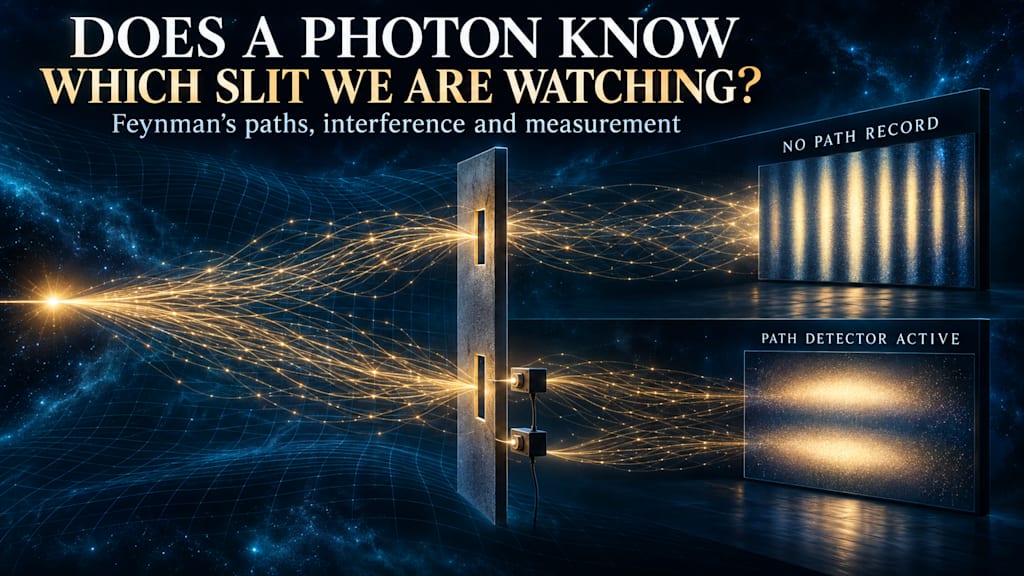
The double-slit experiment makes Feynman’s approach especially compelling. Send photons towards a barrier with two narrow openings, and record where they arrive on a screen behind it. Each photon produces a single detection event, but many events gradually build an interference pattern with regions where arrivals are common and others where they are rare.
With both slits available and no reliable record of which one a photon used, the contributions associated with the alternatives can interfere. The pattern is unlike simply adding the results from opening each slit separately. Feynman treated this as one of the clearest demonstrations of quantum behaviour.
The surprising part is that the pattern can build up even when photons are sent one at a time. We cannot explain it by imagining that one photon bumps into the next. The possibilities associated with a single detection event must be treated together.
What Changes When We Monitor the Slits?
Now arrange for a device to reveal which slit a photon passed through. The interference pattern disappears when the paths become reliably distinguishable. This is often described by saying that the photon “knows it is being watched”, but that wording gives the photon knowledge it does not need.
A detector must interact with the light or with something connected to its route. That interaction can leave information about the path in the detector or its surroundings. Once the two alternatives carry distinguishable records, we can no longer combine them in the same way to produce the original interference pattern. No conscious observer has to read the result.
Merely placing an inactive camera beside the apparatus would not have this effect. Nor does it matter whether a person decides to look at the recorded data. What matters is whether the physical arrangement makes the alternatives distinguishable.
Experiments called quantum erasers make the point subtler. Under suitable conditions, path information can be made unavailable in selected sets of results, and interference can then appear in those sets. That does not mean the photon received a message from the future. It means that the pattern depends on which quantum alternatives remain distinguishable and on how the recorded results are compared.
What About Action at a Distance?
Entanglement raises a different mystery. Two particles prepared together can show correlations even after travelling far apart. Measurements of such particles have ruled out important attempts to explain those correlations using predetermined local properties. This is the problem Einstein famously associated with “spooky action at a distance”.
Could zero proper time along a photon’s path explain the connection? It is an appealing thought, but it does not provide an established explanation. Entanglement concerns a shared quantum state and can involve particles that have mass as well as photons. Relativity’s description of one lightlike path does not, by itself, account for the correlations between two separated measurements.
There is also a vital limit: the correlations cannot be used to send a chosen message instantly from one experimenter to another. The results become apparent when the experimenters later compare their records through ordinary communication. Whatever interpretation we favour must preserve that observed distinction.
Does the Photon Choose After Seeing the Detector?
Feynman’s calculation connects a starting arrangement with possible final detections, so the detector naturally appears in the full description. That can make it sound as though the photon first surveys the future, notices the detector and then selects a route through the past.
The calculation does not establish that sequence of events. In the double-slit experiment, changing the apparatus changes the physical experiment and therefore the alternatives we must combine. If a working path detector is present, the light and detector interact. If it is absent, there is no equivalent path record. We do not need a photon to be warned that somebody is monitoring it.
Perhaps a future understanding of quantum physics will give us a clearer account of what happens between preparation and detection. For now, Feynman’s “all paths” approach predicts interference, while the availability of which-path information explains when that interference is lost. The picture of a photon travelling outside time remains an interpretation to examine, not a conclusion the experiment has proved.
Conclusion
Feynman gave us a powerful way to calculate a photon’s possible arrival: combine the contributions from its possible paths. Relativity tells us that the proper time along a lightlike path is zero, but it does not give a photon a viewpoint from which to inspect the future.
The double-slit experiment does not require a photon to know whether it is watched. Interference depends on whether its alternatives remain indistinguishable, while a working path detector changes the physical situation by leaving a record. That answer may feel less dramatic than a photon peering ahead through time, but the genuine puzzle remains extraordinary: nature makes reliable predictions from possibilities that refuse to behave like ordinary routes through space.
About the Creator
Alan Spencer
Have been an author and writer for over 20 years. Have been a journalist, editor, proofreader, and a designer and presenter of training courses. Have written over 100 articles, two books, and around 20 training courses.
Enjoyed the story? Support the Creator.
Subscribe for free to receive all their stories in your feed. You could also become a paid subscriber, letting them know you appreciate their work.
Comments
There are no comments for this story
Be the first to respond and start the conversation.