
Distributed Antenna System Market Trends: 5G Deployment, Network Densification & Forecast to 2034
How rising 5G deployment, increasing mobile data traffic, and network densification initiatives are accelerating infrastructure investments in the distributed antenna system market

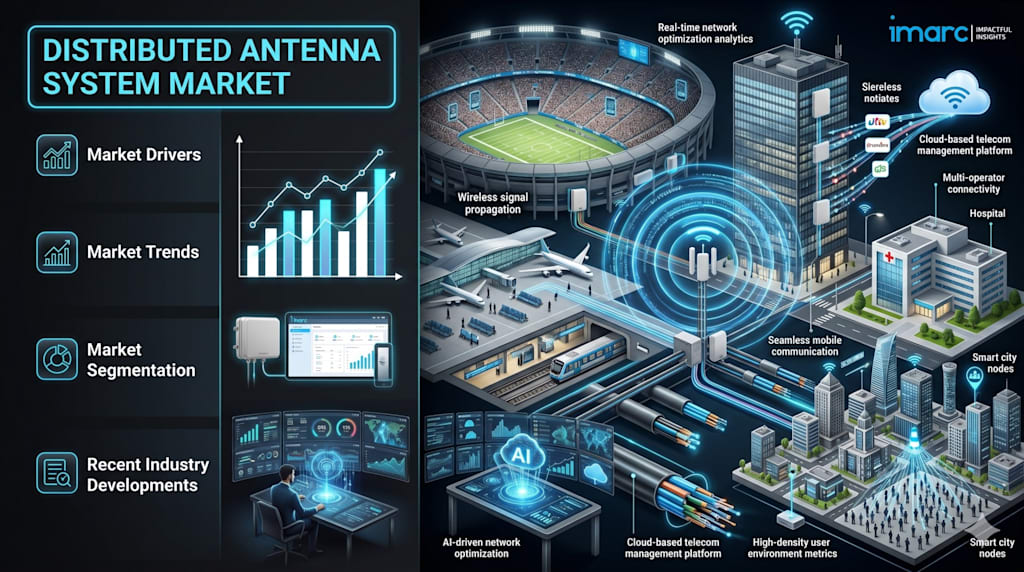
According to IMARC Group's latest research publication, The global distributed antenna systems market size was valued at USD 17.55 Billion in 2025 and is projected to reach USD 41.91 Billion by 2034, exhibiting a CAGR of 9.85% during 2026-2034.
How AI is Reshaping the Future of the Distributed Antenna System Market
- AI-Powered Network Optimization and Autonomous Signal Management: AI is fundamentally transforming how distributed antenna systems are planned, deployed, and managed by enabling real-time autonomous optimization of signal distribution across complex multi-antenna environments. Machine learning algorithms continuously analyze traffic loads, signal quality metrics, and user density patterns to dynamically reallocate bandwidth and adjust antenna parameters without manual intervention. This capability is particularly valuable in high-density venues such as stadiums, convention centers, and transportation hubs, where fluctuating crowd movements create unpredictable demand spikes. Deployments integrating AI-driven signal management have demonstrated the ability to redistribute capacity in real time based on crowd flow, ensuring consistent high-quality connectivity across every zone of a venue regardless of localized congestion.
- Predictive Maintenance and Fault Detection Across DAS Infrastructure: AI-driven predictive maintenance platforms are reshaping how operators manage distributed antenna system infrastructure by identifying component degradation, signal degradation patterns, and potential equipment failures before service disruptions occur. Sensors embedded throughout DAS networks feed continuous performance data into machine learning models that flag anomalies and generate maintenance alerts, enabling technicians to address issues proactively rather than responding to outages reactively. This approach significantly reduces operational downtime, extends equipment lifecycles, and lowers the total cost of ownership for large-scale DAS deployments spanning airports, healthcare campuses, and multi-building enterprise environments where unplanned connectivity failures carry substantial operational and safety consequences.
- AI-Enhanced Self-Organizing Networks for Dynamic DAS Configuration: The integration of AI into self-organizing network technologies is enabling distributed antenna systems to automatically configure, optimize, and heal themselves in response to changing network conditions. AI-powered self-organizing network engines continuously monitor 4G LTE and 5G traffic patterns, identify areas of congestion or signal degradation, and autonomously reconfigure the DAS architecture to resolve performance issues without requiring engineer intervention. This capability is proving particularly critical as 5G deployments introduce greater frequency complexity and denser small cell environments, where the volume of configuration variables makes manual optimization operationally impractical at scale for telecom operators managing networks across hundreds of indoor and outdoor antenna nodes simultaneously.
- AI-Integrated IoT Connectivity Management and Multi-Operator Orchestration: As the volume of IoT-connected devices deployed across smart buildings, manufacturing floors, and urban infrastructure accelerates, AI is enabling distributed antenna systems to manage the complexity of simultaneously supporting thousands of heterogeneous device connections alongside conventional cellular and public safety traffic. AI orchestration layers embedded within modern DAS platforms prioritize traffic flows, enforce quality-of-service policies for mission-critical IoT applications, and coordinate signal distribution across multi-operator neutral host environments where a single infrastructure serves multiple mobile network operators concurrently. This multi-operator orchestration capability is becoming a central commercial differentiator for neutral host DAS providers, enabling them to maximize infrastructure utilization while delivering carrier-grade performance to each operator sharing the network.
Distributed Antenna System Industry Overview:
The global distributed antenna system market is experiencing strong growth momentum driven by the accelerating deployment of 5G networks, the rising demand for reliable in-building and outdoor wireless connectivity, and the expanding installation of public safety communication infrastructure across commercial, institutional, and government facilities. The proliferation of smartphones, bandwidth-intensive applications, and IoT-connected devices is generating unprecedented volumes of mobile data traffic that legacy single-antenna systems are architecturally incapable of handling, compelling venues, enterprises, and telecom operators to invest in scalable DAS infrastructure that distributes signal load across multiple antenna nodes.
Distributed Antenna System Market Trends and Drivers
The surging demand for enhanced wireless connectivity across high-density public and commercial environments is the foundational driver of the distributed antenna system market. Stadiums, airports, shopping malls, convention centers, hospitals, and corporate campuses are each contending with the challenge of delivering reliable, high-capacity cellular and Wi-Fi coverage to thousands of simultaneous users in environments where building materials, structural complexity, and signal interference render traditional single-antenna approaches wholly inadequate. DAS resolves these challenges by distributing signal load across a network of strategically positioned antenna nodes, eliminating coverage dead zones, alleviating congestion, and delivering consistent user experiences regardless of occupancy levels.
The expanding deployment of smart building technologies and the proliferation of IoT devices are creating a second powerful demand catalyst across the distributed antenna system market. Connected building management systems, smart security infrastructure, automated manufacturing equipment, and patient monitoring devices in healthcare settings each depend on robust and consistent wireless connectivity that only purpose-built DAS infrastructure can reliably provide across every square meter of a complex facility. The emergence of smart city programs globally is further broadening the addressable market, as municipal authorities invest in public Wi-Fi and cellular network infrastructure that underpins integrated transport management, emergency communication systems, and digital citizen services.
Increasing public safety communication mandates and government investment in emergency response infrastructure represent the third structural growth driver shaping the distributed antenna system market. Regulatory authorities across North America and Europe are enforcing requirements for the installation of in-building DAS to ensure that police, fire, and emergency medical services personnel maintain uninterrupted radio communications in all areas of commercial and public buildings, including subterranean zones, parking structures, and elevator shafts where cellular signals cannot penetrate without dedicated distribution infrastructure. Compliance with public safety codes is compelling building owners, facility managers, and property developers to integrate DAS systems into new constructions and major renovation projects, creating a regulatory-driven demand pipeline that operates independently of commercial connectivity investment cycles.
Leading Companies Operating in the Global Distributed Antenna System Industry:
- American Tower Corporation
- Boingo Wireless Inc.
- Cobham Wireless
- Comba Telecom Systems Holdings
- CommScope Inc.
- Corning Incorporated
- Dali Wireless Inc.
- TE Connectivity
- Westell Technologies Inc.
- Zinwave (Wilson Electronics, LLC)
Distributed Antenna System Market Report Segmentation:
- By Offering:
- Components
- Services
Services represent the largest segment, driven by the increasing volume of site survey, system integration, deployment, and ongoing maintenance activities associated with expanding DAS installations across sports arenas, commercial buildings, healthcare facilities, and transportation hubs that require specialized technical expertise throughout the system lifecycle.
By System Type:
- Active
- Passive
- Digital
- Hybrid
Hybrid distributed antenna systems hold the largest share, as they combine the strengths of both passive and active architectures to deliver efficient signal distribution while maintaining signal quality across long distances, making them advantageous in environments with variations in signal frequencies, building structures, and diverse coverage requirements.
By Coverage:
- Indoor
- Outdoor
Indoor distributed antenna systems account for the largest share, as the emergence of advanced 5G technologies with higher frequency bands and shorter propagation characteristics has made dedicated indoor signal distribution essential for delivering the low latency and high-speed connectivity that enterprises and consumers expect within large-footprint facilities.
By Technology:
- Carrier Wi-Fi
- Small Cells
- Self-Organizing Network
- Others
Self-organizing networks exhibit clear dominance in the market, driven by the increasing deployment of 4G LTE and 5G networks that require continuous real-time optimization, monitoring, and autonomous reconfiguration to maintain optimal performance as traffic patterns, interference sources, and network load conditions evolve across complex multi-antenna environments.
By End Use:
- Manufacturing
- Healthcare
- Government
- Transportation
- Hospitality
- Public Venues
- Education
- Telecommunication
- Others
Public venues represent the largest end-use segment, as distributed antenna systems are extensively deployed in stadiums, convention centers, and entertainment complexes to resolve slow data speeds, dropped calls, and poor coverage that dense crowds and complex building structures create, while in-building public safety communication requirements in these venues further reinforce DAS adoption.
Regional Insights:
- North America (United States, Canada)
- Asia Pacific (China, Japan, India, South Korea, Australia, Indonesia, Others)
- Europe (Germany, France, United Kingdom, Italy, Spain, Russia, Others)
- Latin America (Brazil, Mexico, Others)
- Middle East and Africa
North America exhibits clear dominance in the distributed antenna system market, driven by rising investments in advanced telecommunications infrastructure, the accelerating rollout of 5G networks with extensive small cell and DAS deployment requirements, the widespread adoption of wireless communication for both mission-critical public safety operations and commercial connectivity, and a regulatory environment that mandates in-building coverage systems across a broad range of commercial, institutional, and government facility categories.
Recent News and Developments in the Distributed Antenna System Market
- January 2026: Boldyn Networks was selected by Seattle-Tacoma International Airport to design, build, and manage a next-generation 5G neutral host distributed antenna system delivering reliable connectivity across more than one million square feet of terminal, concourse, tarmac, parking garage, and rental car facility infrastructure, supporting the airport which served a record 52.6 million passengers and continues to expand its digital connectivity capabilities for the modern traveler.
- October 2025: Huawei reported the completion of digital antenna deployments across 20 countries for more than 40 operators, with the new-generation digital DAS architecture delivering power consumption reductions of 60 to 70% compared with legacy active systems, underscoring the growing role of energy efficiency as a competitive differentiator in large-scale DAS infrastructure investment decisions.
- February 2025: CommScope completed the divestiture of its indoor DAS and outdoor wireless networks business to Amphenol, marking a significant competitive realignment in the distributed antenna system market as Amphenol brought its extensive connectivity hardware manufacturing capabilities to the ERA platform, one of the benchmark all-digital DAS architectures widely deployed across large enterprise and venue environments.
Note: If you require specific details, data, or insights that are not currently included in the scope of this report, we are happy to accommodate your request. As part of our customization service, we will gather and provide the additional information you need, tailored to your specific requirements. Please let us know your exact needs, and we will ensure the report is updated accordingly to meet your expectations.
About the Creator
Abhay Rajput
I am working in market research company that provides market and business research intelligence across the globe.
Enjoyed the story? Support the Creator.
Subscribe for free to receive all their stories in your feed.
Comments
There are no comments for this story
Be the first to respond and start the conversation.