
Dimethyl Ether Market: LPG Substitution Trends, Energy Security & Market Development
Expanding use of dimethyl ether in household fuel applications and LPG substitution is creating new opportunities in emerging economies worldwide

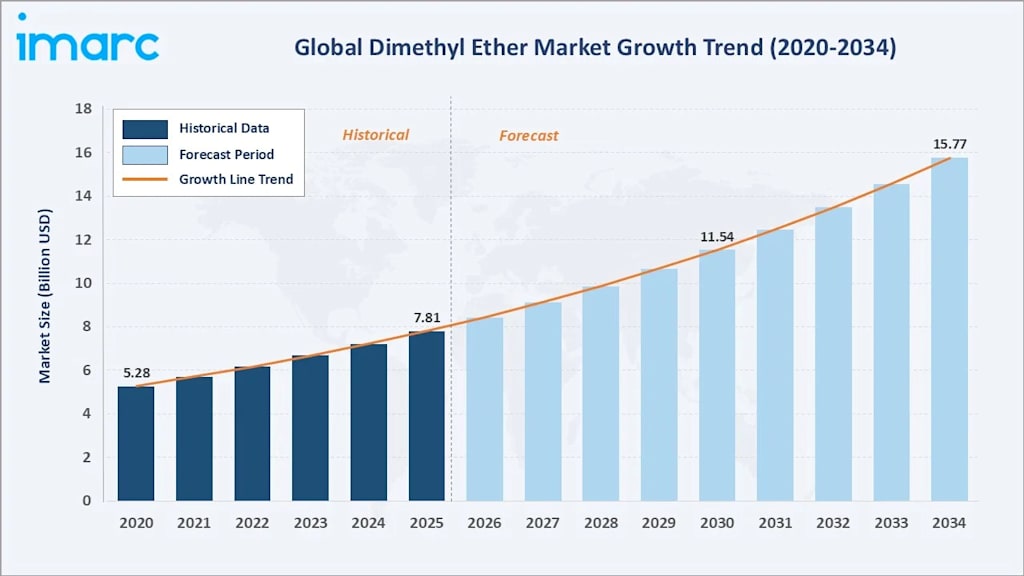
Rising environmental concerns, the push for clean-burning alternative fuels, and increasing applications in the chemical industry are driving dimethyl ether demand, supported by a shift toward sustainable energy, product innovation, and expanding LPG blending practices globally. According to IMARC Group’s latest data, The global dimethyl ether market size was valued at USD 7.81 Billion in 2025. Looking forward, IMARC Group estimates the market to reach USD 15.77 Billion by 2034, exhibiting a CAGR of 8.12% from 2026-2034.
Dimethyl ether now represents a multi-billion-dollar global market exceeding several billion dollars and exhibiting steady year-on-year expansion. Demand is driven by rising environmental consciousness, industrial industrialization that favors cleaner manufacturing inputs, and increased interest in low-emission alternatives to traditional diesel and liquefied petroleum gas (LPG). Production innovation, coal-to-chemical project expansions, and the development of bio-based pathways are further accelerating uptake. Major segments include LPG blending, aerosol propellants, transportation fuels, and chemical feedstocks, with industrial consumers prioritizing seamless infrastructure integration, reduced carbon footprints, and stable chemical compliance.
Dimethyl Ether Market Growth Drivers:
- Surging Demand for LPG Blending
Industrial and residential energy providers increasingly mix dimethyl ether into liquefied petroleum gas (LPG) to lower overhead costs and curtail harmful emissions. Because it shares highly comparable physical properties with conventional propane and butane, it liquefies under mild pressure conditions around 0.5 MPa. This allows energy networks to leverage their existing storage tanks, pipelines, and distribution infrastructure without requiring expensive system overhauls. Consequently, large-scale energy projects integrate this compound to enhance regional fuel security while meeting strict domestic energy quotas.
- Strict Environmental Regulations on Commercial Fleets
Global regulatory bodies continue to tighten restrictions on particulate matter, nitrogen oxides, and soot emissions from heavy-duty logistics and transport fleets. This regulatory push positions the compound as an ideal substitute for conventional diesel due to its high cetane rating and clean-burning molecular profile. Because the chemical structure lacks carbon-to-carbon bonds, its combustion prevents the formation of fine soot particles entirely. Fleet managers utilize this clean profile to comply with regional climate mandates while ensuring reliable cold-start capabilities for long-haul shipping applications.
Get Your Free "Dimethyl Ether Market" Sample PDF Report Now!
- Expansion of High-Volume Industrial Applications
Manufacturing sectors leverage this organic compound as a highly efficient, non-toxic propellant across consumer aerosols, pharmaceuticals, and industrial spray coatings. Beyond its performance in packaging, it serves as a core chemical intermediate in the synthesis of high-value downstream commodities like light olefins and plastics. Its stable chemical properties and low toxicity profile make it a preferred raw material for modern chemical plants optimizing their output. This structural transition toward clean intermediate inputs ensures a steady consumption volume across established global industrial zones.
Dimethyl Ether Market Trends:
- Escalating Investments in Large-Scale Bio-DME Projects
Energy companies and chemical manufacturers are heavily investing in processing facilities that convert organic municipal waste, agricultural residues, and black liquor into renewable bio-DME. This shift directly addresses the industrial need for true circular economy models by trapping carbon within the fuel supply chain. By utilizing sustainable feedstocks, these production facilities achieve a drastically lower carbon footprint compared to coal-derived alternatives. This trend supports corporate decarbonization targets and offers logistics providers verifiable carbon-neutral fuel compliance options.
- Strategic Alliances in Global Supply Chains
Major energy developers and transport companies are forming joint ventures to build dedicated regional distribution networks and retrofitting stations. These corporate partnerships focus on developing commercial-grade fuel injection systems and specialized high-volume storage tanks suited for commercial fleets. By securing robust cross-border supply chains, market leaders effectively reduce localized logistics bottlenecks and guarantee consistent fuel volume availability. This structural alignment allows fleet operators to comfortably commit to multi-year transitions away from standard fossil fuels.
- Technological Advancements in Direct Synthesis Pathways
Chemical processing plants are modernizing operations by transitioning from conventional two-step manufacturing to innovative single-step direct synthesis. This direct approach transforms raw synthesis gas into the final product within a single reactor chamber, combining methanol synthesis and dehydration phases. This method optimizes production timelines, improves overall thermal efficiency, and significantly lowers initial capital equipment expenditures. This engineering evolution allows chemical manufacturers to run highly competitive, low-cost operations even during volatile global market fluctuations.
Recent News and Developments in Dimethyl Ether Market
- September 2025: A leading vehicle manufacturing group initiated a field test involving a fleet of heavy-duty commercial trucks retrofitted with specialized fuel injection lines designed to run exclusively on clean-burning dimethyl ether variants.
- November 2025: An international energy consortium finalized a joint venture aimed at expanding existing port infrastructure to accommodate high-volume liquefied gas blending, directly accelerating regional distribution capabilities.
- February 2026: A regional environmental agency approved a comprehensive subsidy framework intended to offset the initial conversion costs for industrial manufacturing facilities transitioning their aerosol propellant lines to eco-friendly formulations.
Note: If you require specific details, data, or insights that are not currently included in the scope of this report, we are happy to accommodate your request. As part of our customization service, we will gather and provide the additional information you need, tailored to your specific requirements. Please let us know your exact needs, and we will ensure the report is updated accordingly to meet your expectations.
About the Creator
Andrew Sullivan
Hello, I’m Andrew Sullivan. I have over 9+ years of experience as a market research specialist.
Enjoyed the story? Support the Creator.
Subscribe for free to receive all their stories in your feed.
Comments
There are no comments for this story
Be the first to respond and start the conversation.