
Digital Twin in Manufacturing Market: From USD 8 Billion to USD 139 Billion — What Is Driving the World's Fastest-Growing Factory Technology
BMW cut production planning costs by 30% without buying a single new machine. Here is how the digital twin in manufacturing market is quietly transforming industrial operations worldwide.

Somewhere inside BMW's sprawling global production network, a factory that does not physically exist is running at full capacity. It simulates assembly lines, tests production changes, and flags bottlenecks — all before a single robot arm moves or a single worker steps onto the floor. This virtual factory mirrors more than 30 of BMW's global production sites in real time, and according to BMW Group itself, it has reduced production planning costs by up to 30%.
No new machines. No new workers. Just a digital replica of what already exists — and the intelligence to run simulations faster than any physical test ever could.
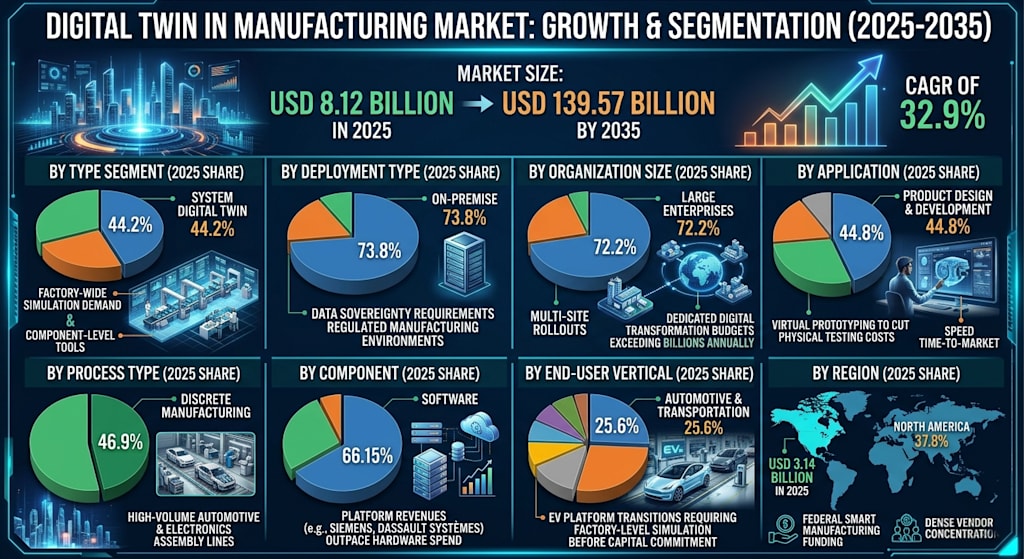
This is the digital twin in manufacturing market in action. And it is growing at a pace that very few industrial technologies ever match. The global digital twin in manufacturing market was valued at USD 8.12 billion in 2025 and is projected to reach USD 139.57 billion by 2035 — a CAGR of 32.9%. That is a seventeen-fold expansion in a single decade, backed by government investment programs, enterprise software commitments, and a manufacturing industry that is rapidly discovering what happens when your factory has a smarter, faster twin running alongside it.
For professionals who need the full analytical picture — covering twin types, deployment models, enterprise size segments, applications, end-user industries, and regional forecasts through 2035 — the complete research is documented in the digital twin in manufacturing market report at Evolvance Market Research.
Digital Twin in Manufacturing Market Size and Growth
The growth trajectory of this market is not driven by hype. It is driven by measurable, documented returns that manufacturing executives can present to finance teams with confidence.
NIST has calculated that unplanned downtime accounts for between 8.3% and 13.3% of planned production time in US discrete manufacturing, generating approximately USD 245 billion in annual losses. Defects add another USD 32 billion to USD 58.6 billion on top. When digital twin technology demonstrably reduces both — as BMW's results confirm — the ROI conversation becomes straightforward rather than speculative.
North America leads all regions with a 37.8% market share valued at USD 3.14 billion in 2025, backed by federal smart manufacturing funding and a dense concentration of platform vendors. The SMART USA Institute launched its first funding round in June 2025, allocating USD 50 million specifically for digital twin projects in semiconductor manufacturing. Government investment at that scale does not just fund individual projects — it establishes technology standards that shape the entire vendor landscape for the decade that follows.
Digital Twin Market Trends: Four Types, One Direction
The digital twin in manufacturing market spans four distinct twin types, each serving different operational needs and representing a different stage of manufacturing maturity.
System Digital Twins lead with a 44.2% share, covering full factory or supply chain simulation. These are the most complex and most valuable deployments — the kind BMW uses to coordinate production planning across 30 global sites simultaneously. They require significant integration work but deliver the largest measurable returns.
Product Digital Twins address the design-to-production gap, enabling virtual validation before physical builds begin. For automotive manufacturers facing EV platform transitions that require entirely new production line configurations, virtual product validation before capital commitment is not a luxury — it is how you avoid expensive mistakes at scale.
Process Digital Twins map workflows and simulate changes before they hit the production floor. Quality management and process optimization applications together represent significant share of real-world deployments, particularly in aerospace and electronics manufacturing where tolerances are tight and errors are costly.
Component Digital Twins monitor individual machines and assets for performance drift and failure risk, feeding predictive maintenance programs. They are often the entry point for manufacturers new to the technology — lower complexity, faster deployment, and measurable uptime improvements that build internal confidence for larger investments.
Digital Twin Adoption: Who Is Buying and Why
Large enterprises hold a 72.2% share of the digital twin market, supported by multi-site rollouts and dedicated digital transformation budgets. The structural reason is straightforward — mature twin deployments require IT teams capable of integrating data from dozens of machine types across multiple facilities and vendors. Most mid-market manufacturers do not yet have that capability in-house.
But adoption is democratizing faster than most analysts expected. Cloud-native deployment is the primary driver. AWS IoT TwinMaker and Azure Digital Twins now offer twin capabilities without the need to build custom data pipelines from scratch, pulling a meaningful new buyer tier into the market. Volkswagen's five-year extension of its AWS Digital Production Platform — part of a broader USD 1 billion digitalization commitment — demonstrates that even the largest manufacturers are embracing cloud infrastructure for production-critical applications.
The UK's £37.6 million Digital Twin Centre in Belfast, targeting 230 new manufacturing jobs, is one of several government programs actively lowering the entry cost for smaller manufacturers. Germany's Manufacturing-X program and the US SMART USA Institute are pursuing similar objectives. When public investment removes adoption risk, private capital follows.
Digital Twin in Manufacturing: Key Players and Competitive Landscape
The vendor landscape is consolidating fast — and the deals being announced signal that competitive boundaries are being redrawn at speed.
Siemens AG operates across the full stack — PLCs, PLM, digital twins, and industrial AI — with its Xcelerator portfolio integrating hardware and software into a unified industrial data environment. Its planned EUR 10 billion acquisition of Altair Engineering is the largest consolidation move in industrial simulation history. Dassault Systèmes, serving 370,000 customers across 150-plus countries, announced a long-term partnership with NVIDIA in February 2026 to build an industrial AI platform for virtual twins — extending its reach into physics-accurate simulation at industrial scale.
NVIDIA's Omniverse platform can run factory simulations 1,200 times faster than conventional methods. At that pace, a digital twin stops being a planning tool you consult periodically and becomes a real-time decision engine running continuously alongside physical operations. That speed changes the value proposition entirely.
PTC Inc. closed its 2024 fiscal year with 93% recurring revenue and USD 2.25 billion in annual recurring revenue. Subscription lock-in at that level does not happen with tools manufacturers treat as optional. It happens when software becomes load-bearing infrastructure that production operations depend on every single day.
Where the Digital Twin in Manufacturing Market Goes Next
The next phase of this market will be defined by generative AI integration — systems that do not just simulate a process but actively propose operational changes based on production objectives. Rockwell Automation's partnership with Microsoft to embed generative AI into factory digital twins is an early signal of where the technology is heading. The twin stops being an analytical instrument and becomes an operational co-pilot.
The factory of 2030 will not be managed primarily by operators watching physical equipment. It will be managed through a virtual mirror that runs continuously, surfaces decisions automatically, and flags human attention only where genuine judgment is required.
Manufacturers building that capability now are not just investing in a technology tool. They are building the operational infrastructure that will define their competitive position for the decade ahead.
About the Creator
Suge kun
Research Analyst passionate about data & market insights. I turn complex information into clear, actionable strategies. Detail-driven & results-focused — helping businesses make smarter decisions. — Suge Kun
Enjoyed the story? Support the Creator.
Subscribe for free to receive all their stories in your feed.
Comments
There are no comments for this story
Be the first to respond and start the conversation.