
Digital Twin in Automotive Manufacturing Market Is Rewriting the Factory Floor
From BMW's virtual plant simulations to China's 43.9% CAGR, the numbers signal a structural shift in how cars get built.

The Car That Doesn't Exist Yet Has Already Been Crash-Tested a Thousand Times
BMW's engineers in Munich can now complete collision checks for a new production line in three days. Two years ago, the same process took nearly four weeks. No physical prototype changed. No factory floor was rearranged. The only thing that moved was data inside a virtual replica of the plant. That's what digital twins actually do at scale, and the Digital Twin in Automotive Manufacturing Market growth numbers now reflect just how far this technology has moved from pilot project to production standard.
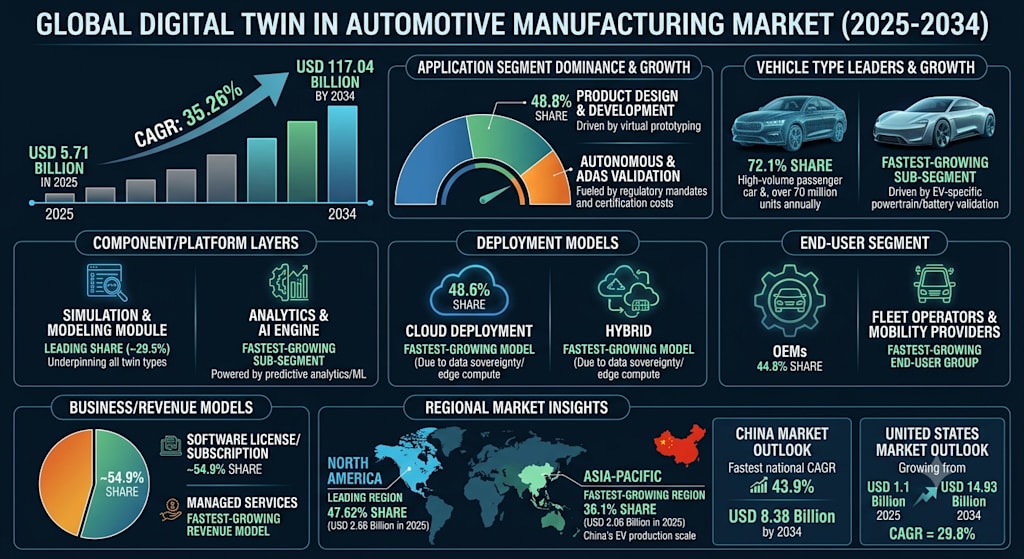
The market stood at USD 5.71 billion in 2025 and is forecast to reach USD 117.04 billion by 2034, growing at a CAGR of 35.26%. A full breakdown of regional share, application segments, and vendor positioning is available in this automotive manufacturing digital twin industry overview. North America currently leads with a 47.62% share, but China's national CAGR of 43.9% tells a different story about where momentum is building.
Building the Car Before the Factory Exists
The conventional assumption is that digital twins are design tools. That's only half right. Product design and development does account for the largest application segment at 48.8% of the market, reflecting the replacement of expensive physical prototypes with virtual crash, aerodynamic, and material stress simulations. Siemens and Dassault Systèmes anchor this space through their Xcelerator and 3DEXPERIENCE platforms. But the faster growth is happening elsewhere.
BMW's Virtual Factory deployment spans more than 30 production sites globally. The program doesn't just simulate new vehicles; it simulates the entire manufacturing environment before a single piece of equipment is installed. When BMW announced plans to integrate over 40 new or updated vehicle models by 2027, the company confirmed that every integration will run through the virtual factory first. This is where the category starts to look less like software spending and more like a prerequisite for building cars at all.
Volkswagen took a different architectural route. Its Digital Production Platform, running on AWS across 43 plants in Europe, North and South America, hosts over 1,200 AI-driven applications, including digital twin orchestration, predictive maintenance, and real-time quality inspection. The sheer scale of that deployment illustrates something the headline market figures don't fully capture: at the OEM level, digital twin infrastructure is becoming indistinguishable from factory infrastructure.
The EV Complication That Changed the Vendor Race
Electric vehicles introduced requirements that existing digital twin platforms weren't built for. Battery thermal management, cell formation validation, powertrain software stacks with millions of lines of code, and charging behavior under variable grid conditions all require simulation environments that ICE-era tools handle poorly. That gap opened procurement opportunities for newer vendors, particularly in markets where EV production is scaling fastest.
China's automotive digital twin market was valued at just USD 0.22 billion in 2025, but the 43.9% projected CAGR reflects BYD, NIO, and Li Auto building EV development programs from scratch, with no legacy toolchain loyalty. Contrast that with multinational vendors like Siemens, whose China revenue dropped from EUR 8.08 billion in FY2024 to EUR 7.14 billion in FY2025 as domestic price pressure and tariff effects compressed margins. The bifurcation is real: global platform vendors face structural headwinds in China even as the market itself accelerates.
For suppliers, the dynamic is sharper than it appears from the outside. Schaeffler's June 2025 partnership with NVIDIA to integrate at least 50% of its 100-plus manufacturing plants into Omniverse by 2030 signals that Tier-1 suppliers are now committing to specific platforms at a scale that creates genuine lock-in. Once a supplier's component simulation environment is embedded in an OEM's system twin architecture, switching is not a software decision. It's a renegotiation of the entire engineering relationship.
Who's Actually Winning the Platform Fight
Five companies (Siemens, Dassault Systèmes, IBM, GE Vernova, and Microsoft) held 29% of combined market share in 2024. That figure is lower than it sounds for a market this concentrated, which is why analysts tracking the Digital Twin in Automotive Manufacturing Market share expect consolidation to accelerate through 2027. Siemens' EUR 9.5 billion acquisition of Altair Engineering in March 2025 was the most visible move: it folded electromagnetic, structural, and fluid simulation capability directly into the Xcelerator stack, raising the barrier for anyone trying to compete at the full-platform level.
NVIDIA's position is less obvious but arguably more durable. Its automotive segment reached USD 2.3 billion in FY2026, up 39% year-over-year, driven partly by Omniverse factory digital twin adoption. Mercedes-Benz, Bosch, and ZF Group are among the named adopters. NVIDIA isn't competing with Siemens on PLM. It's competing for the analytics and AI engine layer, which happens to be the fastest-growing component segment in the market. That's a different race, running on a different track, and Siemens and Dassault both know it.
Hyundai Motor Group's commitment of approximately USD 3 billion to deploy NVIDIA Omniverse Enterprise for factory digital twins across its Korean plants is the clearest evidence that no single vendor captures everything. OEMs are building multi-vendor digital twin architectures, and the integration layer between those vendors is where professional services firms like Capgemini and Accenture are quietly accumulating revenue.
The Regulation Nobody Talks About Until It Costs Money
UN Regulations R155 and R156 are mandatory for new vehicle type approvals across the EU, Japan, South Korea, and 49 additional signatory markets. They require documented cybersecurity management and secure OTA software update processes across the entire vehicle lifecycle. The implication most OEMs underestimate: digital twin-based cybersecurity validation is no longer optional in any market that matters to global vehicle sales.
The EU's Corporate Sustainability Reporting Directive, extended to listed SMEs from 2026, adds a carbon accounting obligation that reaches upstream into the supply chain. For European OEMs and Tier-1 suppliers, this converts sustainability reporting into a digital twin procurement budget. Carbon simulation modules are now embedded in Siemens and Dassault platforms precisely because customers need them to satisfy auditors, not engineers.
As software-defined vehicle complexity compounds and EV architectures multiply the number of systems requiring validation, the economics of physical testing become increasingly untenable. A 2024 study found that virtual commissioning delivered 51% ROI within 12 months, with breakeven at three months, while also cutting assembly line setup time from 130 hours to 59. Those numbers have moved the conversation inside automotive boardrooms from whether to invest to which platform to choose. The vendors who capture that moment of commitment will be defining the production architecture of vehicles that won't roll off a line for another five to seven years.
About the Creator
Suge kun
Research Analyst passionate about data & market insights. I turn complex information into clear, actionable strategies. Detail-driven & results-focused — helping businesses make smarter decisions. — Suge Kun
Enjoyed the story? Support the Creator.
Subscribe for free to receive all their stories in your feed.
Comments
There are no comments for this story
Be the first to respond and start the conversation.