
Digital Printing Market Set to Reach US$ 57.08 Billion by 2033 as Customization and E-Commerce Fuel Demand
Advancements in inkjet technology, personalized packaging, and on-demand production are transforming the global digital printing industry across packaging, textiles, publishing, and advertising.

The Digital Printing Revolution Is Reshaping Modern Manufacturing
The printing industry has undergone a dramatic transformation over the past decade. Traditional printing methods that relied on lengthy setup processes and costly printing plates are increasingly being replaced by digital solutions that offer speed, flexibility, and customization. Today, digital printing is no longer just an alternative—it is becoming the preferred choice for businesses seeking efficiency and personalization.
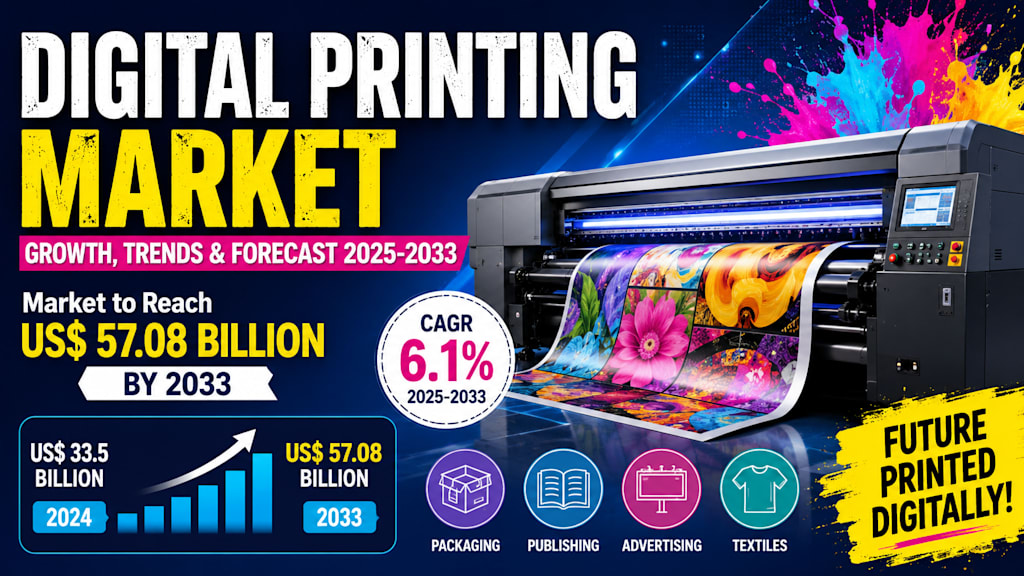
According to Renub Research, the Global Digital Printing Market was valued at US$ 33.5 billion in 2024 and is projected to reach US$ 57.08 billion by 2033, expanding at a CAGR of 6.1% during the forecast period from 2025 to 2033. This growth reflects increasing demand for cost-effective printing solutions, technological advancements, and the growing need for personalized products across industries.
From customized packaging and promotional materials to textile printing and publishing, digital printing continues to unlock new possibilities for businesses worldwide.
Understanding Digital Printing Technology
Digital printing refers to the process of printing digital images directly onto various media substrates without the use of traditional printing plates. Files such as PDFs, graphics, and digital artwork are sent directly to the printer, enabling faster production and greater flexibility.
Unlike conventional offset printing, digital printing eliminates lengthy setup procedures, making it highly suitable for short production runs and customized projects. Businesses can produce exactly what they need when they need it, reducing inventory costs and minimizing waste.
The technology has become essential in sectors including:
Packaging
Publishing
Advertising
Textile manufacturing
Promotional products
Signage and displays
Its ability to deliver vibrant colors, sharp details, and rapid turnaround times has made it a preferred choice for both commercial and personal printing applications.
Why Demand for Customized Printing Is Rising
Modern consumers increasingly expect products and experiences tailored to their preferences. This shift has significantly increased demand for personalized printing solutions.
Brands now utilize customized labels, personalized marketing materials, seasonal packaging designs, and limited-edition product packaging to connect with customers more effectively. Digital printing enables these initiatives without the high costs associated with traditional printing methods.
The rise of direct-to-consumer business models has further accelerated this trend. Companies can now create highly targeted marketing campaigns featuring customized messages, QR codes, names, and product information for specific audiences.
As personalization becomes a key competitive differentiator, digital printing is expected to remain at the center of brand communication strategies.
Technological Innovations Are Driving Market Expansion
One of the strongest growth drivers in the digital printing industry is continuous technological innovation.
Modern digital printers deliver:
Faster production speeds
Higher image resolution
Improved color accuracy
Greater substrate compatibility
Enhanced durability
Advanced technologies such as inkjet printing, laser printing, UV-curable printing, and AI-enabled workflow automation have improved efficiency while reducing operational costs.
Manufacturers are also developing environmentally friendly inks and energy-efficient systems to meet sustainability goals. These innovations are helping businesses improve productivity while reducing their environmental footprint.
The integration of automation and smart manufacturing solutions is further streamlining production processes and enabling higher levels of quality control.
E-Commerce Is Creating New Opportunities
The rapid expansion of e-commerce has become a major catalyst for digital printing adoption worldwide.
Online retailers increasingly rely on customized packaging and branded shipping materials to enhance customer experiences. Attractive packaging has become an important marketing tool, particularly in competitive online marketplaces.
Digital printing allows businesses to produce:
Personalized product packaging
Branded shipping boxes
Promotional inserts
Customized labels
Variable data printing
These capabilities enable companies to create memorable unboxing experiences while strengthening brand identity.
As global e-commerce sales continue to grow, demand for flexible and scalable printing solutions is expected to increase substantially.
Inkjet Printing Remains the Dominant Technology
Among various digital printing technologies, inkjet printing continues to lead the market.
Inkjet systems work by precisely spraying microscopic droplets of ink onto a substrate. This method delivers exceptional color quality and supports a wide range of materials, including:
Paper
Textiles
Plastic
Metal
Glass
The technology is particularly valued for its versatility and ability to produce high-quality prints with minimal waste.
Industries such as packaging, signage, and textile printing have embraced inkjet printing because of its efficiency and ability to handle customized projects cost-effectively.
As printer manufacturers continue to improve speed and print quality, inkjet technology is expected to maintain its dominant position.
Laser Printing Continues to Support Commercial Applications
Laser printing remains a vital segment of the digital printing industry, particularly for commercial and office environments.
This technology uses electrostatic imaging and laser beams to create precise, high-quality prints. Laser printers are known for:
Fast output speeds
Sharp text reproduction
Consistent image quality
Low maintenance requirements
Businesses frequently use laser printing for documents, brochures, labels, and marketing materials.
Although inkjet printing often provides superior color depth for certain applications, laser printing continues to offer excellent efficiency for high-volume production environments.
Packaging Has Become the Fastest-Growing Application
Packaging represents one of the most promising opportunities within the digital printing market.
Consumer brands increasingly seek packaging solutions that can:
Support product differentiation
Enable rapid product launches
Reduce inventory risks
Improve sustainability
Facilitate personalized marketing
Digital printing allows companies to create small production runs and customized packaging designs without significant setup costs.
Industries benefiting from digital packaging include:
Food and beverages
Cosmetics
Pharmaceuticals
Consumer goods
As consumer preferences evolve rapidly, digital printing provides the flexibility required to keep pace with changing market demands.
Advertising Industry Benefits from High-Impact Visuals
Digital printing has transformed the advertising industry by enabling fast production of high-quality visual materials.
Businesses and marketing agencies rely on digital printing for:
Outdoor banners
Posters
Point-of-sale displays
Vehicle wraps
Event signage
The ability to produce vibrant graphics with quick turnaround times helps advertisers respond rapidly to market opportunities.
Additionally, variable data printing enables highly targeted campaigns, improving customer engagement and campaign effectiveness.
As marketing becomes increasingly personalized, digital printing will continue playing a crucial role in advertising strategies worldwide.
Regional Markets Showcase Strong Growth Potential
United States
The United States remains one of the most technologically advanced digital printing markets globally.
Strong demand from packaging, publishing, advertising, and commercial printing sectors continues to support growth. The country's thriving e-commerce ecosystem further boosts demand for customized packaging solutions.
American companies are also leading innovation in sustainable printing technologies and environmentally friendly inks.
France
France's digital printing market benefits from strong demand in luxury packaging, fashion textiles, and premium advertising applications.
The country's emphasis on design excellence and personalization supports adoption of advanced printing technologies. Sustainability regulations are also encouraging investment in eco-friendly printing solutions.
India
India is emerging as one of the fastest-growing digital printing markets.
Factors contributing to growth include:
Expanding retail sector
Rising e-commerce activity
Increased internet penetration
Growing advertising expenditure
Government support for digitalization
Small and medium-sized enterprises are increasingly adopting digital printing because of its affordability and flexibility.
Saudi Arabia
Saudi Arabia's digital printing industry is expanding as part of the country's broader economic diversification efforts.
Growth is supported by:
Urbanization
Rising consumer spending
Retail sector expansion
Vision 2030 initiatives
Increasing technology adoption
Investment in advanced printing infrastructure is expected to create significant opportunities throughout the forecast period.
Challenges Facing the Industry
Despite strong growth prospects, several challenges remain.
High Initial Investment
Advanced digital printing systems require substantial upfront investment. Equipment acquisition, maintenance, and specialized inks can create financial barriers, particularly for small businesses.
Durability Limitations
Certain digital printing applications still face challenges related to print durability and substrate compatibility. Industries requiring extreme resistance to environmental conditions may continue relying on alternative printing technologies.
Addressing these limitations will be important for expanding digital printing into additional industrial applications.
10 Recent Developments in the Digital Printing Industry
Konica Minolta introduced the AccurioPress C14000 production press for high-speed commercial printing applications.
HP launched a new generation of intelligent digital printing presses targeting packaging and commercial printing sectors.
Canon India expanded its PIXMA MegaTank and imageCLASS printer portfolio with ten new models.
Mimaki USA unveiled the Tx330-1800 direct textile inkjet printer for customized textile production.
Mimaki Europe announced participation in major European print technology exhibitions with new innovations.
ColorJet India launched the Fab Jet Pro textile printing system capable of producing up to 13,000 square meters daily.
Tenaui commissioned the Middle East's largest digital commercial printing center in Saudi Arabia.
Canon strengthened its industrial printing ecosystem through advanced inkjet technology deployment.
HP expanded automation-driven workflow solutions to improve production efficiency.
Multiple industry leaders increased investment in UV-curable printing technologies to support sustainable manufacturing initiatives.
Key Companies Shaping the Market
Several major companies continue driving innovation and competition within the digital printing sector:
Smurfit Kappa Group PLC
WestRock Company
Southland Printing Company Inc.
IronMark Inc.
Xeikon NV
ARC Document Solutions LLC
Avery Dennison Corporation
Multi-Color Corporation
These organizations are investing heavily in advanced printing technologies, automation, sustainability initiatives, and customized solutions to meet evolving customer requirements.
Final Thoughts
Digital printing has evolved from a niche production method into a critical component of modern manufacturing, marketing, and packaging. The technology's ability to deliver speed, flexibility, personalization, and cost efficiency makes it indispensable in today's fast-changing business environment.
As e-commerce expands, consumer expectations rise, and businesses seek more agile production methods, digital printing is positioned for sustained growth. With the global market expected to reach US$ 57.08 billion by 2033, the industry is entering a new era defined by innovation, customization, and sustainability.
Organizations that embrace advanced digital printing technologies today will be better positioned to compete in an increasingly personalized and digitally connected marketplace.
About the Creator
Enjoyed the story? Support the Creator.
Subscribe for free to receive all their stories in your feed.
Comments
There are no comments for this story
Be the first to respond and start the conversation.