
Did Marconi Take the Idea of Radio From Nikola Tesla?
How Tesla’s Earlier Patents Helped Marconi Create a Wireless Communications Empire
Introduction
Guglielmo Marconi is usually described as the inventor of radio, while Nikola Tesla is remembered for alternating current, electrical experiments and spectacular demonstrations. The true history is considerably more complicated because several inventors contributed important parts of wireless transmission.
Tesla demonstrated wireless principles and patented a tuned four-circuit transmission system before Marconi obtained his important American patent. Marconi then turned wireless telegraphy into a practical commercial system, although some features of his later patent had already appeared in the work of Tesla and other inventors.
Wireless Experiments Before Tesla and Marconi
Neither Tesla nor Marconi discovered electromagnetic waves. James Clerk Maxwell predicted their existence mathematically during the nineteenth century, and Heinrich Hertz demonstrated them experimentally during the 1880s.
Hertz showed that electrical sparks could produce electromagnetic waves that travelled through space. However, he did not develop them into a practical long-distance communications system.
Several inventors recognised the possibilities of Hertz’s experiments. Oliver Lodge investigated tuning and resonance, while Édouard Branly and others worked on detectors that could respond to electromagnetic signals.
Tesla and Marconi therefore entered a field already taking shape. Their achievements mattered, but neither man created wireless communication without earlier scientific foundations.
Tesla’s Wireless Demonstrations
During the early 1890s, Tesla gave public lectures demonstrating high-frequency and high-voltage electrical systems. He showed that electrical energy could be transmitted without ordinary connecting wires, and he discussed using similar principles for communication.
Tesla understood that a transmitting circuit and receiving circuit could be tuned to the same frequency. This tuning allowed a receiver to respond more effectively to a particular transmitted signal.
The principle resembles tuning a modern radio to one station while rejecting others. Without effective tuning, several wireless transmitters operating in the same area could interfere with each other.
Tesla was particularly interested in transmitting electrical power over long distances. However, his patents and lectures also recognised that the same apparatus could transmit intelligible messages.
Tesla’s Four-Circuit System
Tesla applied for important American wireless patents on 2 September 1897. United States Patent 645,576 was granted on 20 March 1900, while the related Patent 649,621 was granted on 15th May 1900.
His arrangement contained four important electrical circuits. Two circuits were at the transmitter, while two others were at the receiver.
The transmitter used a primary circuit coupled to a secondary circuit and antenna. The receiver employed a corresponding antenna circuit coupled to another circuit that operated the receiving equipment.
Tesla stated that the circuits should be carefully adjusted to operate in electrical resonance. This feature later became important in the patent dispute involving Marconi’s wireless system.
Tesla did not merely describe the general dream of wireless communication. His patents contained technical arrangements showing how electrical energy and signals could be transmitted and received through tuned circuits.
Marconi’s Early Wireless Work
Marconi began experimenting with wireless signals in Italy during the 1890s. He combined existing components into apparatus that could transmit telegraph signals over steadily increasing distances.
Marconi was not primarily trying to transmit electrical power. His objective was reliable wireless communication, particularly for ships, coastal stations and commercial telegraph services.
He moved to Britain and applied for a British wireless patent in 1896. His early system transmitted signals successfully, but it did not initially include the complete four-circuit tuned arrangement covered by his later patent.
Marconi deserves considerable credit for turning laboratory principles into working equipment. He improved antennas, increased transmission distances and developed an organised commercial wireless service.
Where Tesla’s Patents Became Important
Marconi filed an application for another important American patent in November 1900. This application described a system containing four high-frequency circuits that could be adjusted into electrical resonance.
The United States Patent Office initially rejected parts of Marconi’s application. Earlier work by Tesla, Lodge and other inventors created difficulties because patent law does not permit someone to patent an arrangement that another inventor has already disclosed.
Marconi continued to amend and defend his application. The United States granted Patent 763,772 on 28th June 1904, covering improvements in wireless telegraphy.
Tesla’s earlier Patent 645,576 had already described a four-circuit arrangement with two circuits at the transmitter and two at the receiver. It also explained that the circuits should be adjusted to operate in resonance.
Marconi’s system included important practical refinements, but the underlying arrangement was not entirely new. Tesla’s patent had anticipated several features that Marconi later attempted to claim.
Did Marconi Copy Tesla?
It is tempting to present this history as a simple case of Marconi stealing Tesla’s invention. However, the available evidence does not prove that every part of Marconi’s apparatus was copied directly from Tesla’s designs.
Marconi was conducting his own experiments and achieved genuine practical successes. He combined ideas from several sources and developed equipment capable of operating over distances that other experimenters had not achieved.
However, Marconi could not legitimately claim exclusive ownership of every principle used in his later system. Tesla had already patented important elements of tuned wireless transmission, while Lodge and John Stone Stone had developed other relevant methods.
Marconi therefore built upon a collection of earlier discoveries. Tesla’s work formed an important part of that foundation, although it was not the only earlier work involved.
The Transatlantic Achievement
On 12th December 1901, Marconi reported receiving the Morse code letter “S” in Newfoundland after it had been transmitted from Cornwall. The signal consisted of three dots and represented an extraordinary claimed achievement for its time.
Some historians have questioned whether the signal was received exactly as Marconi described because the experiment lacked independent recording equipment. Nevertheless, subsequent demonstrations established that long-distance radio communication was possible.
Marconi understood something that Tesla sometimes neglected. A successful invention required reliable equipment, financial backing, trained operators and a commercial organisation capable of selling the service.
Tesla was often attracted to enormous projects that exceeded the available technology or financial resources. Marconi focused more directly on wireless telegraphy and built a successful international business.
The 1943 Supreme Court Decision
The patent dispute eventually reached the United States Supreme Court in Marconi Wireless Telegraph Company of America v. United States. The Court issued its decision on 21st June 1943, several months after Tesla died.
The Marconi company sought compensation for the American Government’s use of certain wireless patents. The Court examined whether the patent claims were valid and whether earlier inventions had already disclosed the claimed technology.
The Court ruled that important claims in Marconi’s 1904 patent were invalid because they had been anticipated by earlier work. Tesla’s tuned four-circuit arrangement formed part of that earlier knowledge.
However, the decision did not simply declare Tesla the sole inventor of radio. The Court relied heavily upon the earlier work of John Stone Stone and Oliver Lodge, as well as Tesla’s patents.
The judgment specifically preserved Marconi’s reputation for achieving successful practical radio transmission under his earlier patent. It stated that his deserved reputation did not give him the right to patent every later improvement in wireless technology.
The Myth About the Supreme Court
Many articles claim that the Supreme Court overturned Marconi’s radio patent and officially declared Tesla the inventor of radio. That description turns a complicated patent judgment into an attractive but inaccurate story.
The Court considered particular claims within particular patents. It did not award the entire invention of radio to one individual, and it did not erase Marconi’s earlier achievements.
Tesla’s importance was nevertheless confirmed by the judgment. The Court recognised that his patent had disclosed tuned transmitting and receiving circuits before Marconi filed the later patent under consideration.
Tesla therefore deserves far more credit for radio development than many conventional accounts have given him. Marconi deserves credit for making wireless communication practical, commercially successful and internationally recognised.
The Nobel Prize Controversy
Marconi shared the 1909 Nobel Prize in Physics with Karl Ferdinand Braun for their contributions to wireless telegraphy. Tesla received no Nobel Prize, despite his earlier experiments and patents.
This difference contributed to the belief that Marconi received all the fame while Tesla’s contribution was deliberately ignored. Marconi certainly possessed commercial advantages and influential financial supporters that Tesla frequently lacked.
However, the Nobel Prize recognised practical wireless telegraphy rather than the scientific principles behind radio. Marconi had demonstrated long-distance communication and built a working commercial network.
Invention Is Rarely the Work of One Person
Radio emerged from the combined work of Maxwell, Hertz, Branly, Lodge, Tesla, Stone, Marconi and many others. Each man contributed different scientific principles, components or practical improvements.
Tesla’s greatest contribution was his understanding of high-frequency electrical resonance and tuned circuits. Marconi’s greatest achievement was combining available knowledge into reliable communications equipment and building a service people could actually use.
Patent law attempts to separate earlier discoveries from later improvements. However, history often remembers the person who commercialised an invention rather than everyone who created its foundations.
Conclusion
Marconi did not invent radio entirely on his own, and his later wireless system used principles Tesla had already described and patented. Tesla’s four-circuit tuned arrangement was an important step towards selective and reliable wireless transmission.
The 1943 Supreme Court decision confirmed that Marconi could not claim exclusive ownership of several later developments. However, it did not declare Tesla the single inventor of radio or deny Marconi’s considerable practical achievements.
Tesla helped establish the electrical foundations of wireless transmission, while Marconi transformed wireless telegraphy into a working international service. The fairest conclusion is not that one man invented everything, but that Marconi’s success depended partly upon discoveries that Tesla and other inventors had made before him.
Editor’s Note
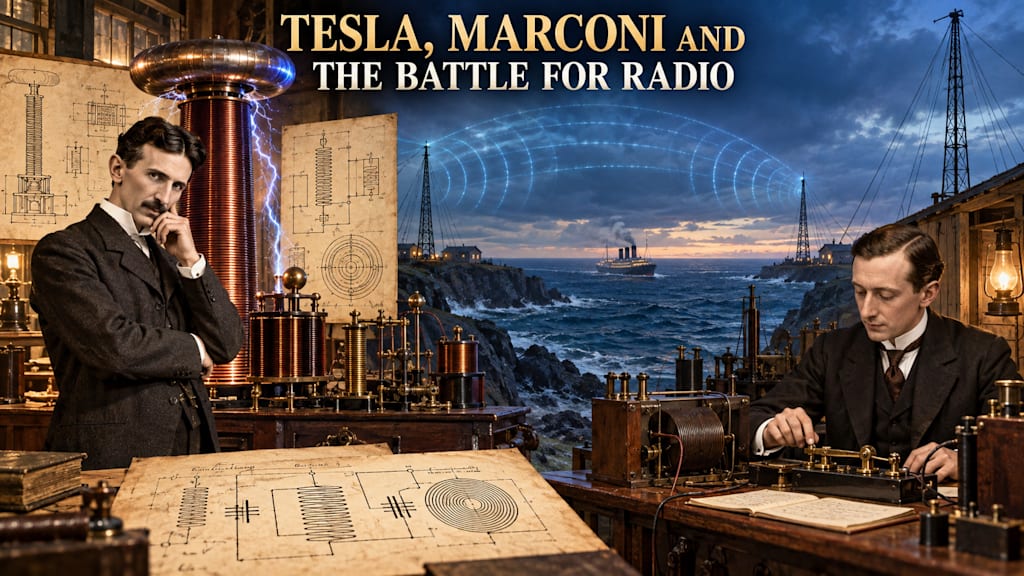
I used ChatGPT to help locate, organise, and examine information relating to the subject. I also used ChatGPT to create the accompanying image.
I wrote the final article in my own words, using the research gathered with ChatGPT's assistance, along with my own interpretation, selection, and presentation of the material. The finished article therefore represents my own work and editorial judgement, with ChatGPT used as a research and image-generation tool.
About the Creator
Alan Spencer
Have been an author and writer for over 20 years. Have been a journalist, editor, proofreader, and a designer and presenter of training courses. Have written over 100 articles, two books, and around 20 training courses.
Enjoyed the story? Support the Creator.
Subscribe for free to receive all their stories in your feed. You could also become a paid subscriber, letting them know you appreciate their work.
Comments
There are no comments for this story
Be the first to respond and start the conversation.