
Delethalization Pad Material Comparison: EPDM Rubber vs Closed-Cell EVA Foam vs Polyurethane in Extreme Weather
A weather-performance comparison of EPDM rubber, closed-cell EVA foam, and polyurethane for long-term outdoor impact safety.

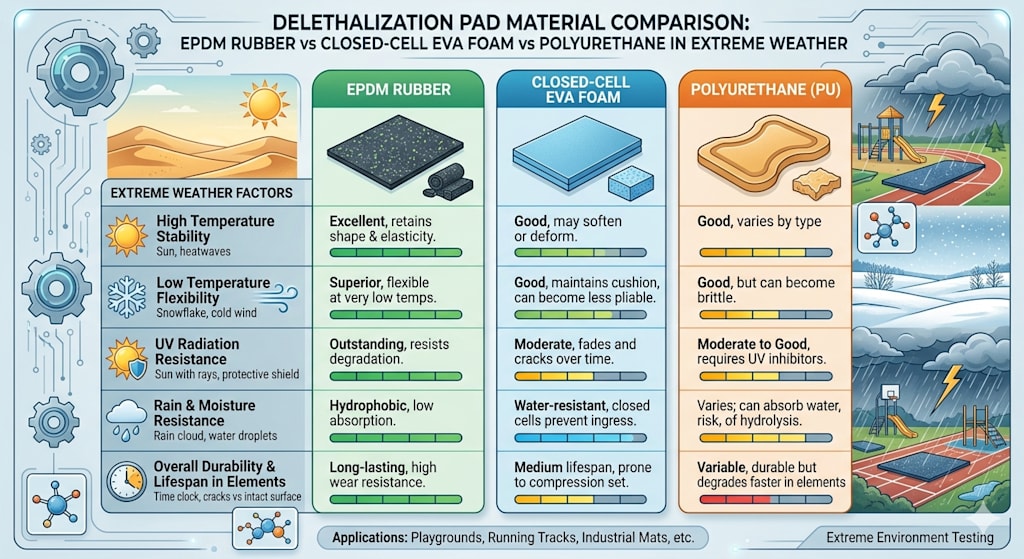
When a delethalization pad is designed for outdoor or harsh-environment use, material choice matters as much as thickness, density, and installation quality. A pad that performs well in mild weather may fail early when exposed to UV rays, freeze-thaw cycles, heavy rain, humidity, salt air, or constant temperature swings.
Three materials often come into the discussion:
- EPDM rubber
- Closed-cell EVA foam
- Polyurethane
Each one behaves differently under stress. Some resist sunlight better. Some hold up better to compression. Some are lighter and cheaper, but age faster. For long-term performance in extreme weather, the right answer depends on the full exposure profile, but one material usually stands out for outdoor durability.
Which Material Lasts Longest in Extreme Weather?
For continuous outdoor exposure, EPDM rubber generally offers the best long-term weather resistance. It is widely valued for its resistance to UV radiation, ozone, rain, and temperature swings. That makes it a strong candidate for delethalization pads used in exposed locations.
Polyurethane can deliver excellent wear and impact resistance, but its lifespan depends heavily on the formulation. Some polyurethane systems handle abrasion very well, while others are more vulnerable to UV exposure and hydrolysis.
Closed-cell EVA foam is usually the least durable in severe outdoor conditions. It is lightweight and easy to fabricate, but long-term exposure to sun, heat, and repeated environmental cycling often shortens its service life.
EPDM Rubber for Delethalization Pads
EPDM rubber is often the most reliable choice when weather resistance is the top priority.
Why EPDM performs well outdoors
EPDM has strong resistance to:
- UV exposure
- Ozone cracking
- Moisture
- Temperature extremes
- Weather aging
This matters for a delethalization pad because outdoor safety surfaces rarely stay dry, shaded, or stable in temperature. EPDM maintains flexibility better than many foam-based materials and is less likely to become brittle under sun exposure.
Strengths of EPDM
- Excellent outdoor durability
- Strong resistance to cracking
- Good long-term elasticity
- Stable performance in hot and cold climates
Limitations of EPDM
- Heavier than foam
- Can cost more than EVA
- May not absorb impact as efficiently as a purpose-built foam system at the same thickness
Best use case
EPDM works best for delethalization pads exposed to direct sunlight, heavy rain, and long service intervals where replacement access is limited.
Closed-Cell EVA Foam for Delethalization Pads
Closed-cell EVA foam is popular when low weight, comfort, and ease of fabrication matter. For a delethalization pad, it can perform well in controlled environments, but extreme weather exposes its weaknesses.
Why EVA is used
Closed-cell EVA is:
- Lightweight
- Easy to cut and shape
- Good at basic impact cushioning
- Resistant to water absorption compared with open-cell foams
Strengths of EVA
- Low weight
- Simple installation
- Comfortable energy absorption
- Useful for layered pad systems
Limitations of EVA
- Faster aging under UV exposure
- Can harden or lose resilience over time
- Less resistant to long-term heat and weather cycling
- More prone to compression set than rubber in demanding outdoor use
Best use case
EVA is a practical option for interior, semi-sheltered, or lower-exposure delethalization pad applications where cost and weight matter more than maximum weather life.
Polyurethane for Delethalization Pads
Polyurethane sits between rubber and foam in many performance categories. It can be made soft or firm, tough or flexible, and that versatility is why it shows up in many impact products.
Why polyurethane is attractive
Polyurethane offers:
- High abrasion resistance
- Strong impact performance
- Good energy return
- Customizable density and hardness
Strengths of polyurethane
- Often resists wear better than EVA
- Good for repeated impact loads
- Can be engineered for specific pad performance
- Useful where surface abrasion is severe
Limitations of polyurethane
- Not all formulations handle UV equally well
- Some grades are vulnerable to hydrolysis in wet climates
- Heat and sun exposure can age weaker formulations faster than EPDM
- Performance varies more by chemistry than many buyers expect
Best use case
Polyurethane works well in delethalization pads when the main issue is repeated impact or abrasion, especially if the product uses a weather-stable formulation and protective design.
Extreme Weather Factors That Affect Pad Life
A delethalization pad does not fail for just one reason. In real-world conditions, several stressors work together.
1. UV exposure
Sunlight breaks down many polymers over time. EPDM handles this better than EVA, while polyurethane depends on the chemistry used.
2. Moisture and humidity
Rain, standing water, and high humidity can shorten service life, especially for materials that absorb water or hydrolyze under wet conditions.
3. Freeze-thaw cycles
Repeated freezing and thawing can create cracking, stiffness, and loss of elasticity. Materials that stay flexible in cold weather last longer.
4. Heat
High temperatures can soften some materials, accelerate aging, and increase permanent compression.
5. Mechanical fatigue
A delethalization pad often sees repeated impacts, load cycles, and surface wear. Materials with better compression recovery last longer.
Practical Recommendation by Climate
Hot, sunny, and dry climates
EPDM rubber is usually the best long-term choice because UV resistance matters most.
Hot, humid, and rainy climates
EPDM rubber still performs well, while weather-stable polyurethane can also work if hydrolysis resistance is confirmed.
Cold climates with freeze-thaw cycling
EPDM rubber again tends to be the safest choice because it stays flexible across a wider temperature range.
High-impact, high-wear environments
Polyurethane may be the better option when abrasion and repeated loading matter more than constant sunlight exposure.
Low-budget or short-service applications
Closed-cell EVA foam can work, but it is usually not the best pick for severe outdoor exposure.
What Buyers Should Ask Before Choosing a Delethalization Pad
Before selecting a material, ask these questions:
- Is the pad fully exposed to sunlight?
- Will it face rain, snow, or standing water?
- How often will it take impact or load?
- Does the site experience freezing temperatures?
- Is abrasion more important than weather resistance?
- How often can the pad be replaced or inspected?
These answers matter because the “best” delethalization pad material is the one matched to the actual environment, not just the one with the highest lab rating.
Final Verdict
For extreme weather and long outdoor life, EPDM rubber usually lasts longest overall in a delethalization pad application.
- EPDM rubber is the strongest all-around outdoor performer.
- Polyurethane can be excellent when abrasion resistance is the priority, but its weather life depends on the formulation.
- Closed-cell EVA foam is useful for lighter-duty or lower-exposure situations, but it is usually the weakest choice for harsh weather.
If the goal is the longest service life in exposed conditions, EPDM is the most dependable starting point.
FAQs
Is EPDM better than EVA foam for delethalization pads?
Yes. EPDM is generally more durable outdoors and handles UV, ozone, and weather exposure better than closed-cell EVA foam.
Does polyurethane always last longer than rubber?
No. Polyurethane can outperform in abrasion and impact resistance, but weather life depends on the specific formulation. In direct outdoor exposure, EPDM is often more reliable.
Which material is best for a delethalization pad in wet climates?
EPDM is usually the safest choice for wet climates because it resists moisture, weather aging, and temperature changes very well.
Which material is cheapest?
Closed-cell EVA foam is often the lowest-cost option, but lower cost usually comes with a shorter outdoor lifespan.
About the Creator
Bob Hus
My impulse control is a writer’s block I’ve finally cured. I trade my peace of mind for prose, and business has never been better.
Enjoyed the story? Support the Creator.
Subscribe for free to receive all their stories in your feed.
Comments
There are no comments for this story
Be the first to respond and start the conversation.