
Data Center Liquid Cooling Market Outlook: Advanced Cooling Efficiency and Growth Opportunities
The Data Center Liquid Cooling Market is experiencing rapid growth driven by the need for advanced cooling efficiency in high-performance computing environments.

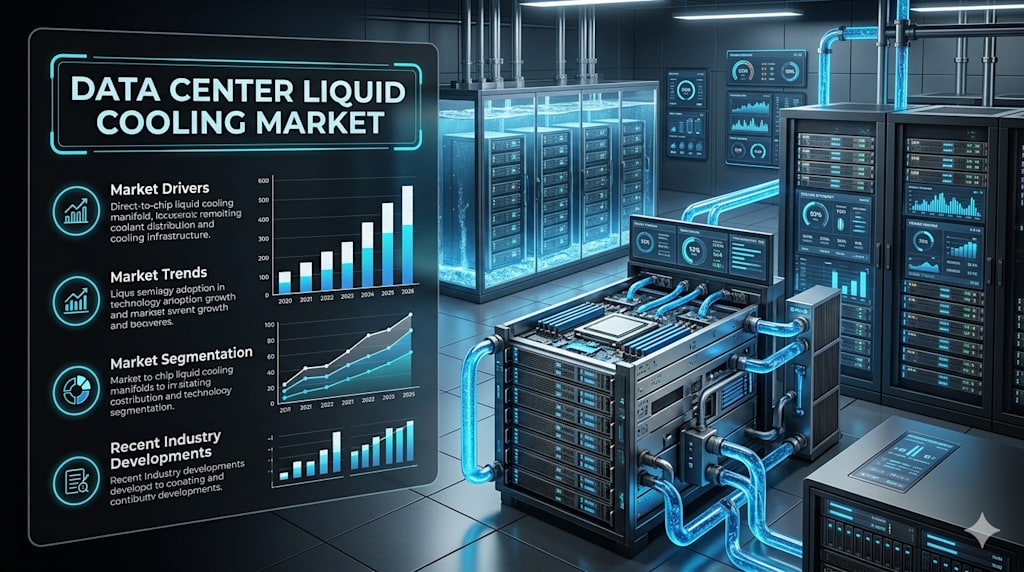
According to IMARC Group's latest research publication, The global data center liquid cooling market size reached USD 4.2 Billion in 2025. Looking forward, IMARC Group expects the market to reach USD 19.1 Billion by 2034, exhibiting a growth rate (CAGR) of 17.82% during 2026-2034.
How AI is Reshaping the Future of Data Center Liquid Cooling Market
- AI-Driven Thermal Prediction and Workload Management: AI algorithms continuously analyze server utilization patterns, ambient temperatures, and GPU/CPU load metrics to anticipate thermal spikes before they occur. In high-density AI computing environments where GPU clusters like Nvidia H100 and GB200 series routinely exceed 700W per chip, predictive thermal models enable real-time adjustment of coolant flow rates and pressure levels.
- Intelligent Fluid Flow Optimization in Direct-to-Chip Systems: Machine learning models embedded in modern coolant distribution units analyze sensor data from hundreds of cold plates simultaneously, dynamically balancing fluid distribution across server racks.
- Anomaly Detection and Predictive Maintenance: AI-powered monitoring platforms continuously process data from thousands of sensors embedded across cooling loops, heat exchangers, and pump systems to detect micro-deviations in pressure, flow rate, and temperature that indicate early-stage equipment degradation.
Data Center Liquid Cooling Industry Overview
The data center liquid cooling industry is undergoing a structural transformation driven by the explosive computational demands of AI model training and inference workloads, combined with tightening government energy regulations. India, which currently operates more than 150 data centers and ranks 14th globally, is emerging as a key growth market where liquid cooling adoption is accelerating to meet rising rack densities. North America continues to lead globally, backed by hyperscale cloud providers investing heavily in direct-to-chip and immersion cooling infrastructure. A prominent example is the KDDI and HPE collaboration announced in June 2025 to establish an AI data center in Osaka set to launch in early 2026, powered by Nvidia's GB200 NVL72 platform with integrated direct liquid cooling, targeting startups and enterprises requiring low-latency, energy-efficient AI computing capabilities.
Data Center Liquid Cooling Market Trends and Drivers
The rapid proliferation of AI and machine learning workloads is the primary structural force reshaping demand for liquid cooling solutions. GPUs and TPUs deployed in AI training clusters generate thermal densities that conventional air cooling physically cannot manage at rack powers exceeding 30kW to 100kW. Shell responded directly to this pressure in June 2025 by launching its DLC Fluid S3 direct liquid cooling solution, claiming up to 27% improvement in power usage effectiveness compared to air-cooled environments, with a service life exceeding six years and full alignment with Open Compute Project standards, addressing the long-term operational requirements of hyperscale operators.
Government regulatory frameworks are simultaneously creating compliance-driven demand. As jurisdictions across North America, Europe, and Asia Pacific enforce tighter carbon emission caps and energy efficiency standards, data centers operating under air cooling face increasing financial and regulatory exposure. Liquid cooling systems, offering measurable energy reductions and enabling waste heat recycling for district heating applications, are positioning themselves as essential infrastructure rather than optional upgrades.
The cloud provider and colocation segment is investing in scalable liquid cooling deployments to accommodate tenant demand for GPU-dense compute nodes. The hyperscale category in particular is prioritizing immersion and direct-to-chip technologies that can accommodate rack densities anticipated to exceed 200kW in next-generation AI server configurations. Aligned Data Centers launched a dedicated high-density liquid cooling system in February 2024 specifically engineered for supercomputing requirements, reflecting how purpose-built cooling infrastructure is becoming a competitive differentiator for colocation operators seeking to attract AI workload tenants.
Leading Companies Operating in the Global Data Center Liquid Cooling Industry
- Alfa Laval AB
- Asetek A/S
- Asperitas
- Chilldyne
- CoolIT Systems Inc.
- Fujitsu Limited
- Green Revolution Cooling Inc.
- Iceotope
- Lenovo Group Limited
- Rittal GmbH & Co. KG
- Schneider Electric SE
- Vertiv Group Corp.
Data Center Liquid Cooling Market Report Segmentation
By Component:
- Solution (Direct Liquid Cooling, Indirect Liquid Cooling)
- Services (Design and Consulting, Installation and Deployment, Support and Maintenance)
Solution accounts for the largest share because direct and indirect liquid cooling systems outperform traditional air cooling in thermal management effectiveness, energy efficiency, and capacity to handle high-density AI and HPC workloads.
By Data Center Type:
- Large Data Centers
- Small and Medium-sized Data Centers
- Enterprise Data Centers
Large data centers hold the leading position driven by their hyperscale infrastructure requirements, high server density, and need for scalable cooling solutions that support extensive data storage and cloud service delivery.
By End Use:
- Cloud Providers
- Colocation Providers
- Enterprises
- Hyperscale Data Centers
Enterprises represent the largest end-use segment as digital transformation accelerates internal IT infrastructure complexity, requiring robust and scalable liquid cooling solutions to maintain operational stability and performance.
By Application:
- BFSI
- IT and Telecom
- Media and Entertainment
- Healthcare
- Government and Defense
- Retail
- Research and Academic
- Others
IT and telecom dominate the application landscape owing to their continuous requirement for high-performance network infrastructure, extensive data processing capacity, and mission-critical reliability standards that liquid cooling directly supports.
Regional Insights:
- North America (United States, Canada)
- Asia Pacific (China, Japan, India, South Korea, Australia, Indonesia, Others)
- Europe (Germany, France, United Kingdom, Italy, Spain, Russia, Others)
- Latin America (Brazil, Mexico, Others)
- Middle East and Africa
North America holds the largest regional market share, supported by concentrated hyperscale cloud investments, advanced direct-to-chip cooling deployments, and regulatory momentum toward energy-efficient data center operations.
Recent News and Developments in Data Center Liquid Cooling Market
- June 2025: Shell launched DLC Fluid S3, a direct liquid cooling fluid for AI and high-performance computing data centers, delivering up to 27% improvement in power usage effectiveness over air cooling, offering over six years of service life with full OCP standard compliance and compatibility with key server materials.
- June 2025: Trane Technologies enhanced its liquid cooling portfolio with scalable Coolant Distribution Units ranging from 2.5MW to 10MW, incorporating smart monitoring and AI-optimized performance management to support high-density AI workloads while improving energy efficiency and sustainability across data center operations.
- June 2025: KDDI and HPE announced a new AI data center in Osaka powered by Nvidia's GB200 NVL72 platform with integrated direct liquid cooling, scheduled to launch in early 2026, targeting startups and enterprises with low-latency, energy-efficient AI computing through KDDI's WAKONX platform.
- February 2024: Aligned Data Centers launched a purpose-built liquid cooling system engineered specifically for high-density compute and supercomputing requirements, addressing growing demand from AI infrastructure operators seeking scalable thermal management solutions.
- February 2024: SK Enmove signed a Memorandum of Understanding with SK Telecom and Iceotope Technologies to advance cooperation on next-generation liquid cooling solutions, reflecting converging interest from telecom operators entering AI edge computing infrastructure.
- January 2024: Modine acquired the intellectual property and select assets of TMG Core, a specialist in single- and two-phase liquid immersion cooling technology for high-density data centers, accelerating its thermal management capabilities for next-generation AI server environments.
Note: If you require specific details, data, or insights that are not currently included in the scope of this report, we are happy to accommodate your request. As part of our customization service, we will gather and provide the additional information you need, tailored to your specific requirements. Please let us know your exact needs, and we will ensure the report is updated accordingly to meet your expectations.
About the Creator
Olivia Smith
Olivia Smits is a Research and Marketing Analyst who specializes in market research, trend analysis, and consumer insights. I help businesses make smarter marketing and strategy decisions by turning data into clear, actionable insights.
Enjoyed the story? Support the Creator.
Subscribe for free to receive all their stories in your feed.
Comments
There are no comments for this story
Be the first to respond and start the conversation.