
Data Center Cooling Market Trends: Liquid Cooling Adoption, Energy Efficiency & Forecast to 2034
How rising data consumption, AI workloads, and high-density servers are increasing demand for advanced thermal management and efficient cooling solutions in the data center cooling market

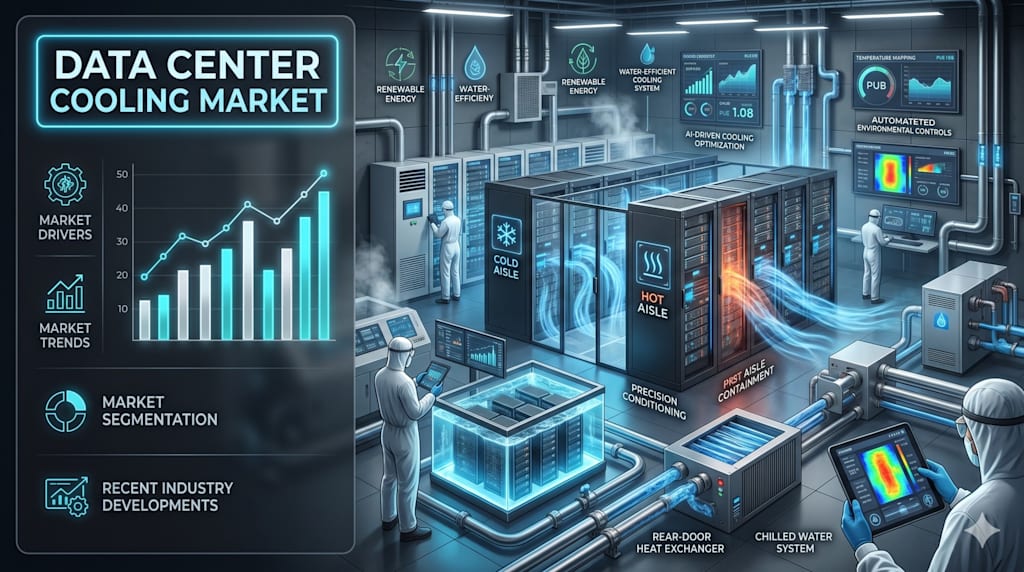
According to IMARC Group's latest research publication, The global data center cooling market size was valued at USD 19.7 Billion in 2025 and is projected to reach USD 59.8 Billion by 2034, exhibiting a CAGR of 13.17% during the forecast period 2026-2034.
How AI and Technology Are Reshaping the Future of the Data Center Cooling Market
- AI-Driven Predictive Cooling Optimization: Machine learning platforms integrated with thousands of facility sensors continuously analyze temperature gradients, server load distributions, humidity levels, and airflow patterns to dynamically adjust cooling parameters in real time without human intervention. Google's DeepMind-based AI system demonstrated the scale of this opportunity by achieving a 40% reduction in cooling energy consumption through predictive thermal optimization across its global data center network. These intelligent systems reduce overcooling incidents, eliminate hotspot formation before equipment damage occurs, and enable facility operators to lower power usage effectiveness ratios toward 1.0, a performance benchmark that translates directly into multi-million-dollar operational cost savings at hyperscale deployments running continuous AI and high-performance computing workloads.
- Direct-to-Chip Liquid Cooling for High-Density GPU Clusters: As modern GPU-dense server racks now dissipate beyond 200 kW per rack, a threshold that renders conventional CRAC air cooling units entirely ineffective, direct-to-chip cold plate technology has moved from pilot programs to production-floor standard at major hyperscale operators. Cold plate systems circulate chilled fluid through metal blocks mounted directly onto processor surfaces, transferring heat 3,000 times more efficiently than air-based systems and enabling compute densities previously impossible within standard rack footprints. CoolIT Systems' OMNI coldplates with Split-Flow technology, optimized for NVIDIA GB200 Grace Blackwell Superchips, exemplify how component-level innovation is being designed in lockstep with AI silicon development to meet the thermal envelope demands of next-generation large language model training infrastructure.
- Immersion Cooling for Hyperscale and AI-Intensive Environments: Single-phase and two-phase immersion cooling systems, which submerge server hardware directly in dielectric fluids to achieve heat flux densities of up to 1,500 W/cm², are being deployed at production scale by operators running the most thermally demanding AI and high-performance computing clusters. Two-phase systems leverage fluid vaporization to carry heat away from compute components with exceptional efficiency, eliminating the need for traditional raised-floor air distribution entirely and enabling data center operators to dramatically increase compute density per square meter of floor space. Submer secured a USD 55.5 million investment to scale its immersion cooling infrastructure, while Green Revolution Cooling received strategic financing from Samsung Ventures, SK Enmove, and ENEOS specifically to accelerate global deployment of immersion technologies that reduce capital expenditure, operational costs, and carbon footprints simultaneously.
- Recirculating Water Systems and Closed-Loop Zero-Evaporation Design: Growing pressure from municipal water authorities, environmental regulators, and corporate sustainability commitments is driving a fundamental shift away from open evaporative cooling towers toward closed-loop water recirculation architectures that eliminate consumptive water loss entirely. AWS developed a proprietary direct-to-chip liquid cooling system in just 11 months to support growing AI chip heat loads, achieving a 46% reduction in mechanical energy consumption during peak cooling cycles and a global power usage effectiveness of 1.15 using a closed-loop fluid system. Microsoft committed that all data centers designed from August 2024 onward will incorporate closed-loop, zero-water-evaporation cooling designs, reflecting how sustainability policy is now functioning as a capital allocation driver rather than a voluntary reporting metric for the world's largest data center operators.
- Waste Heat Recovery and District Energy Integration: Nordic data center operators are pioneering the commercial monetization of server waste heat, with facilities in Sweden, Finland, and Denmark now delivering measurable thermal output into municipal district heating networks that supply residential and commercial buildings. European cities including Frankfurt and Amsterdam have begun imposing mandatory waste-heat reuse quotas on new data center development approvals, creating a regulatory environment where cooling system design must account for heat recovery infrastructure as a planning prerequisite rather than an optional efficiency feature. AirJoule, backed by GE Vernova, introduced a patented sorbent-based technology that extracts pure, recyclable water from data center waste heat streams, with its first commercial deployment announced for a 600 MW facility outside Hubbard, Texas, demonstrating that waste heat recovery is transitioning from pilot demonstration into utility-scale commercial application.
Data Center Cooling Market Industry Overview
The global data center cooling market is experiencing strong growth momentum, driven by the explosive proliferation of AI infrastructure, the accelerating transition from air-based to liquid-based thermal management systems, and rising regulatory pressure on energy efficiency and water consumption across every major data center geography. According to IMARC Group's latest research, the global data center cooling market size reached USD 19.7 Billion and is projected to reach USD 59.8 Billion within the forecast window, reflecting the scale of capital investment being directed into thermal infrastructure as AI workload density continues to outpace the capabilities of legacy cooling architectures.
Air conditioning represents the dominant solution segment, underpinned by its established role across the installed base of mid-tier enterprise data centers and its continued relevance for server environments operating below the thermal thresholds that necessitate liquid intervention. However, liquid-based cooling technology is rapidly capturing the largest share of new-build deployments, particularly across hyperscale cloud facilities and dedicated AI training clusters where rack power densities have surged from legacy 10 kW envelopes to configurations exceeding 140 kW per rack for NVIDIA Blackwell platform deployments. Installation and deployment services command the largest share of the services segment, reflecting the capital-intensive and technically complex nature of transitioning existing air-cooled facilities toward hybrid or fully liquid-based thermal management architectures.
Room-based cooling holds the largest share within the type of cooling segmentation, representing the foundational cooling approach for the broad installed base of conventional enterprise and colocation data centers where wholesale infrastructure replacement is constrained by capital budgets and tenant lease obligations. Enterprise data centers represent the largest end-user segment by type, driven by financial institutions, telecommunications operators, government agencies, and large corporations managing proprietary IT infrastructure that requires guaranteed uptime, regulatory compliance, and controlled environmental conditions that third-party colocation cannot fully provide. The IT and Telecom vertical accounts for the largest share of vertical demand, driven by the continuous expansion of cloud service provider infrastructure, 5G network core processing requirements, and the computational demands of real-time communications platforms operating at global scale.
Asia Pacific exhibits clear dominance in the data center cooling market, driven by the rapid development of digital infrastructure across China, India, Japan, Singapore, and South Korea to support surging data storage, AI model development, and cloud service consumption across the region's expanding digital economy. China's accelerating AI build-out is forcing rapid adoption of liquid cooling architectures as domestic AI chip thermal envelopes increase, while India's government-backed digital infrastructure expansion programs are generating institutional demand for advanced cooling solutions across newly commissioned hyperscale campuses in Mumbai, Chennai, and Hyderabad.
Data Center Cooling Market Trends and Drivers
The growing demand for efficient data centers, rising focus on maintaining energy efficiency and sustainability, and increasing proliferation of cloud computing to delegate routine tasks and store massive amounts of data are the foundational forces propelling the data center cooling market forward at an accelerating pace. Cloud service providers collectively manage infrastructure supporting 60% of the world's corporate data, with 90% of large organizations having implemented multi-cloud infrastructure strategies that distribute processing loads across geographically dispersed data center nodes each requiring robust, scalable thermal management systems capable of handling dynamic and unpredictable workload spikes without performance degradation or equipment failure risk.
The transition to edge computing, which entails the deployment of smaller data centers in proximity to end-users for low-latency processing in applications including autonomous vehicles, industrial automation, real-time video analytics, and financial trading platforms, is creating a distributed demand base for compact, high-efficiency cooling solutions that can operate reliably across diverse physical environments without the controlled conditions of purpose-built hyperscale campuses. Edge facilities processing time-sensitive workloads cannot tolerate the thermal management failures that cause server throttling or shutdown, making precision cooling infrastructure a non-negotiable operational requirement rather than a capital optimization consideration. The proliferation of IoT devices, which are expected to reach over 32 billion connected units globally, continuously generates data that must be processed and stored in facilities where heat management determines both system reliability and energy cost.
Government policy frameworks across North America, Europe, and Asia are increasingly shaping the technological trajectory of data center cooling investment through energy efficiency mandates, water consumption restrictions, carbon reporting requirements, and green building certification programs that apply specifically to digital infrastructure. The European Union's Energy Efficiency Directive creates binding obligations for large data centers to report power usage effectiveness, water usage effectiveness, and renewable energy utilization metrics, creating regulatory pressure that accelerates investment in advanced cooling technologies capable of improving these reported figures. The United States Department of Energy's COOLERCHIPS program, a collaborative research initiative involving industry partners including Boyd, NVIDIA, and national laboratories, specifically targets reducing data center cooling energy consumption to less than 5% of total facility energy use, a performance threshold that would represent a fundamental advance over current industry averages where cooling consumes between 30% and 40% of total data center power draw.
The high energy consumption of conventional cooling systems and rising upfront capital costs associated with liquid cooling infrastructure transitions represent the primary constraints on market growth, particularly for mid-sized enterprise operators lacking the balance sheet capacity of hyperscale cloud providers to absorb the capital expenditure required for facility-wide thermal system upgrades. However, the development and adoption of energy-efficient and environmentally friendly cooling technologies including free cooling systems that leverage ambient outdoor air, geothermal cooling that utilizes stable underground temperatures, and advanced closed-loop liquid systems that eliminate water consumption and reduce mechanical energy demands presents significant opportunities for reducing total cost of ownership over the operational lifecycle of data center facilities, progressively improving the financial case for advanced cooling adoption across a broader range of operator types and geographies.
Leading Companies Operating in the Global Data Center Cooling Market
- Airedale International Air Conditioning
- Asetek
- Black Box Corporation
- Climaveneta Climate Technologies
- Coolcentric
- Emerson Electric
- Fujitsu
- Hitachi
- Netmagic
- Nortek Air Solutions
- Rittal
- Schneider Electric
- STULZ GmbH
- Vertiv
- Data Center Cooling Market Report Segmentation
- By Solution:
- Air Conditioning
- Chilling Units
- Cooling Towers
- Economizer Systems
- Liquid Cooling Systems
- Control Systems
- Others
Air conditioning represents the largest solution segment, as it remains critical for maintaining correct temperature and humidity levels across the broad installed base of enterprise data centers where servers and networking equipment require consistent environmental conditions for peak performance delivery.
By Services:
- Consulting
- Installation and Deployment
- Maintenance and Support
Installation and deployment holds the largest share of the services segment, driven by the technically complex and capital-intensive requirements of deploying cooling infrastructure across new hyperscale facilities and retrofitting advanced liquid cooling architectures into existing air-cooled data center environments.
By Type of Cooling:
- Room-Based Cooling
- Row-Based Cooling
- Rack-Based Cooling
Room-based cooling accounts for the largest market share, representing the foundational thermal management approach across the established global installed base of enterprise and colocation data centers.
By Cooling Technology:
- Liquid-Based Cooling
- Air-Based Cooling
Liquid-based cooling holds the maximum market share, driven by the superior heat dissipation efficiency required for high-density AI and high-performance computing server environments where air-based systems can no longer maintain thermal performance within acceptable operating parameters.
By Type of Data Center:
- Mid-Sized Data Centers
- Enterprise Data Centers
- Large Data Centers
Enterprise data centers account for the largest market share, as they house the centralized IT infrastructure of major financial institutions, telecommunications operators, government agencies, and corporations requiring guaranteed uptime and controlled environmental management.
By Vertical:
- BFSI
- IT and Telecom
- Research and Educational Institutes
- Government and Defense
- Retail
- Energy
- Healthcare
- Others
IT and Telecom represents the dominant vertical, driven by the continuous infrastructure expansion of cloud service providers, telecommunications network core processing requirements, and the computational demands of real-time digital communications platforms.
Regional Insights:
- North America (United States, Canada)
- Asia Pacific (China, Japan, India, South Korea, Australia, Indonesia, Others)
- Europe (Germany, France, United Kingdom, Italy, Spain, Russia, Others)
- Latin America (Brazil, Mexico, Others)
- Middle East and Africa
Asia Pacific exhibits clear dominance in the data center cooling market due to the rapid development of digital infrastructure across the region to support increasing data storage and processing needs, with China, India, and Japan leading investment in advanced cooling solutions for newly commissioned hyperscale and AI-dedicated data center campuses.
Recent News and Developments in the Data Center Cooling Market
- July 2025: AWS introduced a proprietary in-row liquid cooling system co-designed with NVIDIA, enabling GPU rack cooling without requiring major modifications to existing facility infrastructure. The system fits within standard rack footprints and supports smooth scaling of AI workloads in legacy data center environments, with AWS evaluating extension of the technology to its Graviton chipset family as heat demands from next-generation custom silicon continue to increase.
- June 2025: Green Revolution Cooling secured new financing from Samsung Ventures, HTS, SK Enmove, and ENEOS, with Samsung C&T entering into a strategic partnership with the company to accelerate global deployment of immersion cooling technologies. The funding is specifically directed at scaling solutions that reduce capital expenditure, operational costs, and carbon footprints for hyperscale and AI-intensive data center operators across North America, Europe, and Asia Pacific.
- March 2025: Vertiv Group Corp. launched the CoolLoop Trim Cooler, a solution designed to manage water temperature fluctuations in liquid-cooled systems, and simultaneously announced a collaboration with Tecogen Inc. to incorporate advanced natural gas-powered chiller technology into its data center cooling product portfolio for global deployment. The dual announcements reflect Vertiv's strategy of expanding across both liquid cooling hardware and integrated facility energy management as hyperscale operators seek unified thermal and power management solutions.
- December 2024: Schneider Electric partnered with NVIDIA to release AI-ready data center reference architectures supporting high-density liquid cooling at the rack level, designed to reduce energy consumption and accelerate deployment timelines for hyperscale clients building dedicated AI training infrastructure. The collaboration extends to sustainable infrastructure solutions addressing the full thermal management lifecycle from rack-level cooling distribution to facility-wide power usage effectiveness optimization.
- October 2024: Vertiv acquired BiXin Energy Technology to reinforce its high-capacity chiller product line for Asian markets, while Schneider Electric completed its approximately USD 850 million acquisition of Motivair Corp, a specialist in liquid cooling for high-performance computing environments, adding immersion cooling capability for GPU clusters to its global data center infrastructure portfolio. Both transactions reflect accelerating industry consolidation as established thermal management vendors seek to close technology gaps in liquid and immersion cooling before hyperscale AI infrastructure procurement cycles shift decisively away from conventional air-based systems.
Note: If you require specific details, data, or insights that are not currently included in the scope of this report, we are happy to accommodate your request. As part of our customization service, we will gather and provide the additional information you need, tailored to your specific requirements. Please let us know your exact needs, and we will ensure the report is updated accordingly to meet your expectations.
About the Creator
Abhay Rajput
I am working in market research company that provides market and business research intelligence across the globe.
Enjoyed the story? Support the Creator.
Subscribe for free to receive all their stories in your feed.
Comments
There are no comments for this story
Be the first to respond and start the conversation.