
Dairy Processing Equipment Market Insights: IoT Integration, Real-Time Monitoring & Forecast to 2034
How smart sensors, IoT integration, and predictive maintenance are enabling real-time monitoring and optimizing performance across dairy processing facilities worldwide

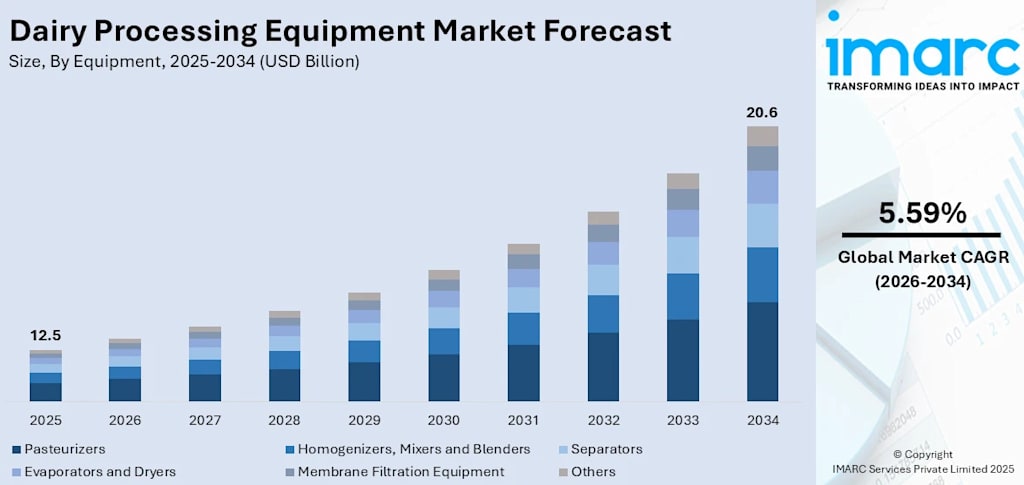
The rising demand for safe, high-quality dairy products and the push for operational efficiency through automation are the primary forces fueling the dairy processing equipment sector. Manufacturers are increasingly adopting advanced pasteurizers, homogenizers, and membrane filtration systems to meet strict food safety standards and cater to the growing consumer preference for value-added products like Greek yogurt, UHT milk, and protein-enriched beverages. According to IMARC Group’s latest data, The global dairy processing equipment market size was valued at USD 12.5 Billion in 2025. Looking forward, IMARC Group estimates the market to reach USD 20.6 Billion by 2034, exhibiting a CAGR of 5.59% from 2026-2034.
Dairy processing technology has evolved into a vital infrastructure segment that supports a global industry producing over 930 million tons of milk annually. Growth is underpinned by rapid urbanization, where more than 4 billion people now live in urban centers, driving the need for shelf-stable and conveniently packaged dairy options. Innovation is centered around reducing human touchpoints through robotics, enhancing energy recovery in pasteurization, and utilizing AI-driven diagnostics to minimize downtime.
Dairy Processing Equipment Market Growth Drivers:
- Rising Global Consumption of Processed Dairy
Urbanization and rising disposable incomes in emerging economies are fundamentally changing dietary habits, shifting demand toward processed and value-added dairy products. With global milk production having surged by over 75% in recent decades to reach 930 million tons, processors require high-capacity equipment to handle increased volumes. In regions like India, which accounts for 25% of global milk output, there is a massive push to modernize infrastructure. This supports the adoption of UHT systems and aseptic packaging that allow dairy products to be transported over long distances without refrigeration.
- Technological Advancements in Automation
The industry is moving toward "smart" factories where automation represents over 56% of the equipment market share. Manufacturers are investing in AI-powered lines and IoT sensors that provide real-time data on temperature, pressure, and flow rates. These technologies reduce labor costs, eliminate human error in sanitation, and ensure consistent product quality. Recent data suggests that producers using fully automated lines can achieve up to 25% higher yields compared to manual operations. This digital transformation is essential for meeting the high-speed requirements of modern production while maintaining rigorous hygiene protocols.
Download Your Complimentary "Dairy Processing Equipment Market" Insights Today!
- Stringent Food Safety and Regulatory Compliance
Governments worldwide are implementing stricter food safety regulations, such as the Food Safety Modernization Act (FSMA) in the U.S. and similar mandates in Europe and Asia. These regulations necessitate the use of advanced pasteurizers and sterilization modules that can guarantee 99.99% removal of bacteria and spores. Equipment with built-in Clean-in-Place (CIP) systems is becoming the industry standard to prevent cross-contamination. Consequently, dairy companies are forced to upgrade legacy equipment to newer, more transparent systems that offer full traceability from the farm to the final retail package.
Dairy Processing Equipment Market Trends:
- Focus on Sustainability and Energy Efficiency
Environmental impact has become a top priority, leading brands to invest in equipment that features integrated heat recovery and water recycling capabilities. Modern pasteurizers now utilize regenerative heating to save up to 90% of energy costs compared to older models. Furthermore, membrane filtration technology is trending because it allows for efficient water recovery and protein concentration with a lower carbon footprint than traditional evaporation. These eco-friendly initiatives help processors comply with tightening carbon regulations while appealing to a consumer base that increasingly favors responsibly produced food.
- Innovation in Functional and Plant-Based Dairy
The market is diversifying beyond traditional milk into functional dairy and plant-based alternatives, requiring flexible processing equipment. There is a notable surge in demand for specialized separation and concentration machinery to produce high-protein yogurt and lactose-free milk. Additionally, many dairy processors are installing "switchable" production lines that can transition between dairy and plant-based beverages with minimal downtime. This trend is driven by the wellness movement, where consumers seek beverages enriched with vitamins, probiotics, or electrolytes, forcing equipment manufacturers to design more modular and adaptable systems.
- Expansion of Modular and On-Site Processing
A significant shift is occurring toward modular, compact processing units that allow smaller, local dairies to process milk directly at the source. This "micro-dairy" trend reduces transportation costs and carbon emissions while enabling the production of artisanal, farm-fresh cheeses and yogurts. By 2026, these portable units are expected to gain more traction in regions with fragmented milk supply chains. This modularity allows producers to scale their operations incrementally, making advanced technology accessible to mid-sized enterprises that were previously sidelined by the high capital costs of massive, fixed-installation factories.
Recent News and Developments in Dairy Processing Equipment Market:
- September 2025: Several major dairy cooperatives in the European Union initiated a multi-million dollar upgrade program to replace traditional boilers with electric heat pump systems, aiming to achieve carbon-neutral milk processing by the end of the decade.
- October 2025: The Indian government expanded its Animal Husbandry Infrastructure Development Fund (AHIDF) to provide subsidized loans for the setup of automated milk chilling and processing centers in rural districts to boost export quality.
- January 2026: A prominent technology firm unveiled a blockchain-based traceability module that integrates directly with pasteurization hardware, allowing consumers to scan a QR code on milk cartons to see the exact time and temperature of processing.
Note: If you require specific details, data, or insights that are not currently included in the scope of this report, we are happy to accommodate your request. As part of our customization service, we will gather and provide the additional information you need, tailored to your specific requirements. Please let us know your exact needs, and we will ensure the report is updated accordingly to meet your expectations.
About the Creator
Andrew Sullivan
Hello, I’m Andrew Sullivan. I have over 9+ years of experience as a market research specialist.
Enjoyed the story? Support the Creator.
Subscribe for free to receive all their stories in your feed.
Comments
There are no comments for this story
Be the first to respond and start the conversation.