
Crane Market Trends: Tower Crane Adoption, Smart Controls & Industry Forecast to 2034
How increasing demand for high-rise buildings, commercial complexes, and residential infrastructure is driving adoption of tower cranes and advanced lifting solutions globally

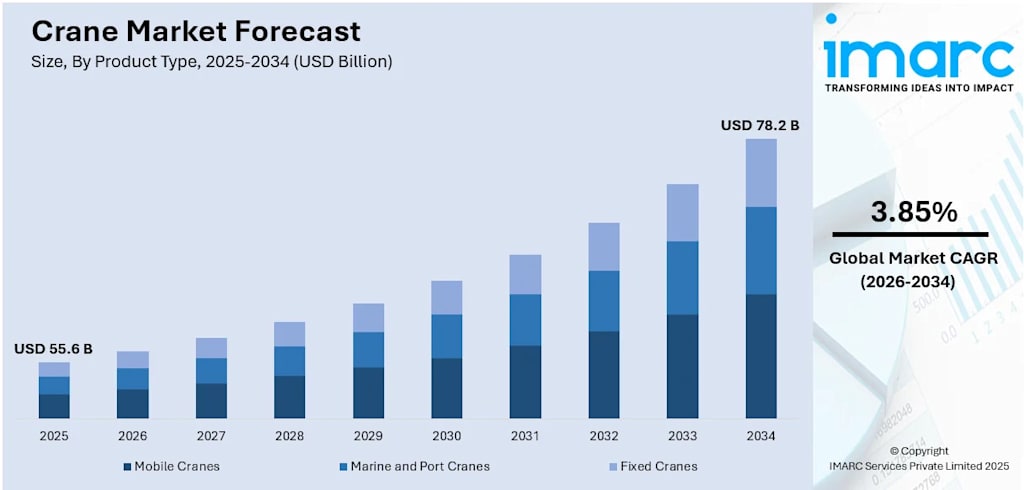
Rising infrastructure development, rapid urbanization, and the expansion of the energy and industrial sectors are propelling the global crane demand. This growth is bolstered by the integration of smart technologies, a surge in high-rise construction, and the modernization of transportation networks. According to IMARC Group’s latest data, the global crane market size was valued at USD 55.6 Billion in 2025. Looking forward, IMARC Group estimates the market to reach USD 78.2 Billion by 2034, exhibiting a CAGR of 3.85% from 2026-2034.
The crane industry has evolved into a vital backbone for global development, with the market now exceeding the USD 55 billion mark and showing consistent upward momentum. This expansion is heavily influenced by the transition toward "smart cities" and the urgent need for heavy-lifting solutions in the renewable energy sector, particularly for offshore wind farm installations. Mobile cranes currently lead the industry, accounting for approximately 78.6% of the market share, prized for their versatility and quick deployment on diverse terrains. Meanwhile, the construction and infrastructure segment remains the primary end-user, representing 35.0% of the market.
Crane Market Growth Drivers:
- Accelerated Urbanization and Infrastructure Expansion
The rapid migration of populations to urban centers, particularly in emerging economies, is creating an unprecedented need for high-rise residential buildings and commercial hubs. Governments are funneling billions into "mega-projects," such as India's National Industrial Corridor, which costs approximately USD 3.41 billion, and China’s ongoing Belt and Road Initiative. These massive undertakings require a constant supply of tower and mobile cranes to manage heavy materials and structural assemblies. As cities grow vertically, the demand for specialized lifting equipment remains a non-negotiable requirement for modern civil engineering.
- Booming Renewable Energy Sector
The global transition toward green energy is a significant catalyst for the crane industry. Large-scale wind energy projects require ultra-high-capacity cranes to install massive turbines and blades, often in challenging offshore environments. With global financial institutions like the World Bank committing over USD 13 billion to renewable energy infrastructure in recent years, the need for specialized crawler and marine cranes has spiked. These projects demand machinery that can handle loads exceeding 300 tons, ensuring that the shift toward sustainable power generation is supported by robust and reliable lifting technology.
- Technological Integration and Automation
Safety and efficiency are driving the adoption of "intelligent" cranes equipped with IoT sensors, AI, and remote-control systems. This technological leap addresses the critical shortage of skilled operators, as seen in the U.S. where the construction sector required over 439,000 new workers in 2025 alone. Automated systems help reduce the risk of accidents which historically average 42 crane-related deaths annually in the U.S. by providing real-time data on load stability and collision avoidance. This move toward automation not only saves lives but also slashes downtime, making smart cranes a high-value investment.
Crane Market Trends:
- Shift Toward Electrification and Zero-Emission Models
Environmental regulations and corporate sustainability goals are pushing manufacturers to move away from traditional diesel-powered engines. There is a marked rise in the development of fully electric and hybrid cranes, which offer the benefit of lower operating costs and significantly reduced noise levels on-site. This is particularly relevant in urban "noise-sensitive" zones and indoor industrial applications. Leading manufacturers are now showcasing electric crawler cranes and battery-operated self-erecting models that maintain high lifting capacities while aligning with global mandates to reduce carbon footprints across the heavy machinery sector.
- Rise of Telematics and Predictive Maintenance
The integration of telematics is transforming how fleet managers oversee crane operations. By using real-time GPS tracking and sensor-based diagnostics, companies can now predict mechanical failures before they occur, preventing costly project delays. This trend is becoming standard across the industry as it allows for optimized fleet utilization and better fuel management. In a market where a single day of downtime can cost thousands of dollars, the ability to monitor hydraulic pressures and engine health remotely is a game-changer for large-scale contractors and rental companies.
- Modular Construction and Off-Site Manufacturing
The growing popularity of modular construction, where large sections of buildings are prefabricated off-site, is altering crane usage patterns. Instead of traditional incremental lifting, cranes are now required to lift much heavier, fully-finished "modules" into place with extreme precision. This shift is boosting the demand for high-capacity hammerhead and luffing jib tower cranes that can handle the sheer weight of these pre-built units. This method significantly speeds up construction timelines, often by up to 50%, making heavy-duty cranes the essential tool for this modern, high-speed building approach.
Recent News and Developments in Crane Market
- January 2025: Tadano Ltd. completed the acquisition of IHI Transport Machinery’s lifting business, effectively strengthening its portfolio in the jib climbing and port crane sectors to better serve the offshore wind market.
- April 2025: Konecranes expanded its European footprint by acquiring the Spanish service firm PIMEG, a move aimed at enhancing its local maintenance network and service delivery for industrial crane users.
- January 2026: Crane Company (Crane Co.) announced a major leadership transition and the successful completion of several strategic acquisitions, signaling a push toward more technology-led and proprietary engineering solutions in the aerospace and advanced technologies sectors.
Note: If you require specific details, data, or insights that are not currently included in the scope of this report, we are happy to accommodate your request. As part of our customization service, we will gather and provide the additional information you need, tailored to your specific requirements. Please let us know your exact needs, and we will ensure the report is updated accordingly to meet your expectations.
About the Creator
Andrew Sullivan
Hello, I’m Andrew Sullivan. I have over 9+ years of experience as a market research specialist.
Enjoyed the story? Support the Creator.
Subscribe for free to receive all their stories in your feed.
Comments
There are no comments for this story
Be the first to respond and start the conversation.