
Cooling Tower Market Trends: Energy Efficiency, Industrial Demand & Forecast to 2034
How rising industrialization, increasing energy demand, and need for efficient heat dissipation are driving adoption of advanced cooling tower systems across global industries

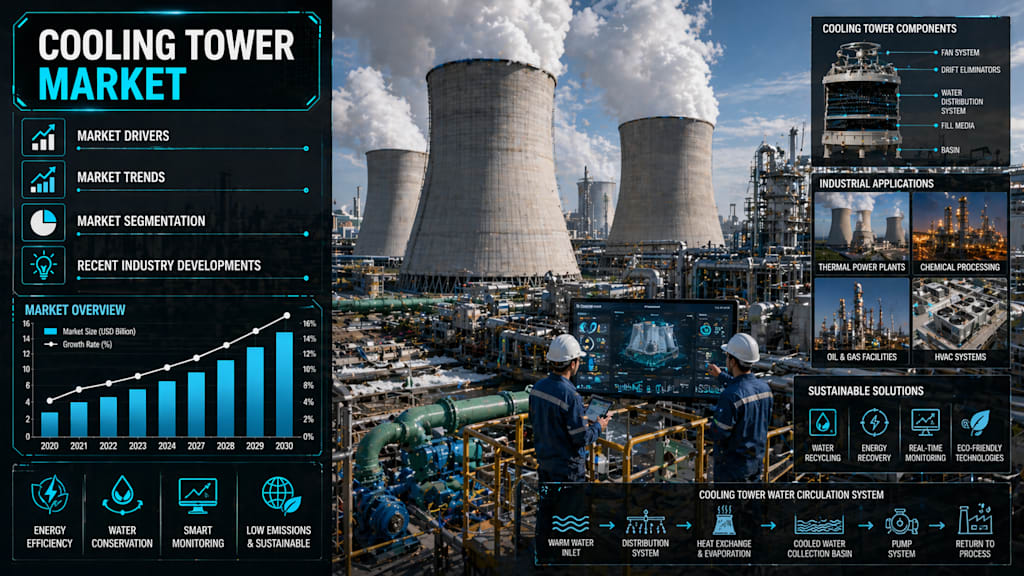
According to IMARC Group's latest research publication, The global cooling tower market size was valued at USD 3.25 Billion in 2025 and is projected to reach USD 4.46 Billion by 2034, exhibiting a CAGR of 3.48% during the forecast period 2026-2034.
How AI is Reshaping the Future of Cooling Tower Market
- Predictive Maintenance and Equipment Failure Prevention: AI-powered monitoring systems analyze real-time sensor data from cooling tower components including fans, pumps, and fill media to detect anomalies before they escalate into costly equipment failures. Machine learning algorithms process historical performance data alongside current operational parameters to generate predictive alerts, enabling maintenance teams to schedule interventions proactively rather than reactively. Facilities implementing AI-driven predictive maintenance frameworks have reported significant reductions in unplanned downtime, which is critical for industries like power generation and petrochemicals where operational continuity directly impacts revenue. These intelligent systems also reduce the frequency of unnecessary scheduled maintenance, optimizing labor allocation and spare parts procurement across large industrial facilities with multiple cooling tower installations.
- Energy Consumption Optimization Through Dynamic Load Management: AI systems integrated with cooling tower operations can continuously evaluate ambient temperature, humidity levels, heat load variations, and system capacity to dynamically adjust fan speeds, water flow rates, and pumping cycles. By automating these parameters in real time, facilities eliminate the energy waste associated with fixed-speed operations and manual setpoint adjustments. Variable Frequency Drive systems guided by AI logic have demonstrated measurable reductions in electricity consumption, particularly relevant given that cooling towers in large industrial plants can account for a substantial portion of total facility energy expenditure. This capability directly supports corporate sustainability targets and operational cost reduction mandates that now govern capital investment decisions in the HVAC, chemical, and food processing sectors.
- Water Usage Reduction and Chemical Treatment Optimization: Water scarcity regulations and conservation mandates across key industrial markets are pressuring operators to demonstrate measurable reductions in freshwater withdrawal. AI-powered water management platforms monitor blowdown cycles, drift losses, evaporation rates, and cycles of concentration to optimize water usage in real time, reducing consumption without compromising thermal performance. Additionally, AI systems govern chemical dosing for scale inhibition, corrosion control, and biological treatment by analyzing water quality sensor data continuously, ensuring precise chemical delivery that prevents under-treatment risks and eliminates the waste associated with over-treatment. Hydroleap's strategic partnership with IX Technology in Singapore specifically targeted this challenge, aiming to reduce water consumption, lower chemical use, and improve regulatory compliance for data center cooling tower operations.
- Thermal Performance Modeling and Process Simulation: Advanced AI-driven simulation tools allow engineers and facility operators to model cooling tower performance under varying load conditions before committing to physical adjustments or capital modifications. These digital twin environments ingest operational data from existing cooling systems and simulate the impact of retrofits, fill media upgrades, or configuration changes, reducing trial-and-error costs associated with performance optimization. For industries such as power generation and petrochemicals, where thermal efficiency directly correlates with output quality and regulatory compliance, AI-enabled performance modeling provides a competitive advantage by shortening optimization cycles and improving decision-making accuracy across engineering and operations teams.
Cooling Tower Industry Overview:
Asia Pacific commands the dominant position in the global cooling tower market, driven by accelerating industrialization, expanding power generation infrastructure, and the rapid growth of manufacturing capacity across China, India, and Southeast Asian economies. The region's thriving power generation sector generates substantial heat loads that require large-scale thermal dissipation solutions, making cooling towers a foundational infrastructure component for new plant developments. North America and Europe follow as significant markets, where aging infrastructure replacement programs and stringent environmental regulations are driving procurement of advanced cooling tower systems equipped with water conservation technologies and emissions control capabilities.
Cooling Tower Market Trends and Drivers
The escalating cost of energy across global industrial markets is the primary behavioral driver reshaping cooling tower procurement criteria. Organizations operating energy-intensive facilities in power generation, petrochemicals, and manufacturing are prioritizing capital investments that demonstrably reduce electricity and water consumption per unit of heat dissipated. Cooling towers equipped with VFD-controlled fans, drift eliminators, and high-efficiency fill media are now standard specifications in new industrial construction projects and retrofit programs, as facility operators seek to align operational expenditure with sustainability commitments and regulatory energy benchmarks. The USD 9 Million contract awarded to Babcock and Wilcox for two SPIG FRP cooling systems serving a clean hydrogen production facility in the Middle East illustrates how cooling towers are becoming embedded within the broader clean energy infrastructure buildout, extending demand into sectors that previously had limited engagement with large-scale thermal management equipment.
Industrial expansion across emerging economies is generating structural demand for cooling tower installations that extends well beyond cyclical project activity. Rapid urbanization is driving electricity demand growth that requires new power generation capacity, while simultaneously expanding the manufacturing base producing goods for growing consumer markets. Both dynamics require effective heat rejection systems at scale. The global data center market, projected to reach USD 461.8 Billion, represents a particularly high-growth demand channel as cloud computing adoption and AI workload expansion force operators to address increasingly dense thermal management challenges. Data center operators require cooling solutions that deliver precision temperature control, high reliability, and verifiable water efficiency metrics, pushing procurement toward closed-circuit and hybrid cooling tower configurations over conventional open-circuit designs.
Stringent environmental regulations governing water consumption, wastewater discharge, and atmospheric emissions are simultaneously creating compliance-driven replacement demand and elevating the technical specifications required in new cooling tower installations. Governing agencies across North America, Europe, and Asia Pacific are mandating measurable reductions in freshwater withdrawal for industrial operations, directly incentivizing adoption of dry cooling and hybrid configurations that minimize evaporative losses. Volatile organic compound emission controls are additionally requiring cooling tower operators to implement advanced filtration and air quality management systems integrated within their thermal management infrastructure. Manufacturers developing compliant product lines that address both water conservation and emissions control mandates are positioned to capture disproportionate market share as the regulatory environment tightens further across key industrial geographies.
Leading Companies Operating in the Global Cooling Tower Industry:
- Babcock and Wilcox Enterprises Inc.
- Baltimore Aircoil Company Inc. (Amsted Industries Inc.)
- Brentwood Industries Inc.
- Delta Cooling Towers Inc.
- ENEXIO Management GmbH
- Hamon Corporation (Hamon and Cie)
- International Cooling Tower Inc.
- Johnson Controls Inc.
- SPX Cooling Technologies Inc.
- Reymsa Cooling Towers Inc.
- Thermal Care Inc. (IPEG Inc.)
- Thermax Limited (RDA Holdings Private Limited)
Cooling Tower Market Report Segmentation:
By Tower Type:
- Open-Circuit Cooling Towers
- Closed-Circuit Cooling Towers
- Hybrid Cooling Towers
Open-circuit cooling towers represent the largest segment, owing to their cost-effectiveness and superior capacity to dissipate substantial heat loads across heavy manufacturing and power generation applications.
By Flow Type:
- Cross Flow
- Counter Flow
Cross flow configurations hold the largest share of the industry due to their ease of maintenance, lower static pressure requirements, and suitability for large industrial installations.
By Design:
- Mechanical Draft Cooling Tower
- Natural Draft Cooling Tower
Mechanical draft cooling towers dominate the design segment as they offer precise airflow control and are adaptable across a wider range of industrial and commercial applications.
By Construction Material:
- Fiber-Reinforced Plastic (FRP)
- Steel
- Concrete
- Wood
- High-Density Polyethylene (HDPE)
- Others
By End-User:
- Chemical
- HVAC
- Petrochemicals and Oil and Gas
- Power Generation
- Food and Beverages
- Others
Power generation holds a dominant position among end-user segments due to the substantial and continuous heat rejection requirements of thermal and nuclear power facilities worldwide.
Regional Insights:
- North America (United States, Canada)
- Asia Pacific (China, Japan, India, South Korea, Australia, Indonesia, Others)
- Europe (Germany, France, United Kingdom, Italy, Spain, Russia, Others)
- Latin America (Brazil, Mexico, Others)
- Middle East and Africa
Asia Pacific exhibits a clear dominance in the cooling tower market due to the region's increasing need to dissipate heat and maintain operational efficiency, coupled with the thriving power generation sector.
Recent News and Developments in Cooling Tower Market
- March 2025: Babcock and Wilcox announced the award of a contract exceeding USD 9 Million for its B&W Environmental business segment to design and supply two SPIG fiberglass-reinforced polymer cooling towers for a clean hydrogen production facility in the Middle East. The systems will provide efficient and low-emissions cooling for a plant utilizing renewable energy sources for hydrogen production.
- November 2024: Hydroleap announced a strategic partnership with IX Technology, a Singapore-based provider of data center mechanical and electrical infrastructure solutions. The collaboration targets water management transformation in cooling towers, enabling data center operators to reduce water consumption, lower chemical use, and improve regulatory compliance across their cooling infrastructure.
- June 2025: SPX Cooling Technologies introduced a new series of hybrid cooling towers designed to meet tightening water conservation regulations across North American industrial markets. The product line combines evaporative and dry cooling mechanisms, reducing freshwater consumption by a significant margin compared to conventional open-circuit configurations while maintaining equivalent heat rejection performance.
- January 2026: Thermax Limited announced the expansion of its cooling tower manufacturing capacity in India, investing in a new production facility to meet growing domestic and export demand driven by infrastructure development programs and power sector expansion across South and Southeast Asian markets.
Note: If you require specific details, data, or insights that are not currently included in the scope of this report, we are happy to accommodate your request. As part of our customization service, we will gather and provide the additional information you need, tailored to your specific requirements. Please let us know your exact needs, and we will ensure the report is updated accordingly to meet your expectations.
About the Creator
Abhay Rajput
I am working in market research company that provides market and business research intelligence across the globe.
Enjoyed the story? Support the Creator.
Subscribe for free to receive all their stories in your feed.
Comments
There are no comments for this story
Be the first to respond and start the conversation.