
Containerized Data Center Market Witnesses Strong Growth Globally
How edge computing adoption, rapid digitalization, and scalable infrastructure solutions are driving deployment across enterprises in the containerized data center market.

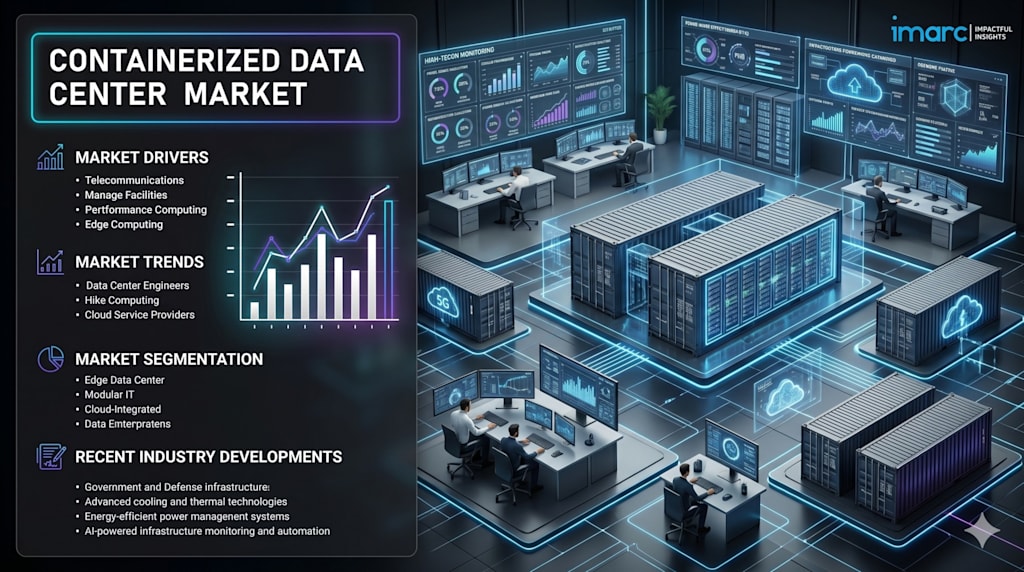
According to IMARC Group's latest research, The global containerized data center market size reached USD 15.5 Billion in 2025 and is projected to reach USD 72.7 Billion by 2034, exhibiting a CAGR of 18.71% during 2026-2034.
How Containerized Data Centers are Reshaping the Global Technology Infrastructure Landscape
- AI and High-Performance Computing Driving Modular Demand at Scale: The explosion of AI workloads has transformed containerized data centers from a niche solution into a critical infrastructure category. The Stargate Project, a joint venture involving OpenAI, SoftBank, and Oracle, announced USD 500 Billion in AI infrastructure investment through 2029, with each AI training cluster generating intense demand for GPU-optimized containerized units equipped with advanced liquid cooling and high-density power systems. Direct-to-chip and immersion cooling technologies are enabling GPU cluster densities of 100 to 200 kW per rack within containerized systems, making high-density AI deployments that were previously impossible in portable formats commercially viable. This convergence of AI compute demand and modular deployment architecture is fundamentally repositioning containerized units as the backbone of next-generation digital infrastructure.
- Edge Computing and 5G Integration Unlocking a New Deployment Frontier: The proliferation of 5G networks and industrial IoT applications is generating massive demand for distributed, low-latency computing capacity that traditional centralized data centers simply cannot fulfill at the edge. Omdia projects 5.9 billion cellular IoT connections by 2035, compelling telecom operators to deploy micro data centers at cell tower base stations and industrial nodes across geographies where permanent construction is impractical or economically unviable. Containerized units, transportable by a single truck in the 20 FT configuration and deployable in 8 to 12 weeks versus 18 to 24 months for traditional builds, provide exactly the agility required by 5G infrastructure rollouts. This speed and portability advantage is positioning containerized deployments as the default compute architecture for edge networks spanning manufacturing floors, remote resource sites, and urban micro-hub deployments.
- Sustainability Mandates and Green Infrastructure Investment Reshaping Product Design: Energy efficiency has shifted from a procurement preference to a compliance requirement, and containerized data centers are emerging as a leading solution for enterprises and governments seeking measurable reductions in data center carbon footprints. Next-generation containerized systems integrating 800V HVDC power architectures reduce power conversion losses by 30 to 40% versus legacy 208V AC systems, while liquid cooling configurations capture up to 90% of waste heat for reuse, reducing total cooling energy consumption by 40 to 60% compared to traditional air-cooled designs. Sustainability-certified containerized deployments are accessing green bond financing at preferential rates, improving project economics for large-scale green infrastructure programs, and commanding 15 to 25% price premiums in sustainability-driven procurement categories.
Containerized Data Center Industry Overview: A Market in Global Motion
The Containerized Data Center Market operates across a diverse global ecosystem spanning mature North American hyperscale deployments, rapidly expanding Asia Pacific digital infrastructure programs, and emerging high-growth opportunities across the Middle East, Africa, and Latin America. North America commands a dominant 34.0% regional share, underpinned by the most advanced hyperscaler investment cycle globally, with Microsoft, Amazon, Google, and Meta collectively deploying tens of billions of dollars annually in modular and containerized capacity expansion. Asia Pacific follows with 28.6% of global market share, driven by China's national digital infrastructure policy, India's data localization mandates compelling domestic investment, and Southeast Asia's surging digital economy. Europe's 22.4% share reflects the EU Digital Decade targets and Green Deal sustainability requirements accelerating adoption of energy-efficient modular infrastructure across the continent.
The value chain integrates component manufacturers including Intel, AMD, Samsung, and NVIDIA with system integrators such as HPE and Dell Technologies, containerization specialists like Schneider Electric and Vertiv, and managed operations providers serving BFSI, IT and telecommunications, government, healthcare, defense, education, and entertainment and media end-use industries. System integration and containerization stages capture the highest value-add margins, with integrated vendors combining hardware manufacturing, containerization, logistics, and managed services achieving premium pricing and sticky long-term service relationships.
Containerized Data Center Market Trends and Drivers
The capital efficiency and deployment speed advantage of containerized data centers over traditional purpose-built facilities is the foundational commercial driver reshaping enterprise infrastructure procurement. Containerized units reduce time-to-operation from 18 to 24 months to 8 to 12 weeks, with factory-integrated testing eliminating on-site commissioning complexity. This speed advantage is critical for organizations scaling digital capacity under competitive pressure, particularly in AI deployment scenarios where time-to-compute directly determines commercial outcomes.
Greenfield deployment dominates the application mix at 40.0% in 2025, reflecting strong preference for purpose-built containerized infrastructure that eliminates legacy system constraints. New enterprise campuses, government digital hubs, telecom edge nodes, and industrial IoT facilities increasingly specify containerized solutions from project inception, recognizing that the speed, energy efficiency, and scalability of modular deployment outperforms traditional construction across virtually every performance metric.
The rapid expansion of prefabricated modular campus architecture represents another powerful structural trend. Hyperscalers and co-location providers are deploying containerized campuses of 50 to 200 or more units, creating scalable, incremental capacity expansion models that reduce stranded capital risk. Campus architectures with shared power and cooling distribution achieve cost structures approaching traditional built facilities while retaining the deployment speed and scalability advantages of modular design.
Brownfield deployments at 34.6% in 2025 address the large installed base of organizations needing to augment existing data center capacity without major construction programs. Containerized add-ons to existing facilities provide incremental capacity at 30 to 50% lower cost per kilowatt than traditional buildout, making containerized expansion the default choice for budget-conscious IT directors managing capacity constraints. The Upgrade and Consolidation segment at 25.4% reflects enterprise technology refresh programs and data center consolidation mandates reducing multiple aging facilities into modern, energy-efficient containerized infrastructure.
Leading Companies Operating in the Global Containerized Data Center Market
- Hewlett Packard Enterprise (HPE)
- Dell Technologies Inc.
- Cisco Systems Inc.
- Schneider Electric SE
- Vertiv Group Corp.
- Huawei Technologies Co., Ltd.
- Delta Electronics, Inc.
- Rittal GmbH and Co. KG
- Fsas Technologies Inc. (Fujitsu Limited)
Containerized Data Center Market Segmentation
By Type of Container:
- 40 FT Container holds the leading position with 45.0% of the segment, offering superior computing capacity, rack density, and integrated systems architecture required by enterprise and hyperscale customers. A standard 40 FT unit accommodates 8 to 24 equipment racks with 400 to 800 kW total IT load capacity, enabling meaningful compute deployments without requiring multiple containerized units in parallel.
- Customized Container accounts for 32.4% of the segment, addressing specialized requirements including military-grade hardening, extreme temperature operation, offshore deployment, or non-standard power configurations. Custom units command 40 to 80% price premiums over standard configurations, generating revenue contribution disproportionate to unit volume.
- 20 FT Container at 22.6% serves edge computing, remote site, and rapid-response deployments where portability and ease of single-truck transport are primary operational requirements.
By Organization Size:
- Large Organizations lead with 42.0% of the segment, reflecting their greater capital budgets, complex multi-site infrastructure requirements, and strategic imperative to scale AI and cloud workloads rapidly using modular solutions that avoid lengthy traditional construction timelines.
- Midsize and Small Organizations are growing adoption segments, particularly in markets where managed containerized deployments offered through subscription and consumption models are removing upfront capital barriers to enterprise-grade modular infrastructure.
By Application:
- Greenfield dominates with 40.0% of the application segment, valued for enabling purpose-built, energy-efficient containerized infrastructure on new sites without the constraints imposed by legacy facility architecture.
- Brownfield deployments at 34.6% represent the largest augmentation opportunity, serving organizations needing to expand existing data center capacity without full construction programs.
- Upgrade and Consolidation at 25.4% captures enterprise technology refresh and facility rationalization programs consolidating multiple aging sites into modern containerized infrastructure.
By End Use Industry:
- IT and Telecommunications leads end-use with 28.0% of the segment, driven by hyperscaler capacity expansion, 5G network edge infrastructure rollouts, and cloud service provider investment across all major global markets.
- BFSI, Government, Healthcare, Defense, Education, and Entertainment and Media represent significant secondary end-use industries, each deploying containerized units for distinct operational requirements ranging from financial data sovereignty compliance to military-grade portable command infrastructure and remote healthcare computing deployments.
By Region:
- North America commands 34.0% of global market share, anchored by hyperscaler capital expenditure and federal AI infrastructure initiatives under programs tied to the Inflation Reduction Act.
- Asia Pacific follows with 28.6%, representing the fastest-growing region, driven by China's national digital infrastructure policy, India's data localization mandates, and Southeast Asia's accelerating cloud adoption.
- Europe holds 22.4%, reflecting EU Digital Decade investment targets, Green Deal energy efficiency mandates, and growing edge computing deployment across the continent.
- Middle East and Africa at 8.6% is the highest-growth emerging region, with Saudi Arabia's Vision 2030 digital infrastructure program, UAE smart city projects, and Africa's mobile-first digital economy generating large-scale containerized deployment demand.
- Latin America at 6.4% is accelerating on the back of cloud infrastructure buildout in Brazil, Mexico, and Colombia, where containerized units address both cost efficiency and remote deployment requirements.
Recent News and Developments in the Containerized Data Center Market
- June 2025: Schneider Electric launched a new line of eco-friendly containerized data centers engineered to minimize energy consumption, achieving Power Usage Effectiveness below 1.15. The product line aligns with global sustainability mandates and targets enterprise and hyperscale customers with strong ESG commitments seeking measurable carbon footprint reductions.
- May 2025: Delta Electronics unveiled its 800V HVDC containerized AI data center solution, representing the convergence of advanced energy technology and IT infrastructure within a single containerized deployment. The system delivers a 30 to 40% reduction in power conversion losses versus legacy AC architectures, directly addressing the energy intensity challenges of GPU cluster deployments.
- November 2024: Dell Technologies announced a strategic partnership with a leading cloud service provider to develop integrated containerized solutions enhancing hybrid cloud capabilities, enabling enterprise customers to deploy consistent on-premises extensions of public cloud environments through containerized modular units.
Note: If you require specific details, data, or insights that are not currently included in the scope of this report, we are happy to accommodate your request. As part of our customization service, we will gather and provide the additional information you need, tailored to your specific requirements. Please let us know your exact needs, and we will ensure the report is updated accordingly to meet your expectations.
About the Creator
Abhay Rajput
I am working in market research company that provides market and business research intelligence across the globe.
Enjoyed the story? Support the Creator.
Subscribe for free to receive all their stories in your feed.
Comments
There are no comments for this story
Be the first to respond and start the conversation.