
Consumer Credit Market Forecast: Open Banking, Data Analytics & Forecast to 2033
How AI-driven credit scoring, real-time data insights, and personalized lending solutions are transforming the global consumer credit market outlook.

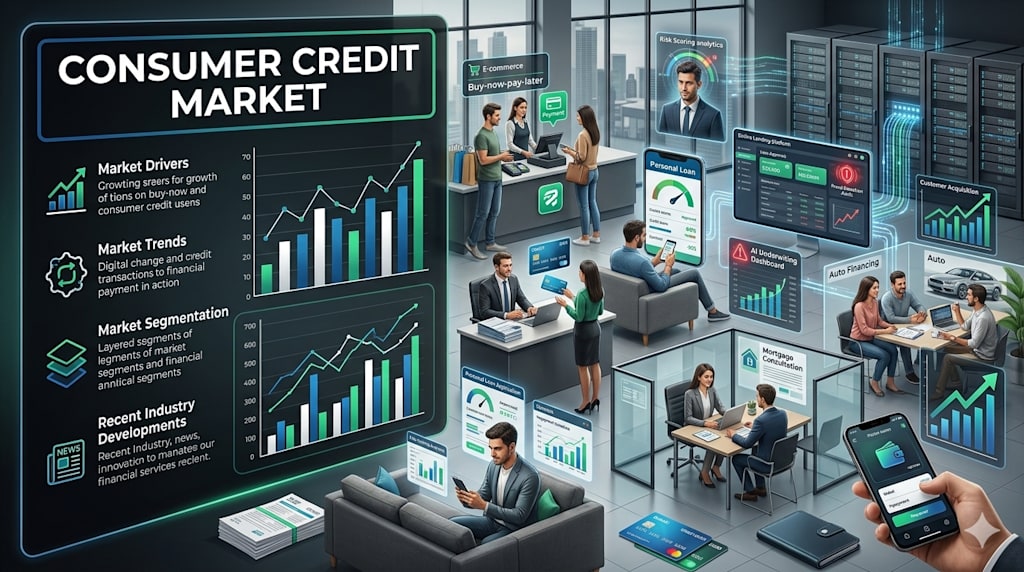
Rising economic growth, digital transformation of financial services, and expanding MSME ecosystems are driving consumer credit demand, supported by fintech innovation, government financial inclusion policies, and the rapid adoption of mobile banking and embedded payment solutions. According to IMARC Group's latest data, The global consumer credit market size was valued at USD 12.0 Billion in 2024. Looking forward, IMARC Group estimates the market to reach USD 17.0 Billion by 2033, exhibiting a CAGR of 3.9% from 2025-2033. North America currently dominates the market, holding a market share of over 35% in 2024. North America currently dominates the market, holding a market share of over 35% in 2024.
The consumer credit market is a rapidly evolving segment within global banking and financial services, driven by increasing demand for personal loans, SME financing, home loans, and flexible payment products. Growing middle-class populations in emerging markets, rising adoption of AI-driven credit scoring, and the mainstream acceptance of Buy Now, Pay Later (BNPL) services are collectively reshaping how credit is accessed and managed. Fintech platforms, embedded finance integrations, and regulatory reforms for digital lending are further expanding credit access to underserved and remote populations. Key segments include personal loans, credit cards, home equity loans, and BNPL services, with consumers prioritizing digital accessibility, flexible repayment options, and personalized financial solutions.
Request a Business Sample Report for Procurement & Investment Evaluation
Consumer Credit Market Growth Drivers:
Rising Digitalization in Financial Services
The BFSI sector is undergoing rapid digital transformation, fundamentally changing how credit is issued, managed, and accessed. AI, Machine Learning, and Cloud Computing are enabling real-time credit scoring, automated loan processing, and personalized product offerings for diverse consumer profiles. A study commissioned by Razorpay and conducted by IDC found that SMEs spend approximately 816 hours and 32 lakh rupees annually on banking-related activities, underlining the need for faster, smarter digital credit infrastructure. Governments are actively supporting this shift, with central banks in emerging economies establishing dedicated working groups to regulate and formalize digital lending through mobile platforms and apps.
Growth of Micro, Small, and Medium Enterprises
The proliferation of MSMEs across developing nations is a powerful catalyst for consumer credit demand. In India, MSMEs contribute approximately 33% of GDP and have generated over 120 million jobs across industries. Recent startup activity has also accelerated, with the latest cohort of 10,000 startups receiving regulatory approvals in just 156 days, down from 808 days for the first cohort. Tier-2 and Tier-3 cities now account for 49% of India's startup activity. In the United States, approximately 92% of businesses are microbusinesses, each relying on credit for inventory, equipment, and operational continuity.
Expanding Buy Now, Pay Later and Embedded Finance Models
Consumer expectations around payment flexibility have driven explosive adoption of BNPL products and embedded credit solutions. These models are now integrated directly into retail, e-commerce, and travel platforms, enabling seamless credit access at the point of purchase. BNPL diversifies the credit product mix available to both consumers and small businesses, reducing reliance on traditional lending channels while improving financial inclusion across demographics.
Consumer Credit Market Trends:
AI-Powered Credit Scoring and Risk Management
Lenders are increasingly deploying artificial intelligence to evaluate applicants with thin or non-traditional credit histories, broadening formal financial participation. These systems support real-time capital management, multi-asset portfolio pricing, and firm-wide risk minimization through automation and consistency. Advanced data analytics also enable credit providers to design bespoke product offerings aligned with individual consumer behavior, driving both satisfaction and retention in a competitive market.
Government-Led Financial Inclusion Initiatives
Policymakers across Asia, Africa, and Latin America are prioritizing access to formal credit as a lever for economic development. Rural credit schemes, subsidized MSME financing programs, and digital lending regulatory frameworks are bringing new borrower segments into the formal financial system. In the United States, financial literacy initiatives are empowering consumers to make more informed credit decisions, sustaining long-term market confidence and demand.
Social Media and Platform-Driven Credit Discovery
Consumer credit agencies are increasingly leveraging social media platforms to reach digitally active borrowers. Online platforms serve as both marketing channels and credit touchpoints, allowing lenders to engage younger demographics such as millennials and Gen Z who seek flexible credit for education, travel, and lifestyle spending. Embedded finance further integrates credit into everyday consumer platforms, reducing friction and accelerating credit adoption at scale.
Recent News and Developments in the Consumer Credit Market
November 2024: Visa launched its Flexible Credential in partnership with the Affirm Card, enabling users to switch seamlessly between debit and Buy Now, Pay Later payment options within a single card, enhancing flexibility for everyday consumers.
December 2024: Hypercard launched its first consumer credit card on the American Express network, combining employee benefits with travel, lifestyle, and wellness rewards, targeting digitally active millennials and Gen Z borrowers in the United States.
March 2025: Leading fintech lenders across Southeast Asia expanded BNPL offerings to rural e-commerce platforms, bringing flexible payment structures to first-time digital shoppers in underserved markets and reinforcing financial inclusion as a core growth strategy.
January 2026: Several major banks across Europe announced partnerships with AI-driven credit analytics firms to accelerate real-time lending decisions for personal loan applicants, reducing approval timelines from days to minutes and expanding access for thin-file borrowers.
Note: If you require specific details, data, or insights that are not currently included in the scope of this report, we are happy to accommodate your request. As part of our customization service, we will gather and provide the additional information you need, tailored to your specific requirements. Please let us know your exact needs, and we will ensure the report is updated accordingly to meet your expectations.
About the Creator
Suhaira Yusuf
I specialize in Consumer Insights, focusing on transforming detailed market data into strategic business solutions that accelerate growth and improve customer engagement.
Enjoyed the story? Support the Creator.
Subscribe for free to receive all their stories in your feed.
Comments
There are no comments for this story
Be the first to respond and start the conversation.