
Common Challenges in Ambient AI Scribe Adoption
Ambient AI Scribe
Introduction
Physicians spend more time documenting than they do with patients. That single reality is what made ambient AI scribe technology one of the most discussed tools in healthcare over the last two years. It listens to a patient encounter, understands the conversation, and generates a clinical note automatically. The promise is real. But so are the problems that show up once organizations move from pilot to full deployment. Getting it into daily clinical workflows is harder than the demos suggest. Here are the challenges that consistently slow things down.
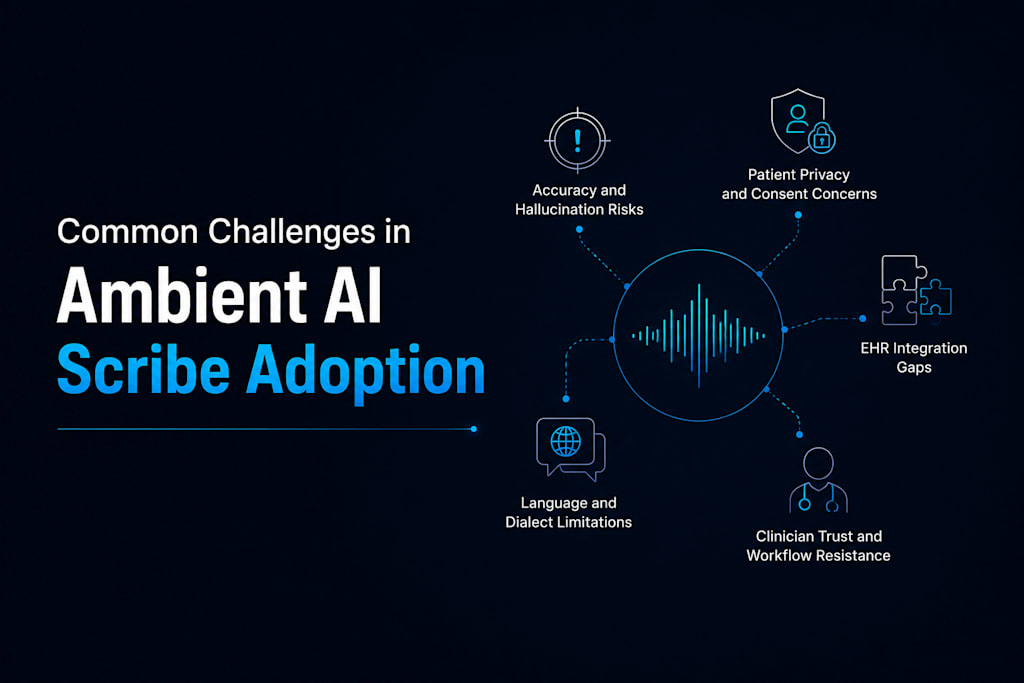
Accuracy and Hallucination Risks - The systems have consistently proven their efficacy in reducing documentation time. However, one thing that remains unchanged is errors. Modern documentation systems are still able to produce errors in form of documentation errors and erroneous information that may influence patient care. Missed drug, dosage, symptom. This is not an exception but a common occurrence such that all notes have to be reviewed by the physicians.
EHR Integration Gaps - Most health systems run on EHR platforms that weren't built to receive AI-generated notes cleanly. Structured fields, custom templates, specialty-specific documentation requirements. An ambient AI scribe that works well in primary care may produce notes that don't map correctly into a cardiology or surgical workflow. Getting the output to land in the right place, in the right format, without manual reformatting, is where most implementation timelines slip.
Patient Privacy and Consent Concerns - Recording a patient encounter introduces consent obligations that vary by state, by institution, and by the type of data being captured. Some patients are comfortable with it. Others aren't, and clinicians need a clear protocol for handling that in the middle of an appointment without disrupting the visit. Organizations that don't establish consent workflows before rollout discover the problem during deployment, not before it.
Language and Dialect Limitations - The vast majority of ambient AI scribe tools are primarily designed for interpreting clinical conversations in the English language. They become ineffective in cases of accents, bilingual conversations, or when patients start switching between languages during visits. This is not an uncommon situation for healthcare organizations with diverse patient populations.
Clinician Trust and Workflow Resistance - The physicians most burned out by documentation are often the most skeptical of tools that generate notes they didn't write. Trust takes time to build. Clinicians want to see the tool perform accurately in their specialty before they rely on it. Organizations that push adoption without giving physicians enough runway to evaluate the output on their own terms see lower engagement and higher abandonment rates after go-live.
Conclusion
The ambient AI scribe space is progressing rapidly and the technology itself is very useful. However, there are certain barriers to adoption and they present themselves in areas that are often unforeseen before deployment. Accuracy, integration, consent, language support, and physician buy-in are all issues that do not take care of themselves. Healthcare organizations that plan for them from the outset tend to have better success than those who only realize their existence post-deployment.
For organizations already building out their Healthcare AI Solutions stack, documentation automation is one of the highest-impact areas to get right from the start.
About the Creator
Enjoyed the story? Support the Creator.
Subscribe for free to receive all their stories in your feed.
Comments
There are no comments for this story
Be the first to respond and start the conversation.